 Add as preferred source on Google
Three layers of content earn AI citations. Which one you build first is a finding you read out of your own citation data. Plus the four signals we use to check whether any of it reaches pipeline.
Content that ranks on Google but never gets cited by ChatGPT, Perplexity or Google AI Overviews is invisible to a growing share of buyers. Half of consumers now intentionally seek out AI Search engines, according to McKinsey's AI Discovery Survey (McKinsey AI Discovery Survey, n = 1,927, October 2025). This guide is how we run content for AI Search with B2B clients at Radyant: which layers of content actually earn citations, how to work out which one to build first in your category, and how we check whether any of it reaches pipeline.
Key takeaways
- Look at what already gets cited in your category before you decide what to build. In Heyflow's prompt tracking YouTube came out as the #1 cited domain, so re-optimizing video they already had beat writing more articles.
- Your SEO fundamentals carry over, and the new surfaces still need their own work. Being the best answer to the question still wins. What changed is where citations come from: video, help centers, LinkedIn, review platforms.
- Thin owned pages are why your own site barely shows up in AI answers. McKinsey found a brand's own sites make up 5% to 10% of the sources AI Search references. Pick your 10 most important pages and rebuild those first.
- You don't control most of what AI Search cites. Muck Rack's May 2026 read put earned media at 84% of citations across more than 25 million links from ChatGPT, Claude and Gemini, a share that has held since July 2025.
- Analytics files most of what AI Search sends you as Direct or Organic. In the Heyflow engagement, the trials that came from AI answers only showed up through a free-text self-reported attribution field.
Why most content strategies break in AI Search
Traditional content strategy is built around keyword research, search volume and ranking positions. AI Search doesn't work that way.
When someone asks ChatGPT "What's the best CMMS software for fleet management?", the model isn't looking up a keyword. Google calls its own version of what happens next query fan-out: AI Mode breaks the question into subtopics and issues many queries at once on the user's behalf. ChatGPT's search appears to behave similarly, though OpenAI hasn't documented it. Either way, the answer comes back citing a handful of sources. Profound puts the typical range at 2 to 7 domains, far fewer than a page of ten blue links.
Three things follow from that for content strategy.
Keyword volume data gets less reliable. AI Search prompts are longer and more specific than keywords, and they often show no volume at all in Semrush or Ahrefs. When we built a 247-page programmatic cluster for Planeco Building, most of the keywords we targeted showed zero search volume in Semrush. We ignored that on purpose, because we knew people were researching the topics. The cluster ended up at 60+ qualified leads in six months.
Structure helps extraction, depth decides. Clear headings, short self-contained paragraphs and tables make a page easy to lift an answer from. The Princeton GEO paper (Aggarwal et al., KDD 2024) found that optimizing content for generative engines lifted visibility by up to 40%, and that the effect varied a lot by domain. Structure on top of thin content still leaves the engines with nothing worth quoting.
Breadth across a topic beats page-level tweaks. Our read is that the engines reward coverage of a whole subject rather than one well-optimized page, which matches what Bernard Huang of Clearscope says about being picked as a source:
"To be selected as a trusted source, you need to demonstrate breadth across all the sub-questions and depth across the nuances."
Bernard Huang, Clearscope
Where do AI Search citations come from?
Most guides treat on-site content and off-site visibility as two separate strategies. We find it easier to read citations as three layers: what you own, what you control without owning, and what other people say about you.
The numbering maps where citations come from. Which layer earns your first quarter of work is a conclusion you reach by tracking a real prompt set and reading which domains and page types actually get cited in your category. Sometimes that's your own site. For Heyflow it was YouTube.
Layer 1: Owned content authority
Owned content always does some of the work, and most teams underinvest in it.
McKinsey found that a brand's own sites make up only 5–10% of the sources AI Search references. That number is real, and it describes the current state rather than the ceiling: most owned content is thin, self-promotional and not worth citing.
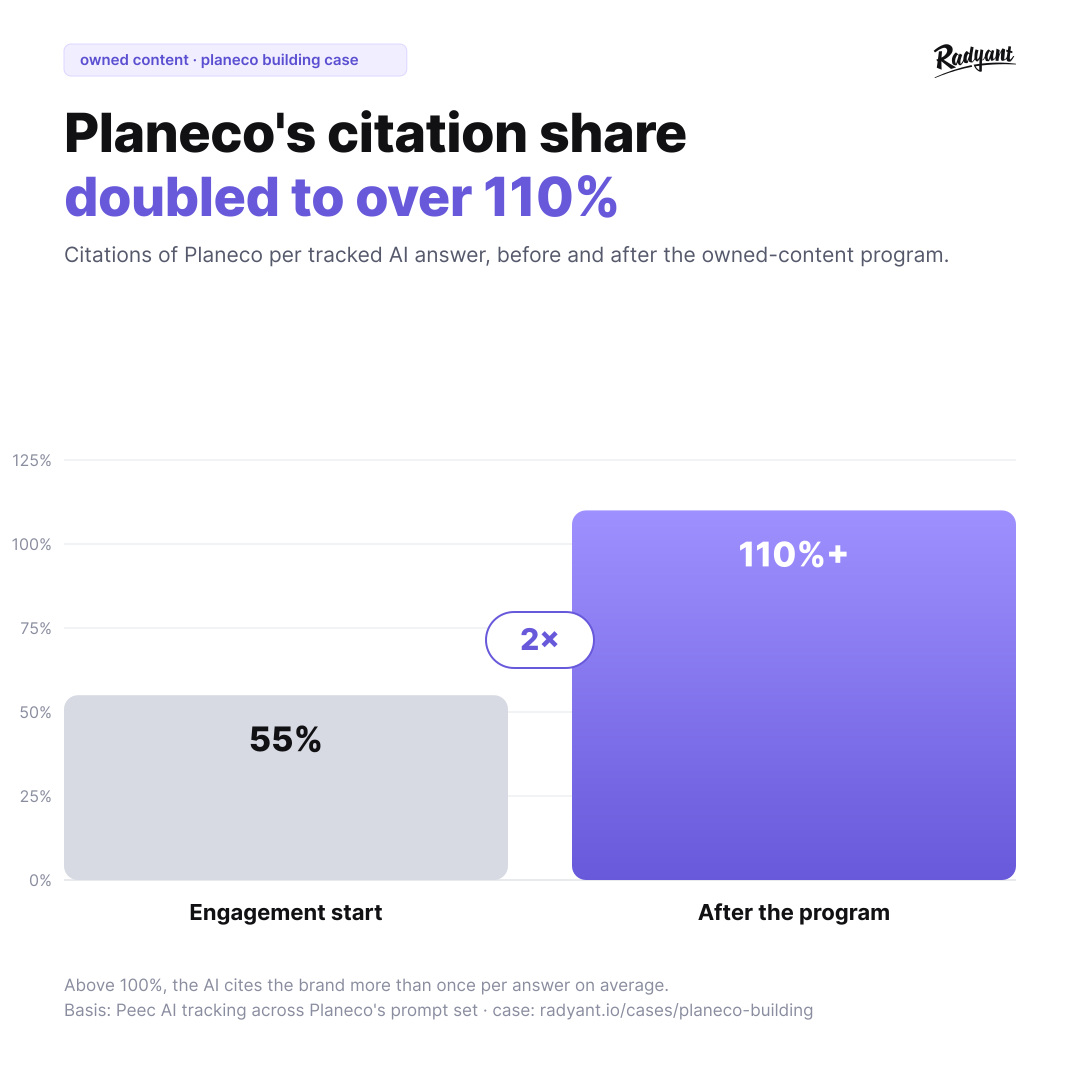
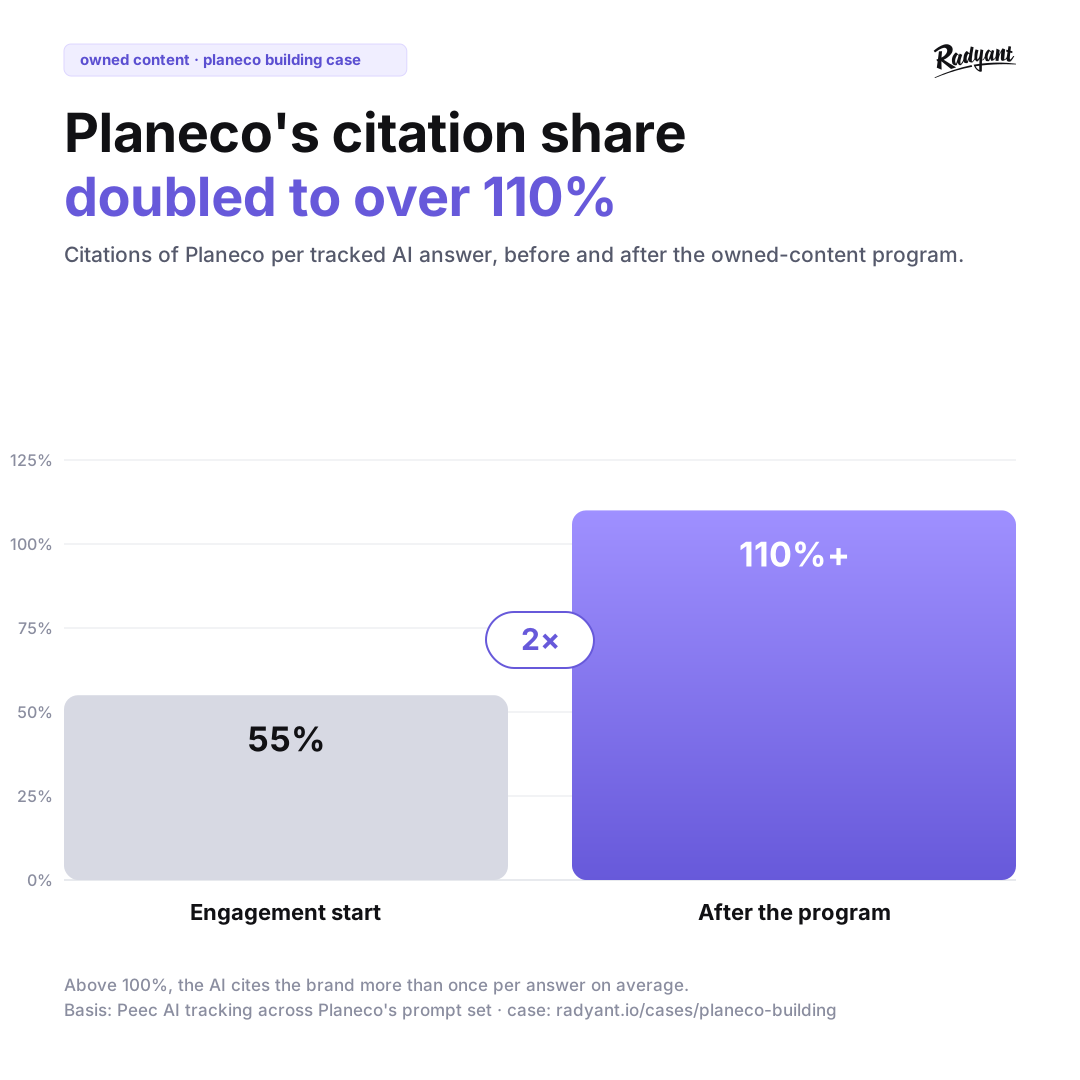
When we worked with Planeco Building, we focused entirely on owned content. No outreach campaigns, no Reddit commenting, no backlink chasing. We ran regular interviews with the co-founders to get permit and regulatory knowledge onto the page that no AI tool could produce on its own. Over about 10 months they saw 5× lead growth, an AI Search citation rate that went from 55% to over 110%, and the #1 spot in their AI Search visibility competitor set.
Citation rate above 100% means the engines cited Planeco more than once per response, on average, across the tracked prompt set.
What makes owned content citation-worthy:
- Depth you could charge for. If nobody would reasonably pay for the information, it probably isn't enough. Comparison tables, step-by-step processes, requirement matrices, structured FAQs.
- Expert knowledge instead of recycled research. The material that holds up comes out of founders and subject matter experts. For Planeco that was permit regulation. For a SaaS company it's usually workflow knowledge that only surfaces in customer calls.
- Coverage across the buyer journey. One strong blog post doesn't carry a topic. Informational, evaluative and decision-stage questions all need an answer somewhere on your site.
- Freshness. Ahrefs found that AI assistants cite content 25.7% fresher than the URLs in Google's organic results, across roughly 17 million citations from ChatGPT, Perplexity, Gemini, Copilot and AI Overviews. Updating pages you already have counts for more here than it did in traditional SEO.
Structure that makes your content easy to extract:
- Self-contained paragraphs, each answering one question
- Question-based H2s and H3s that match how people actually ask
- Definitions and direct answers early in each section
- Specific numbers and data points, with their source attached
- Comparison tables and structured data
Every item on that list also makes the page better for a human reader. That's the point. Optimize for the reader's question and answer it in the most direct way you can, and the engines follow.
Layer 2: Controlled off-site properties
Two platforms are worth real investment even though you don't own them: YouTube and help centers.
For Heyflow, YouTube came out as the #1 cited domain in our prompt tracking. That's what told us where to focus. A default order would have sent us to their blog first. We optimized 20 videos that already existed and produced nothing new. Their AI Search citations went from 0 to 282 a month within three months, 19 of the 20 videos ended up getting cited regularly, and the channel picked up 593 new brand mentions in the same period, on under 1,000 subscribers. The full write-up is in the Heyflow YouTube case.
It shows up in our own data too. In the Peec AI domains view for our project, youtube.com sits among the top domains Google AI Overviews retrieves.
The approach is mechanical once you know where to look:
- Find the queries where AI platforms already cite video in your category
- Map them to videos you have, or ones you plan to make
- Rewrite titles and descriptions to match the language the answers use
- Give each description a clear, extractable summary
- Track citation appearance across ChatGPT, Perplexity and Google AI Overviews
Ethan Smith from Graphite made a version of this point on our Masters of Search podcast: the less entertaining your product is, the more room there is on YouTube. B2B competition on video is thin, which is the opportunity.
Help centers as marketing content
This is the most underrated AI Search asset we've found. Fan-out produces hyper-specific sub-questions. When someone asks "How do I build a multi-step form with conditional logic?", the answer gets assembled from documentation and help articles as much as from marketing pages.
In the Heyflow engagement we found competitors like HubSpot and Unbounce getting cited for features Heyflow also has, because their help articles were organized to answer the specific question. Heyflow's documentation existed but wasn't structured for extraction. The fix is to treat the help center like marketing content: clear headings, self-contained answers, real use cases, structured metadata. The investment is low next to the citation upside.
Layer 3: Earned mentions
Earned media carries most of what the engines cite. Muck Rack's May 2026 Generative Pulse put it at 84% of citations across more than 25 million links from ChatGPT, Claude and Gemini in 17 industries, and the share has held between 82% and 89% across three editions since July 2025.
Earned mentions tend to follow the content: when your owned pages are the definitive answer on a question, people reference them, and when your videos are the clearest explanation of a topic, they get shared and discussed. Third in the list means third on the map, and in a category built on peer discussion this is where you start.
You can answer whether earned media matters for you with data instead of a checklist. Run your target prompt set through the engines and read what they actually cite. Lots of Reddit threads, review sites and forum posts, and earned media will matter for you. Mostly documentation, expert pages and vendor sites, and depth wins.
The tendencies we see once you look: consumer categories, and crowded categories where several brands already have strong owned content, lean on peer discussion, so external validation ends up being the tiebreaker. Regulated topics, complex B2B services and niches with little public discussion lean the other way.
Planeco is the second kind. Permit rules and energy-efficiency requirements can't be crowdsourced from a Reddit thread. The owned content was the authority, which is why it worked without any earned media at all.
Content layers compared
Here's how each content type stacks up across the dimensions that matter for AI Search strategy.
| Dimension | Owned on-site | YouTube | Help center | Reddit/forums |
|---|---|---|---|---|
| Control level | Full | High | Full | None |
| Scalability | High (programmatic) | Medium | High | Low |
| Sustainability | Permanent | Permanent | Permanent | Fragile |
| AI platform coverage | All platforms | Google AI, Perplexity | All platforms | Perplexity, ChatGPT |
| Best for | Authority, depth, topical coverage | B2B explainers, how-tos | Feature-specific queries | Social proof, opinions |
| Investment level | Medium-high | Medium | Low | Low (but risky) |
| Time to citation | Weeks to months | Days to weeks | Days to weeks | Unpredictable |
Invest in the columns you control. Reddit and forums can add to that, and building a strategy on a platform where you control neither the content nor how long it stays up is a risk most B2B companies shouldn't take.
How to measure AI Search content impact
Most brands still have no systematic read on their AI Search performance: McKinsey puts it at 16% that track it systematically. It's usually the first thing we set up in an engagement.
The problem is attribution. Someone asks ChatGPT for a recommendation, sees your brand, then types your name into Google. In your analytics that shows up as Direct or Organic. It never shows up as "ChatGPT recommended us".
We read four signals together. No single one gives you the picture.
Self-reported attribution
A "How did you hear about us?" field on your forms, mandatory, free text rather than a dropdown. Dropdowns never have a "ChatGPT told me" option, and you'll never think to add every possible source. Free text used to be painful to analyze, and now a few hundred responses through Claude come back categorized in seconds. Pair the form field with a CRM field that sales fills in after every first call, capturing how the prospect described finding you in their own words. Most of that detail otherwise dies in the call.
AI-referral sessions
GA4 picks up some AI Search referrals, so watch for sources like chatgpt.com and perplexity.ai. Search Console doesn't break AI Overviews or AI Mode out separately, those clicks sit inside the overall Web search totals. Keep tracking referrals, and stop treating them as the truth about discovery.
Branded-search lift
In our client accounts, branded-query clicks in Search Console tend to rise a few weeks after citation share does. It lags, and it's still useful, because it lands in a report your board already trusts.
AI Search visibility
Your citation share across engines is the leading indicator the other three confirm. Citation share measures how often your brand appears in AI responses for your target queries relative to competitors, and tools like Peec AI and Profound monitor it. Keep it separate from citation rate, the Planeco metric above, which counts citations per response and can pass 100%. Aim past getting mentioned: being cited more than once per response is what a citation rate over 100% represents.
In the Heyflow engagement, the trials that came from AI answers showed up in the self-reported attribution field. Reading AI-referral sessions alone, we would never have seen them.
Scaling content that earns citations
"This sounds great for a handful of pages, but how do I scale it without quality collapsing?" is the question we get most.
Most programmatic content fails in AI Search because it's generic. City names swapped into a template. Product names plugged into a comparison matrix. Google and the AI engines are both good at spotting it.
What works for us is to build one page manually until it's genuinely good, then use it as the reference for everything produced at scale. With Planeco's programmatic cluster that ran like this:
- Build one page by hand for a single query, with expert input, proper structure, comparison elements and real depth.
- Define the variation parameters. What changes between pages (location, product type, regulation) and what stays fixed (structure, depth, the quality bar).
- Build the production workflow. In our case AirOps, with Claude-based quality checks at each step. The tooling handles the variation, the checks hold the bar.
- Ship and iterate. 247 pages went live in 7 days, and 140 of them were ranking in the Top 3 three days after launch.
That first page needs human expertise. The scaling needs AI tooling. Neither gets you there on its own. We walked through the whole workflow in our Behind the Build webinar with AirOps.
What to do this quarter
If you're running marketing and wondering where to start, the first two weeks are the same for everyone. What comes after depends on what the baseline tells you.
Week 1–2: set up measurement and take a baseline
- Add a mandatory free-text "How did you hear about us?" field to your lead forms
- Add a CRM field for sales to record what prospects say on calls
- Take a baseline citation share reading for your top 20–30 target queries
- Note which domains and page types the answers cite, not just whether you appear
Week 3–4: read the baseline, then audit the layer it points at
- Rank the domains and page types cited for your target queries by how often they show up
- Pick the layer where you could plausibly win citations: your own site, video, documentation, or third-party platforms
- Take your 10 most important assets in that layer by pipeline impact, not traffic
- Check each against the criteria above: self-contained paragraphs, question-based headings, specific data with sources, expert knowledge, comparison elements
- Prioritize the 3–5 with the biggest gap between how important they are and how good they are
Month 2: fix what the audit found
- Rewrite or deepen those 3–5 assets with expert input and proper structure
- Audit your help center for features competitors get cited for and you don't
- Refresh the key pages that have gone stale
Month 3: take the next layer on your list
- Re-read the citation baseline and see what moved
- Find 5–10 queries where video already gets cited in your category, then create or optimize YouTube content for them
- Restructure help center articles so an answer can be lifted straight out of them
Measurement comes first, because everything after it is guesswork. From there your own citations pick the order. Owned content always plays a part, and for Heyflow the fastest route to citations ran through 20 videos they already had.
Is AI Search a separate discipline from SEO?
There's a growing industry of consultants and tools positioning GEO (Generative Engine Optimization) as a new discipline, separate from SEO. Some agencies now sell it as the new standard in search optimization.
The honest answer is both, so we say both. It's grounded in SEO: the content standard hasn't moved, and the fundamentals and the judgement carry straight over. Plenty of the tactics being sold as new are things good SEO practitioners have done for years. Question-based headings, because users have specific questions. Key takeaways up front, because users don't have time. Self-contained paragraphs, because that's how you write clearly. Andy Muns, Director of AEO at Telnyx, made that point on our podcast, that the line between AEO and good SEO is thinner than the industry wants to admit.
It also brings work SEO never had to do. Attribution is the obvious one: nothing in your analytics tells you that ChatGPT recommended you. The other is the number of surfaces that now carry citations. Video, help centers, LinkedIn, review platforms and product directories each need their own action, and none of them is your website. That part is genuinely new, and it needs its own budget and its own owner.
"The biggest risk to our industry in 2026 isn't AI; it's that we're trying to fit a baseball bat through a keyhole by applying SEO ranking logic to probabilistic systems."
FAQ
Is GEO/AEO actually a separate discipline from SEO?
Both, honestly. It's grounded in SEO: the core principle is unchanged, be the best answer, and in our experience the brands doing well in AI Search are mostly the ones that already had strong traditional SEO foundations. It also brings work SEO never had. Attribution, where nothing in your analytics tells you ChatGPT recommended you, and a set of surfaces beyond your website (YouTube, help centers, LinkedIn, review platforms, product directories) that each need their own action.
Should I prioritize owned content or off-site mentions for AI Search?
Track it before you decide. Run your target prompt set through ChatGPT, Perplexity and Google AI Overviews, list the domains and page types that come back, and put the work where the citations already land. Owned content always plays a part: Planeco Building went from a 55% citation rate to over 110% with owned content alone. For Heyflow the same tracking showed YouTube as the #1 cited domain, so 20 videos they already had were the faster route, 0 to 282 monthly citations in three months.
How do I prove AI Search ROI to my board?
Read four signals together. AI-referral sessions undercount on their own, because most AI-referred visitors arrive as Direct. Add a mandatory free-text "How did you hear about us?" field to your forms and a CRM field for sales to capture what prospects say on calls, then read branded-search lift and AI Search visibility alongside them. In the Heyflow engagement, that combination surfaced trials that came from AI answers, which standard analytics would have missed completely.
Can programmatic content earn AI citations?
Yes, if it's built on a quality foundation. Generic programmatic content, city names swapped into templates, won't get cited. What works is building one page manually until it's genuinely good, then using it as the reference for AI-assisted production with quality checks at each step. Planeco Building's cluster had 140 pages ranking Top 3 three days after launch, and brought in 60+ qualified leads in six months.
How long until I see results from optimizing for AI Search?
Citations can appear within days to weeks on controlled off-site properties like YouTube and help centers, and within weeks to months for owned pages. Pipeline impact usually follows in 3 to 6 months, depending on your sales cycle. The variable that matters most is how far your current content sits from being worth citing. Strong expert-driven content that needs structural work moves faster than authority built from scratch.
Do I need to rewrite all my content for AI Search?
No. Start with the pages closest to pipeline. Front-load the answer, keep paragraphs self-contained, and add information nobody else has. Once that works, apply the same patterns further out. A full rewrite is almost never necessary. What's usually missing is depth, expert input and structure on content that already exists.