 Add as preferred source on Google
Only 38% of AI Overviews citations now come from top-10 pages, down from about 76% in July 2025. How we build content that gets cited repeatedly, and how we measure it.
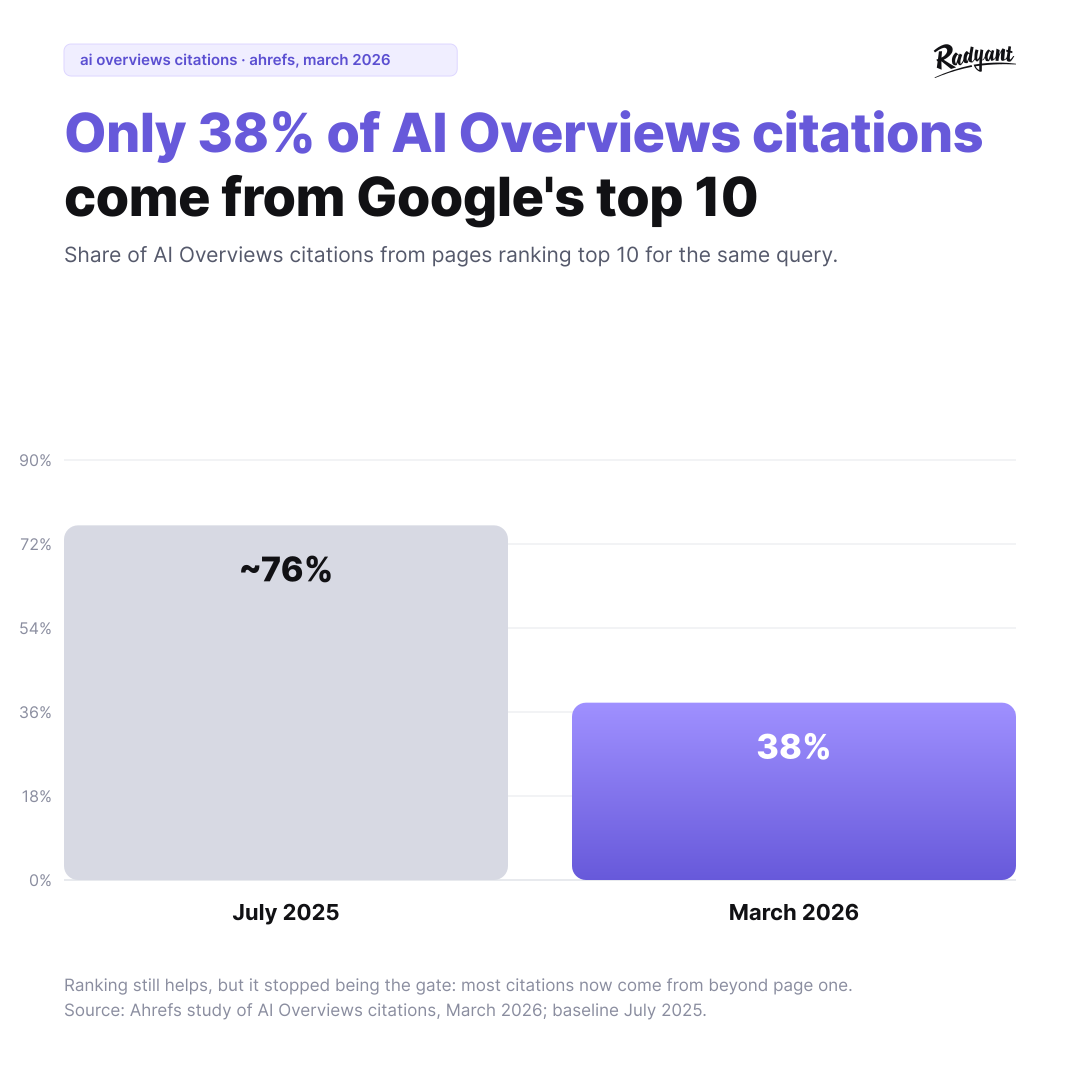
Ranking on page one of Google no longer decides which pages get cited in AI answers. Only 38% of AI Overviews citations come from pages that also rank in Google's top 10 for the same query, down from about 76% in Ahrefs' July 2025 analysis. We've spent two years testing what does earn citations. The short version: content that is genuinely the best answer to the question, on whichever surface your own citation data points at. For Planeco Building that was their own site, which took them from 55% to over 110% citation share, where anything above 100% means the content gets cited more than once in an average AI answer, with zero outreach.
Key takeaways
- Ranking in the top 10 no longer predicts which pages get cited. Ahrefs studied 863,000 keyword SERPs in March 2026: 38% of AI Overviews citations came from top-10 pages, down from about 76% eight months earlier.
- The knowledge in your experts' heads is the part a content farm cannot copy. With Planeco Building we built the pages out of regular co-founder interviews, and their organic leads grew 5x over 10 months.
- Put your strongest answer near the top of the page. Kevin Indig's analysis of 1.2 million search results found 44.2% of ChatGPT citations come from the first 30% of a page. Open each section with the answer.
- Getting cited in AI Overviews tells you little about AI Mode. Ahrefs compared 730,000 response pairs from September 2025 and the two shared 13.7% of their cited sources, on Google's own surfaces.
- Your best AI-driven leads get filed as Direct or Organic. Ask buyers directly in a free-text "how did you hear about us?" field: at Heyflow those answers surfaced AI-attributed trials that click analytics never showed.
Top-10 rankings no longer explain which pages get cited
Ahrefs' March 2026 study of 863,000 keyword SERPs and 4 million URLs cited in AI Overviews found that 38% of pages cited in AI Overviews also rank in the top 10 for that query. In their July 2025 analysis, the figure was about 76%.
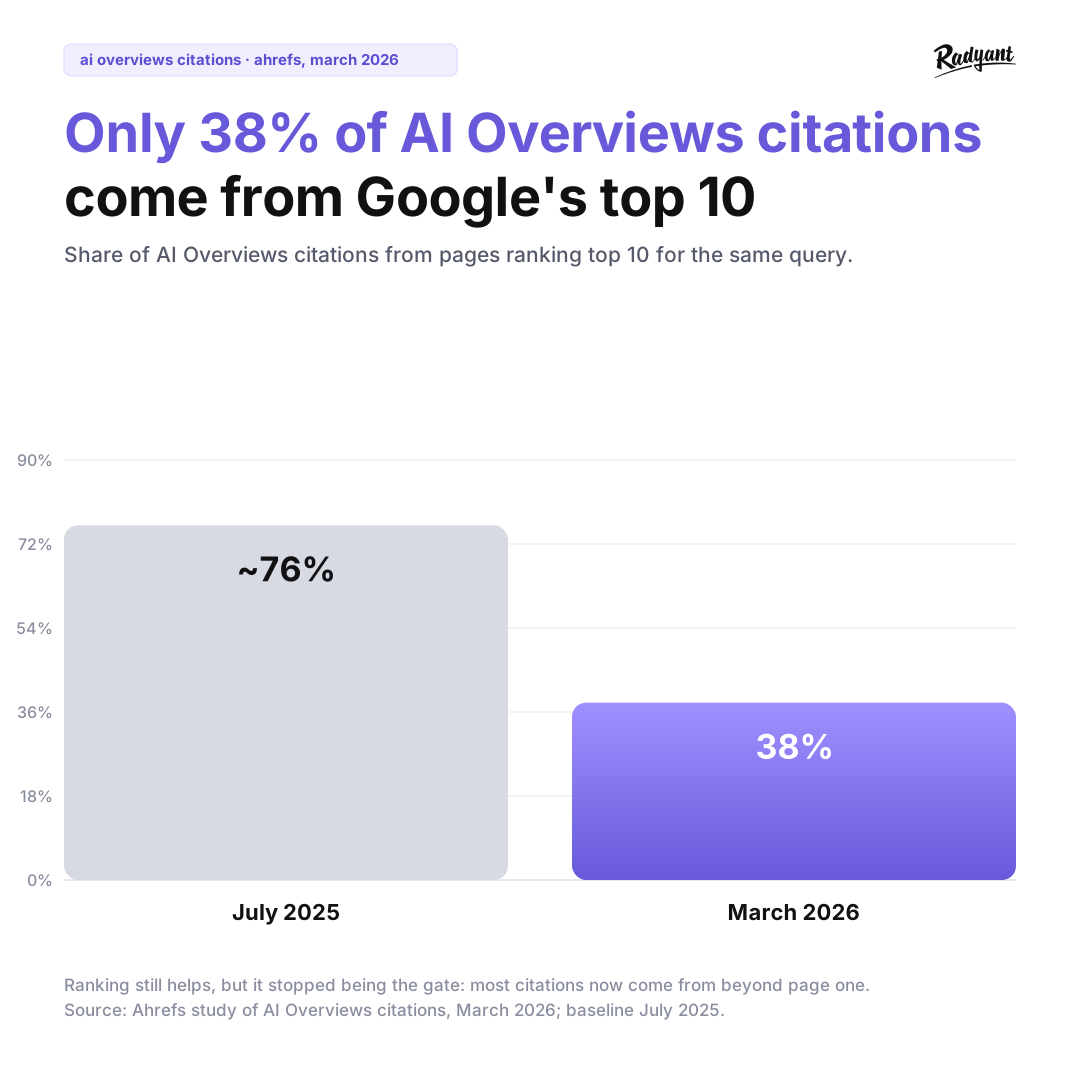
Our read is that this follows Google's query fan-out. Google splits the original query into related sub-queries, retrieves results for each, and the pages that turn up most often across those sub-query SERPs get cited. Ahrefs describes the same mechanic in the study.
So ranking first for your primary keyword is not enough on its own. You need coverage across the sub-queries an engine expands that keyword into.
Clicks are down, and the clicks that remain convert better
AI Overviews correlate with a 58% lower average CTR for the top-ranking page, up from 34.5% in Ahrefs' April 2025 measurement.
Semrush's research puts AI Search visitors at 4.4x better conversion than traditional organic. Fewer clicks, and the ones that land are worth more.
Each surface cites differently, even inside Google
Ahrefs compared 730,000 AI Mode and AI Overviews response pairs from September 2025. The two agreed on what to say 86% of the time and shared 13.7% of their cited sources. Two surfaces inside the same company, one source in eight held in common.
Here is what the studies with published methodology report per surface.
| Surface | Most-cited sources | Citations per answer | Relationship to Google rankings |
|---|---|---|---|
| AI Overviews | YouTube ranks first among cited domains, and accounts for 5.6% of all URLs cited in AI Overviews (Ahrefs) | Not reported in the studies we checked | 38% of cited pages also rank in the top 10 (Ahrefs, March 2026) |
| Google AI Mode | Wikipedia and Quora over-index against AI Overviews, Quora by 3.5x (Ahrefs) | Not reported | Shares 13.7% of its citations with AI Overviews |
| ChatGPT | Wikipedia leads at 7.8% of citations (Profound) | 7.92 (Qwairy) | Cited pages ranking 21 or worse almost 90% of the time (Semrush, July 2025 research) |
| Perplexity | Reddit leads at 6.6% of citations (Profound) | 21.87 (Qwairy) | Not reported |
Bases: Profound's figures come from its analysis of 680 million citations, August 2024 to June 2025. Qwairy counted 669,065 citations across 118,101 AI answers in Q3 2025. The Ahrefs AI Mode comparison uses September 2025 US data.
No single playbook covers all four columns. What carries across them is being the best available answer, which is what the rest of this guide is about.
What gets cited, according to the research
Kevin Indig's analysis of 1.2 million search results is the most detailed public work on how AI systems read a page. Put next to the GEO paper and Ahrefs' ongoing studies, a consistent picture shows up.
The ski ramp: the first 30% of a page does most of the work
In Indig's data, 44.2% of ChatGPT citations come from the first 30% of a page. He calls the shape a ski ramp, attention highest at the top and dropping sharply after. His read is that ChatGPT favors the sentence with the highest information gain in each section, meaning the most complete use of relevant entities and the most additive information.
This is not an argument for front-loading keywords. It means your opening sections should carry your most definitive, data-rich statements. The rest of the page still does work for topical coverage. The first screen is where most of the citing happens.
Traits that cited pages share
- Definitive language. Cited pages were almost 2x more likely to use phrasing like "is defined as" or "refers to", 36.2% against 20.2%.
- Answer capsules. In a Search Engine Land audit of one B2B software company's blog, 72.4% of the posts ChatGPT cited included an identifiable answer capsule, a direct 40 to 60 word answer near the top of a section.
- Entity density. More named entities per paragraph, meaning people, companies, products and concepts, correlates with higher citation rates.
- Original data and visible sources. The GEO paper's three strongest methods were Cite Sources, Quotation Addition and Statistics Addition, each worth a 30 to 40% relative improvement on its position-adjusted word count metric.
What the GEO paper actually tested
The GEO paper ran optimization strategies against generative engines and found they can lift visibility by up to 40%. Three results are worth carrying into a content brief:
- Keyword stuffing gave little to no improvement over the unoptimized baseline. Traditional SEO tactics did not transfer.
- The best combination, Fluency Optimization plus Statistics Addition, outperformed any single strategy by more than 5.5%.
- Cite Sources was weak on its own and strong in company, averaging 31.4% improvement when paired with other methods.
Clearer, more data-rich, better sourced content won. Keyword density lost.
How we build content that gets cited repeatedly
Which surface to start with is a finding from your own citation data. Track a real prompt set, read which sources and which page types actually get cited in your category, then put the work where the citations already land. In some categories that points at YouTube or a review platform before it points at your own pages.
Your own content is part of the answer either way, and the standard for it does not change. If a page is the most complete, most useful answer to your audience's question, AI Search interfaces like ChatGPT, Claude or AI Overviews have something to reach for.
Planeco Building is where we tested that hardest: 5x organic leads in 10 months, citation share from 55% to over 110%, and the strongest AI Search visibility in its competitor set. No outreach campaigns, no Reddit commenting, no link building.
Here is how we built it.
Step 1: start with audience research, not keyword research
Most SEO workflows start with a keyword tool. We start with the audience. What do they actually need to know? What are they asking sales teams? What confuses them about buying?
In the Planeco programmatic work, most of the keywords we targeted showed zero search volume in Semrush. We went ahead anyway, because customer conversations told us people were researching those topics. It produced 60+ leads in 6 months from keywords the tools scored at nothing.
Audience intel picks up demand that keyword tools cannot measure, and AI platforms answer plenty of questions that never reach a keyword database.
Step 2: extract expert knowledge that AI cannot find elsewhere
This is the moat. Content farms can produce "what is X" articles at scale. What they cannot produce is deep regulatory knowledge from a co-founder with 15 years in the industry, or a comparison of two approaches based on real implementation data.
For Planeco we ran regular interviews with the co-founders to pull out regulatory knowledge and turn it into legally accurate content no AI tool could generate on its own. When the information exists nowhere else, an engine that wants to answer the question has to reach for your page.
The practical version: book 30 to 60 minute interviews with your subject matter experts on one topic each. Record, transcribe, pull the unique parts, build the content around those. That is content engineering, and our Behind the Build session with AirOps walks through the whole workflow.
Step 3: build depth-first content
Our standard: if someone wouldn't reasonably pay for the information, it isn't good enough yet. Comparison tables, step-by-step processes, requirement matrices and structured FAQs, where they add something.
For Planeco that meant pages with detailed material comparisons carrying real cost ranges and regulatory requirements, decision flowcharts for questions like which insulation suits which building, regional regulatory breakdowns nobody else had compiled, and FAQ sections built from the questions customers asked on sales calls.
That depth is what makes a page extractable. When ChatGPT answers "what's the best insulation for a pre-1960s building in Germany", it reaches for the page that answers that specific question, not the one with a general overview of insulation types.
Step 4: structure it for extraction
Once the depth is there, make it easy to find inside the page:
- Question-based H2 and H3 headings that match how people phrase things in AI tools
- Answer capsules of 40 to 60 words directly under each heading, giving the direct answer before you expand
- Definitive language in the key statements, "X is defined as" rather than "X could potentially be described as"
- Data tables and comparison matrices an engine can parse
- Schema markup (FAQ, HowTo, Article) so crawlers can read the structure
- Source citations inside your own content when you use external data, which the GEO paper found pays off most in combination with the other methods
One nuance worth stating. These elements work because they make content more useful, not because engines have formatting preferences. We've been using question-based headings and key takeaways for over five years, long before anyone said GEO. They work in AI Search because they worked for readers first. As Andy Muns from Telnyx put it on our podcast, AEO might just be SEO.
Step 5: cover the fan-out queries, not just the head term
Given the 38% overlap with top-10 rankings, your plan has to address the sub-queries an engine expands your primary keyword into. Ways to find them:
- People Also Ask. These frequently overlap with the sub-queries Google generates during fan-out.
- Related searches and autocomplete for your primary keyword, which map to the same expansion patterns.
- The Sources panel of existing AI Overviews for your target queries. Those pages are ranking for the fan-out queries.
- Topical clusters, where a pillar page covers the primary topic and supporting pages go deep on specific sub-topics. That gives fan-out queries several ways into your content.
The Planeco programmatic case is this at scale: 247 pages live in 7 days, each on a specific sub-topic, with 140 of them ranking top 3 within 72 hours. Topical breadth is what query expansion rewards.
Step 6: measure, attribute, iterate
Citation counts on their own do not tell you whether any of it reached pipeline, and cited-source lists change constantly. Both problems need a measurement setup rather than a screenshot.
How to measure AI citation impact
Here is the everyday version of the attribution problem. Someone asks ChatGPT for a recommendation. Your brand comes up. They go to the browser bar, type your name, and either land on your site or run a Google search and click an ad or the organic result. Nothing links that ChatGPT moment to the visit, so HubSpot or GA4 files it as Direct or Organic. Never as "ChatGPT recommended us".
Plenty of budget decisions get made on that incomplete picture. Four signals read together get you closer.
Signal 1: self-reported attribution
Add a "how did you hear about us?" field to your forms. Make it mandatory and free-text rather than a dropdown, since LLMs make analyzing free-text answers trivial now. You start seeing "ChatGPT recommended you" and "I saw you in an AI Search result", which were invisible before. Pair it with a CRM field sales fills in after every discovery call. "I asked ChatGPT for the best X and your name came up" tends to come out on a call before it ever reaches a form.
Signal 2: AI referral sessions
Track referral traffic from chatgpt.com, perplexity.ai, gemini.google.com and copilot.microsoft.com in GA4, and add UTMs where you can. This captures the clicks the platforms do send, which is a floor rather than a total. Keep it, and stop treating it as the whole truth.
Signal 3: branded-search lift
Branded-query clicks and impressions in Search Console. When AI visibility climbs, the demand echo usually shows up here before pipeline moves.
Signal 4: AI Search visibility
Citation share across engines, and whether you get named in the answer at all. This is the leading indicator the other three confirm.
For tracking it, Otterly, Peec AI and Profound monitor how often your brand and pages get cited across platforms. We use Peec on our own project and for clients.
Read it as a series, not a snapshot. Ahrefs found 45.5% of cited sources change from one AI Overview update to the next, with the overviews themselves updating roughly every two days (November 2025 data).
Reading the four together is what surfaced Heyflow's AI-attributed trials. Self-reported attribution is where they came from. Click-based analytics never showed them at all.
YouTube: the third-party surface you control end to end
YouTube fits the owned-content argument rather than contradicting it. You don't own the domain, but you control the video, the title, the description and the transcript, which is more control than you get anywhere else off your own site.
The numbers behind it: among AI Overviews citations that didn't rank in Google's top 100 for the same keyword, 18.2% were YouTube URLs, and YouTube accounts for 5.6% of all URLs cited in AI Overviews. Ahrefs' research across 75,000 brands found mentions on YouTube, in titles, transcripts and descriptions, to be the strongest correlating factor with AI Overviews visibility.
We tested it with Heyflow and published what happened: 0 to 282 monthly AI Search citations from YouTube in three months, from 20 existing videos re-optimized, 19 of which now get cited regularly, on a channel with under 1,000 subscribers.
What doesn't work
- Keyword stuffing for AI. The GEO paper found it gave little to no improvement over an unoptimized baseline.
- Prompt-style writing hacks. Writing content to mimic ChatGPT prompts is repackaged basic UX. Clear questions and answers have always been useful.
- Separate "AI-optimized" versions of a page. If you need a second version for the engines, fix the first one.
- Reddit and forum spam. Dropping brand names into unrelated threads is detectable and counterproductive. If external presence is part of the plan, it has to carry real value.
- Generic programmatic pages with city names swapped in. Our Planeco programmatic case worked because every page held region-specific regulatory information, not because we templated one page 247 times.
- Treating citation frequency as the goal. Chegg's stock fell about 48% in a day on 2 May 2023 after it told investors students were using ChatGPT instead of paying for answers. Their homework answers were text an AI could reproduce without needing to send anyone to Chegg.
The thread through all of these: gaming the platforms fails, improving the content works. Being named in an answer and being cited with a link are also two different outcomes. Our read is that the link goes to pages holding data, frameworks or expertise an engine cannot fully paraphrase.
A citation-readiness checklist
Run your existing pages against these questions:
- Does the first 30% carry your most definitive, data-rich statements? That's where 44.2% of ChatGPT citations came from in Indig's data.
- Does every major section open with a 40 to 60 word answer capsule? 72.4% of the ChatGPT-cited posts in the Search Engine Land audit had one.
- Does it use definitive language, "X is defined as" rather than "X could be considered"?
- Does it contain original data, proprietary research or expert insight that isn't available elsewhere?
- Are the headings phrased as the questions people actually ask?
- Does it cover the fan-out sub-queries, not just the primary keyword?
- Does it include tables or structured frameworks an engine can parse?
- Is it deep enough that someone would reasonably pay for the information?
- Does it cite its own sources with links?
- Is the relevant schema markup in place (FAQ, HowTo, Article)?
Take your highest-traffic pages first, fix the gaps these questions expose, then re-check citation share after the next crawl. Those pages have the most to gain and the most to lose as citation patterns move.
FAQ
Do I need to rank in Google's top 10 to get cited in AI Overviews?
No. 38% of AI Overviews citations come from pages that also rank in the top 10, and Semrush's July 2025 research found ChatGPT cited pages ranking 21 or worse almost 90% of the time. What matters more is covering the sub-queries an engine expands your keyword into, and having content dense enough that a specific answer can be pulled out of it.
Is GEO or AEO a separate discipline from SEO?
Not in our experience. Done properly it is good SEO with better measurement. Clear headings, answer-first formatting, original data and real depth are the same things that made content useful to humans. What changed is the measurement: you now track citation share and read several attribution signals together. We went through this with Andy Muns, Director of AEO at Telnyx, on the podcast.
Which AI platform should I prioritize?
Start with the one your audience uses most, then check the overlap. Ahrefs found AI Mode and AI Overviews share only 13.7% of their cited sources despite agreeing on the answer 86% of the time, and those are two surfaces inside Google. Because per-platform overlap is that low, depth-first content is the efficient route: being the best answer works on all of them at once.
How long before AI citation work shows results?
It depends on where you start. With Planeco Building, citation share went from 55% to over 110% across 10 months. Programmatic pages can rank inside 72 hours. Citations stay volatile though: Ahrefs measured 45.5% of cited sources changing between AI Overviews updates. This is an ongoing loop of publishing, measuring and iterating, not a one-time project.
Can owned content really replace external mentions?
Often, though track it before you decide. Links are not the lever people assume. External mentions still help, they work as an accelerant rather than the foundation.
Should I create video content specifically for AI citation?
There is a good case for it. YouTube accounts for 5.6% of all URLs cited in AI Overviews, and Ahrefs' 75,000-brand research found YouTube mentions to be the strongest correlating factor with AI Overviews visibility. It does not mean low-effort videos. With Heyflow we re-optimized 20 existing videos and went from 0 to 282 monthly AI Search citations in three months, which came from titles, descriptions and transcripts that answered real questions.