
 Add as preferred source on Google
When a Head of Performance Marketing asks an AI tool for the best funnel builder, does she get the same answer as a CTO? We were not sure. So we ran the same funnel builder questions across five AI platforms with eight different buyer personas to find out. The short answer: yes, in some models and for some brands, the effect is large enough to matter. The longer answer is more interesting.
Key takeaways
- Persona context measurably changes which brands AI tools recommend, with absolute visibility swings of up to +24 pp observed in this study.
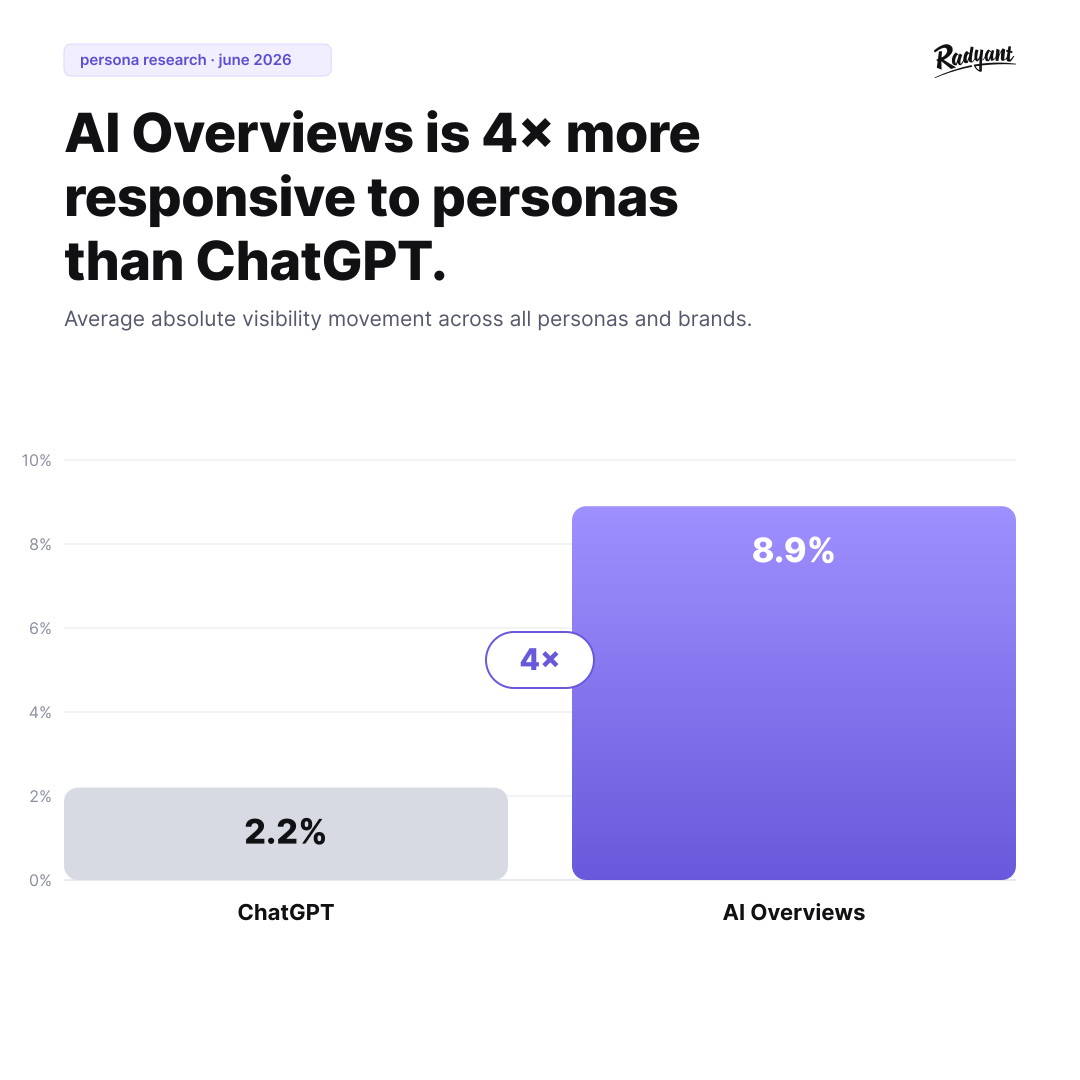
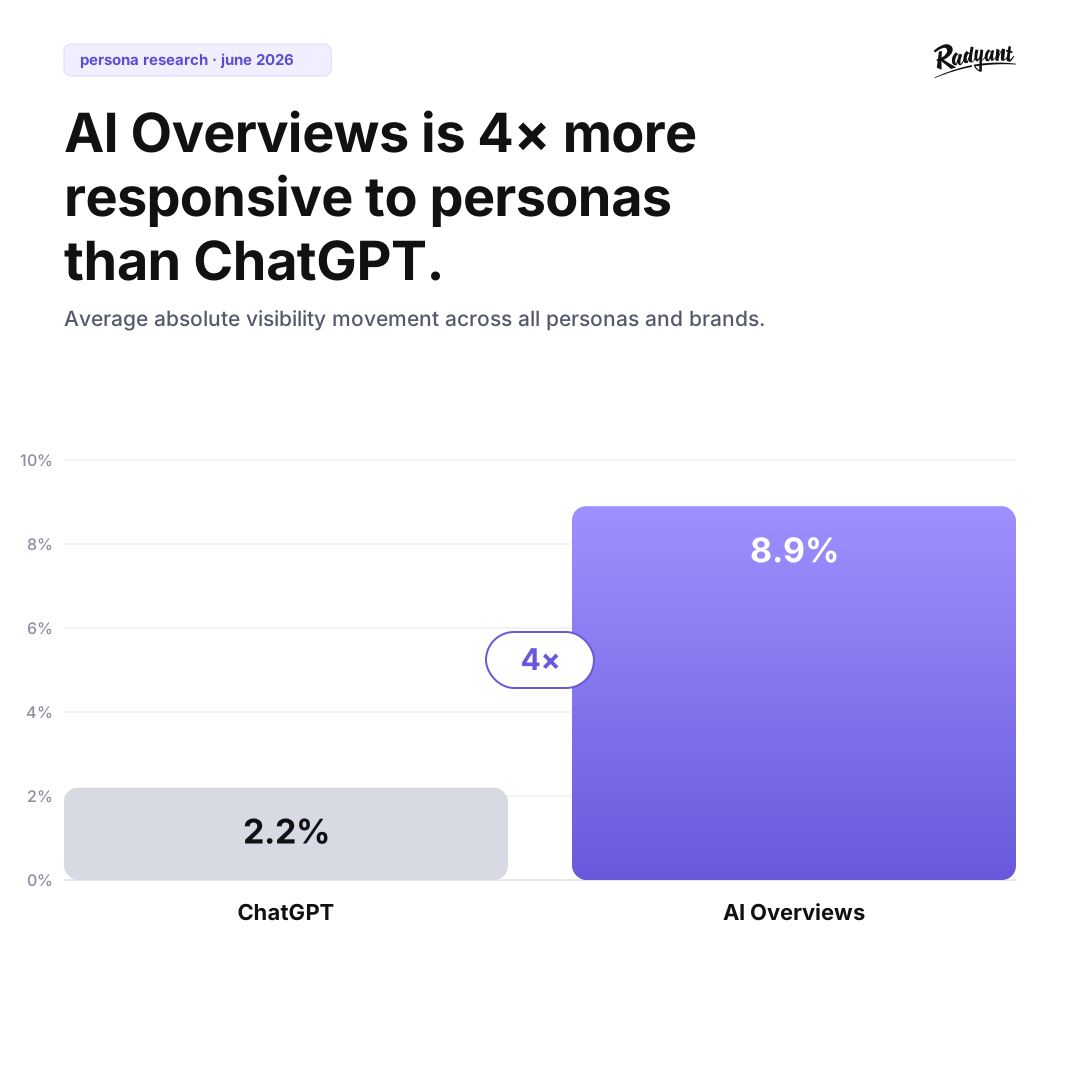
- Google AI Overviews is the most persona-sensitive platform tested, with average per-persona shifts about four times larger than ChatGPT.
- ChatGPT shows minimal response to persona context at the aggregate level; AI Overviews and Gemini show the largest individual brand movements.
- Brands with generic positioning appear to lose visibility when users signal role context; brands with ICP-specific content and vocabulary appear to benefit.
- Most AI Search tracking today ignores persona context entirely, making it an incomplete benchmark for the moments when buyer intent is highest.
Why we ran this study
The question came out of client work. When we track AI visibility for the brands we represent, we run prompts that mirror real buyer behavior. Real buyers rarely type neutral, context-free questions into ChatGPT. They say things. They identify themselves. "I'm in charge of marketing at a mid-sized B2B company." "I'm a founder looking for a tool my team can actually use." If the AI adjusts its answer based on that framing, and the data suggests it does, then tracking without persona context is tracking the wrong thing.
We ran the study in the funnel builder and interactive lead generation category using Peec AI. Ten brands, eight buyer personas including a no-persona control group, eight prompt themes, five models, 54 days of continuous tracking. The result is 17,929 individual AI responses and the data underlying this post.
Study setup: what we measured and how
We tracked 10 brands across five AI models: ChatGPT 5, Google AI Overviews, Google Gemini, Microsoft Copilot, and Perplexity. Over 54 days (March 18 to May 10, 2026), we ran 8 base prompt themes across 8 persona variants each, producing 64 tracked prompts and 17,929 total chat responses. Each prompt-persona combination rests on roughly 280 responses, providing a statistically robust baseline.
The persona prefixes were deliberately minimal. "I'm Head of Performance Marketing." "I'm CTO at a company." "I'm CEO of a company." No industry, company size, or vertical context was included. This was intentional: any differences observed are attributable to role framing alone, nothing else.
| Persona | Prompt prefix |
|---|---|
| P0 · Control group | No prefix (baseline) |
| P1 · Head of Performance Marketing | "I'm Head of Performance Marketing." |
| P2 · Agency Founder | "I'm the founder of an agency." |
| P3 · Head of Growth | "I'm Head of Growth." |
| P4 · CTO | "I'm CTO at a company." |
| P5 · CEO | "I'm CEO of a company." |
| P6 · CMO | "I'm CMO of a company." |
| P7 · Marketing Manager | "I'm a Marketing Manager." |
For statistical validity, we applied two-proportion z-tests comparing each persona's brand mention rate against the P0 control. Because 840 tests were run simultaneously, we also applied Benjamini-Hochberg FDR correction at q < 0.05. All headline findings cited in this post survive both corrections.
The interactive data
The table below shows the full delta data across all brands, models, and personas. Cells marked with a star are statistically significant at p < 0.05 (uncorrected). Toggle Benjamini-Hochberg correction on to see the stricter view: enabling BH reduces significant cells from 185 to 97, but all headline findings survive both corrections with p ≈ 10⁻¹⁵.
| Brand | P0Control | P1HoPM | P2Agency Founder | P3Growth Mgr | P4CTO | P5CEO | P6CMO | P7Mktg Mgr |
|---|---|---|---|---|---|---|---|---|
| Heyflow | 65% | +1pp | ±0 | +1pp | ±0 | +1pp | ±0 | +1pp |
| ClickFunnels | 46% | −8pp | −5pp | −9pp | −7pp | −4pp | −5pp | −4pp |
| GoHighLevel | 45% | −3pp | +10pp | −2pp | ±0 | +1pp | −3pp | ±0 |
| Involve.me | 42% | −3pp | −4pp | −1pp | −4pp | −5pp | −3pp | −1pp |
| Unbounce | 24% | +8pp | −1pp | +2pp | +2pp | −3pp | +2pp | +2pp |
| Systeme.io | 23% | −7pp | −3pp | −6pp | −6pp | −3pp | −4pp | −2pp |
| Perspective | 18% | +3pp | −1pp | ±0 | +3pp | +2pp | +1pp | −2pp |
| Typeform | 16% | +2pp | ±0 | +2pp | ±0 | −1pp | ±0 | −1pp |
| ConvertFlow | 14% | +2pp | −1pp | +2pp | −1pp | −2pp | ±0 | +2pp |
| Jotform | 7% | −3pp | −2pp | −2pp | −2pp | −3pp | −3pp | −2pp |
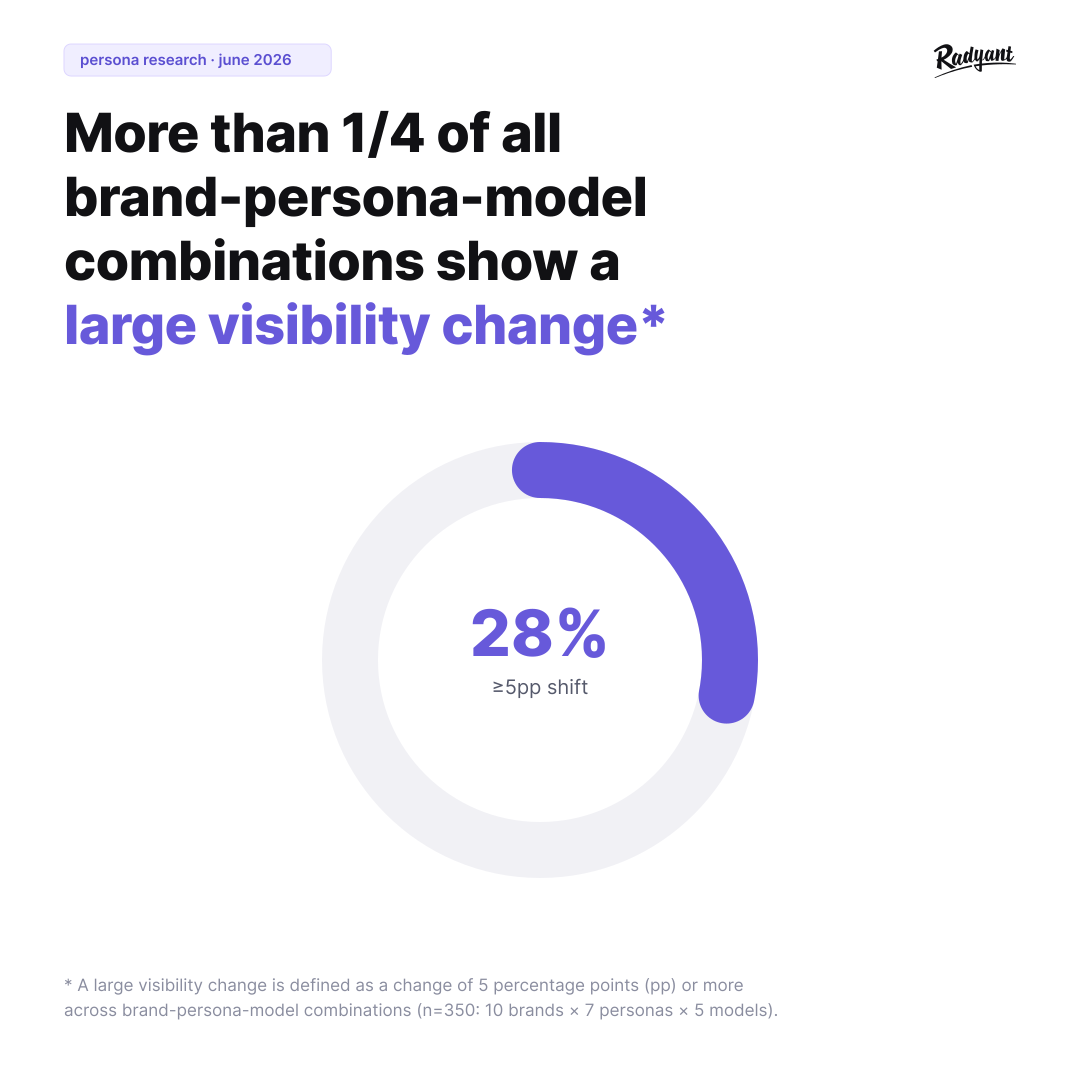
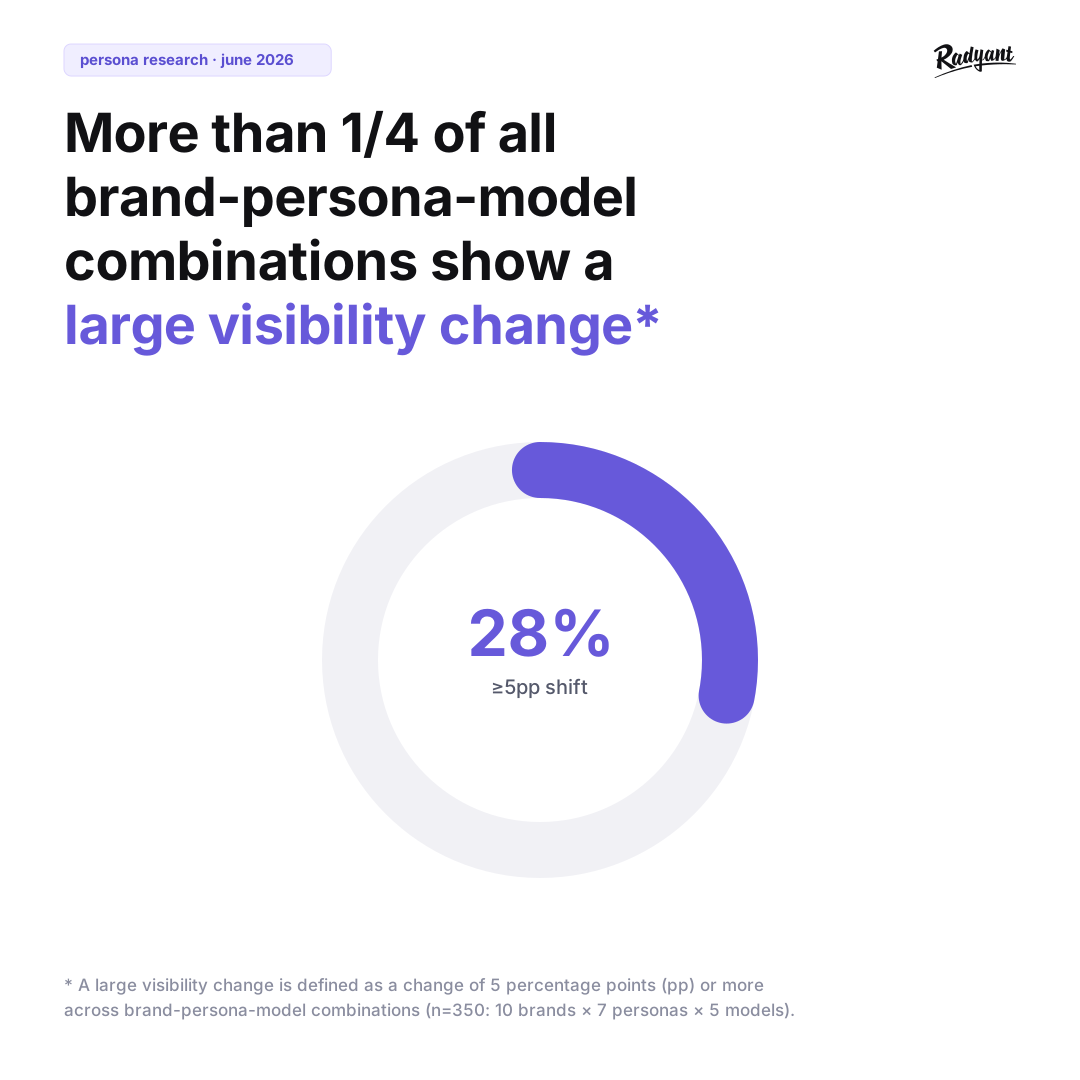
The table is the full record, but the headline lands as a single number. Across all 350 brand, persona and model combinations we tracked, 28 % move by 5 percentage points or more once a persona is added. More than a quarter of the time, telling the AI who is asking changes the answer enough to matter. It's also the cleanest one-image summary of the study, so we made it free to download and share.
What we found
Persona context shifts brand visibility across all five models, but the size and direction of the effect vary substantially by platform and brand. Google AI Overviews reacts the most; ChatGPT reacts the least. Adding any persona tends to narrow the total number of brands recommended. And for most large visibility swings, there is a corresponding vocabulary pattern in the source URLs the models drew on. The sections below cover each of these in turn.
Across all models and all brands, we observed absolute visibility changes of up to +24 pp (Unbounce on Gemini with the Head of Performance Marketing persona) and share of voice gains of up to +9 pp (GoHighLevel on AI Overviews with the Agency Founder persona). Between the best and worst performing persona for a single brand, spreads of over 20 pp in visibility appear in some model-brand combinations.
explore by model
Pick a model to see its single biggest gain and loss, and the persona behind each.
The platforms are not equally sensitive
Google AI Overviews is the most persona-sensitive platform by a significant margin. Its average per-persona absolute visibility shift is 8.9 pp, four times larger than ChatGPT at 2.2 pp. AI Overviews also hosts the single largest negative swing in the study: ClickFunnels loses 24 pp of visibility under the CTO persona. Gemini produces the largest positive swing: Unbounce gains 24 pp with the Head of Performance Marketing persona.
ChatGPT sits at the opposite end. No individual brand exceeds ±15 pp. SOV deltas on ChatGPT rarely exceed ±2 pp in absolute terms. For the brands spending the most energy optimizing for ChatGPT, this means they may be focused on the platform that responds least to the persona signals real buyers actually use.
| Model | Avg net Δ visibility | Avg abs Δ visibility | Biggest gain (brand · persona) | Biggest loss (brand · persona) |
|---|---|---|---|---|
| ChatGPT | +0.8 pp | 2.2 pp | GoHighLevel · Agency Founder: +14 pp | Heyflow · Agency Founder: -6 pp |
| Google Gemini | -1.1 pp | 5.0 pp | Unbounce · HoPM: +24 pp | ClickFunnels · Head of Growth: -16 pp |
| Google AI Overviews | -7.6 pp | 8.9 pp | Perspective · HoPM: +17 pp | ClickFunnels · CTO: -24 pp |
| Microsoft Copilot | -0.3 pp | 2.2 pp | GoHighLevel · Agency Founder: +7 pp | Systeme.io · Head of Growth: -8 pp |
| Perplexity | -0.6 pp | 2.4 pp | ConvertFlow · Marketing Manager: +7 pp | Unbounce · Head of Growth: -10 pp |
Persona context narrows the field
Adding any persona reduces the average number of brands mentioned. With no persona (P0), average visibility across all 10 tracked brands is 30.0 %. With any persona, it drops to between 28.3 % and 29.3 %. The AI isn't just redistributing share. It's recommending a slightly tighter set of brands once it knows who is asking. C-suite personas (CTO, CEO, CMO) produce the most selective responses, at an average of 28.4 % visibility, compared to 29.1 % for marketing practitioners.
High-visibility brands absorb the most movement
The top three brands by baseline visibility (Heyflow at 65 %, ClickFunnels at 46 %, GoHighLevel at 45 %) experience an average absolute visibility change of 3.1 pp per persona. That is roughly twice the 1.6 pp seen in the bottom three (Jotform 7 %, ConvertFlow 14 %, Typeform 16 %). The bottom tier is largely persona-indifferent at the all-models level. This asymmetry matters: the brands with the most to gain or lose from persona sensitivity are the ones that already have meaningful presence in AI answers.
The citation pool tells us something about the mechanism
Across the top-100 citations for each of the eight persona variants, the AI models drew on a combined pool of 201 unique URLs from 88 domains. Most sources appear across multiple persona pools: 47 URLs show up in every single persona's top-100 citations. These are the universal brand references that hold regardless of who is asking. At the other end, 68 URLs appear in only one persona's citation pool. These persona-unique sources are where the per-persona vocabulary shifts concentrate.
For most of the large visibility swings in this study, there is a corresponding source-level correlate: a URL that uses the relevant persona's functional vocabulary and either names a brand positively or omits it. Most sources in the dataset don't use the exact job titles from our persona definitions. Terms like "Head of Performance Marketing", "Agency Founder", or "Marketing Manager" don't appear as editorial audience labels in any retrieved source. What does appear is functional-equivalent vocabulary: "performance marketers", "agencies", "paid acquisition teams", "marketing teams". Whatever mechanism drives the visibility shifts, it operates through semantic proximity rather than verbatim title matching.
The practical implication is precise: brands don't need content with the exact ICP job titles to benefit. They need to publish in the vocabulary those roles use. Terms like "ROAS" and "CPL" for performance marketing contexts, or "white-label" and "client management" for agency contexts. When that vocabulary appears in high-retrieval sources alongside a positive brand mention, visibility rises for that persona.
What this means in practice
Three things follow from the data, in roughly the order they should change what you do next.
1. Publish in your buyers' language. Brands with ICP-specific content that frames the product for specific roles, use cases, and pain points appear to benefit when users provide role context. This doesn't mean inserting exactly matching job titles into your pages. It means publishing in the vocabulary your ICP uses about their own work. When your ideal customer tells an AI who they are, does the AI find sources that speak their language and mention your brand positively?
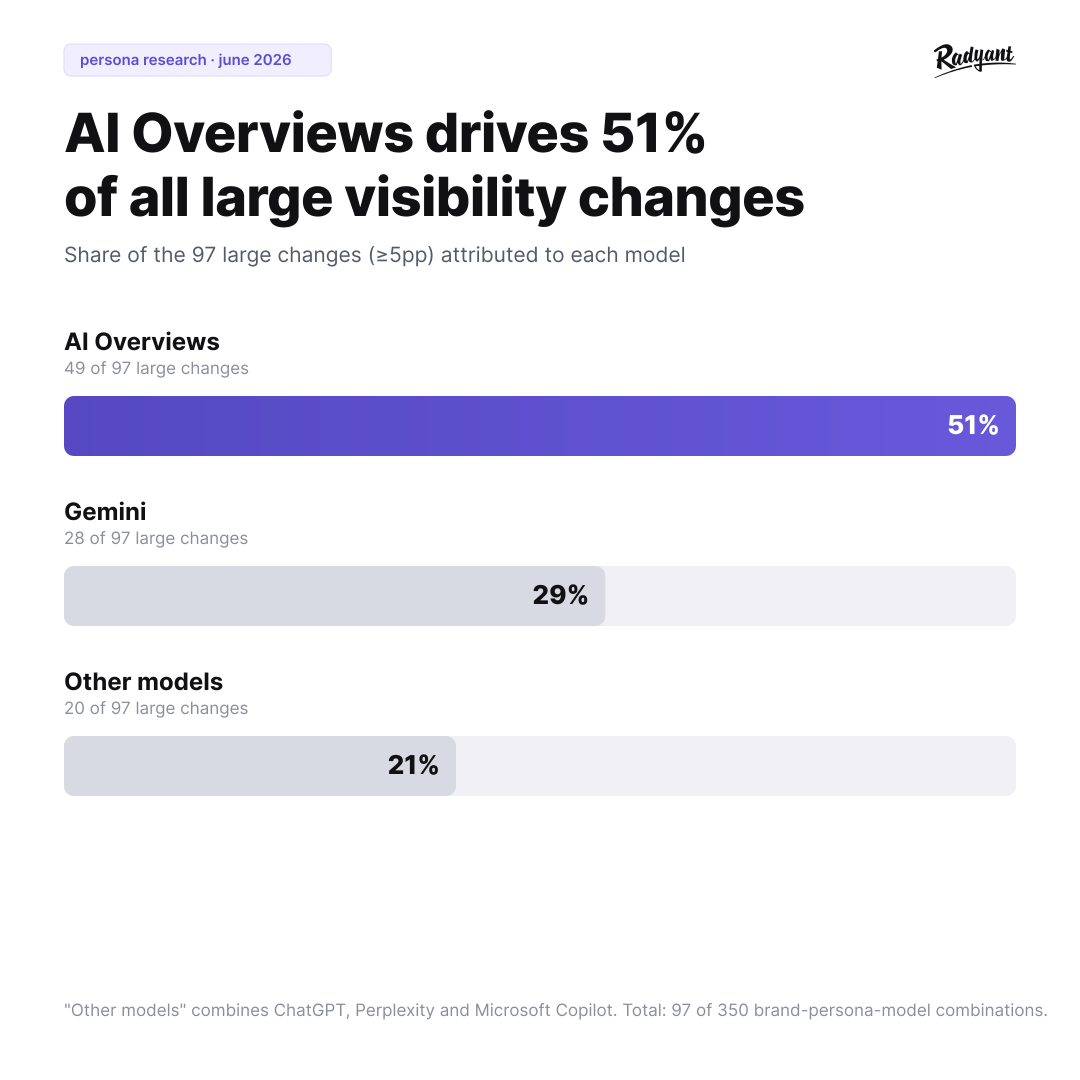
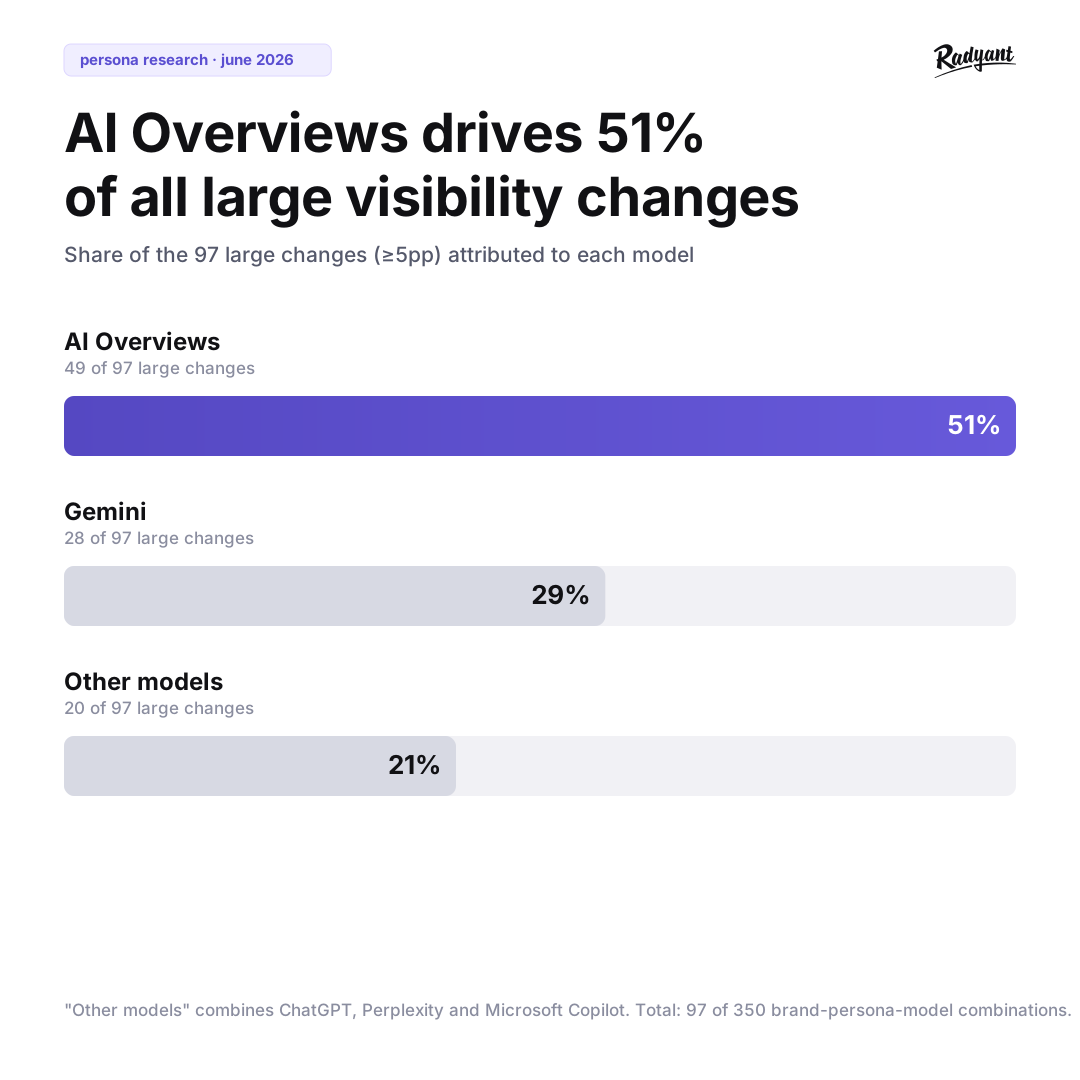
2. Spend your effort where persona context moves the needle. Google AI Overviews and Gemini are the high-leverage surfaces for persona optimization. Between them they account for 80 % of every large visibility change in the study: 51 % land on AI Overviews and 29 % on Gemini, leaving just 21 % spread across ChatGPT, Perplexity and Copilot combined. AI Overviews also reaches 2.5 billion monthly users and appears in 87 % of Google searches, including 88.5 % of bottom-of-funnel queries. Brands spending most of their AEO effort on ChatGPT are optimizing for the model that is least sensitive to the behavior real buyers exhibit.
3. Track with personas, not just the control group. Most AI visibility tracking runs prompts without persona context. The control group is a useful baseline, but it is not the benchmark that matters for brands whose buyers self-identify. The same brand on the same model can show up to 24 pp differences between a neutral prompt and a persona-tagged one. Tracking without personas means not knowing what happens when it counts.
Limitations worth stating plainly
The study covers a single category (funnel builder software) tracked with German-market IP addresses. Persona sensitivity effects may differ in other categories and geographies. The funnel builder vertical was chosen because it features brands with meaningfully different positioning and audience specificity; categories where all brands are more generic may show different patterns.
Real users rarely open an AI chat by stating their job title. The persona prefix is a methodological construct designed to isolate the persona variable cleanly. In practice, LLMs may infer persona context from conversation history, connected accounts, or implicit signals in query phrasing. This study measures the effect of an explicit role declaration; ambient implicit signals would produce a different, likely smaller effect.
Google AI Overviews is delivered through live Google Search with real-time web retrieval. The other four models were tracked via API. These are structurally different surfaces. The cross-model sensitivity comparisons in this post reflect real differences in observed behavior, not a controlled apples-to-apples test. AI Overviews' persona sensitivity may partly reflect its retrieval architecture, not only its language model behavior.
This is a snapshot in time. The study ran from March 18 to May 10, 2026. LLM training data, ranking behavior, and brand content are all dynamic. The directional findings are likely durable; specific percentages will shift as models update and brand content changes.
The bottom line
Persona context does not just tweak AI recommendations. It reshapes them, especially on the platforms where it matters most. Brands that publish content in the language their buyers use see measurable gains. Brands that rely on generic messaging miss opportunities. The data is clear: if you want AI to recommend you to the right audience, you need to speak their language. And yes, that sometimes means talking less about your product and more like your customers.
FAQ
How many responses were collected per prompt-persona combination?
The study averages roughly 280 responses per prompt-persona combination across 54 days of tracking. This substantially exceeds the 10-response minimum identified as sufficient for reliable LLM visibility estimates in published research on LLM sampling methodology from Graphite. Our study exceeds that threshold by 28x per combination.
Why does AI Overviews show such large persona-driven swings?
Our interpretation is that AI Overviews applies stronger persona-based filtering where there is less role-specific content signal associated with a brand. Brands with generic positioning provide fewer relevance anchors for a specific buyer role, making them more likely to be filtered out when role context is present. This is a hypothesis consistent with the data, not a confirmed mechanism. The exact internal behavior of AI Overviews is not something we can observe directly.
Why does ChatGPT show minimal response to persona context?
ChatGPT redistributes share of voice across brands when persona context is added rather than narrowing the total field. The pattern is consistent across all personas and brands: adding role context on ChatGPT does not substantially reduce how many brands get mentioned. The exact reason is not something this study can establish.
Does sentiment change with persona context?
Sentiment was tracked across all personas and models. The scores remain in a narrow band of ±3 to 4 points around each brand's P0 baseline across all personas and models. No brand shows a consistent sentiment shift tied to persona context. We treat these as descriptive metrics rather than statistically testable ones, because the large sample size makes even a 1-point difference technically significant, a sample-size artifact, not a meaningful signal. The pattern suggests that persona filtering operates at the selection level: when an AI changes which brands it recommends for a given persona, it appears not to change how favorably it describes them.
Are these findings statistically significant?
For visibility and share of voice, we applied two-proportion z-tests (p < 0.05) and Benjamini-Hochberg FDR correction across all 840 simultaneous tests. All headline findings cited in this post survive both corrections. The interactive delta table includes significance markers for every cell so you can see which individual movements meet the statistical threshold.