

 Add as preferred source on Google
When software buyers ask AI tools for recommendations, which sources does the AI actually use? We wanted to know, so together with OMR Reviews we ran 20,160 chats across 5 models and 8 software categories to find out. The short answer: review platforms matter more than most software brands think.
Key takeaways
- Around 81% of review platform retrievals go to multi-vendor pages, not individual profiles. Comparisons, listicles, and category pages drive the vast majority of retrievals.
- OMR Reviews is the #1 retrieved single source across all 8,035 domains analyzed, ahead of YouTube, Reddit, and every vendor website in the study. (Yes, we ran this study together with OMR Reviews. Make of that what you will, the data doesn't care.)
- Vendor sites dominate as a source type but are fragmented across hundreds of individual domains. Review platforms concentrate on a handful of addresses, making them the strongest individual sources.
- The model your buyers use changes the picture significantly. Copilot is the most review-heavy at 10%; Gemini uses almost no external sources at all.
- Category determines how much review platforms matter. IT Service Management (13%) and HR Software (10%) are review-platform-heavy; E-Mail-Marketing (4%) and SEO tools (5%) are not.
- Three levers drive AI visibility in software search: (1) building comparison and alternatives content on your own website, (2) getting featured in the right lists on review platforms, and (3) diversifying into editorial and UGC sources.
Software buying decisions are shifting toward AI. When buyers ask ChatGPT, Copilot, or Claude which tool to pick, the AI pulls from a set of sources, and those sources shape the consideration set before any vendor website is visited. Our hypothesis going in: when users ask LLMs with clear commercial intent, review platforms would show up disproportionately often as sources. We wanted to know whether that was actually true, and, if so, which review platforms and page types appeared most often, and how the results varied across different AI models.
How we ran the study
This is a descriptive source analysis conducted by Radyant and OMR Reviews. The numbers come directly from aggregated Peec AI exports.
Here's the setup:
| Parameter | Detail |
|---|---|
| Timeframe | June 4 to 30, 2026 |
| Basis | 20,160 chats, ~156,000 source mentions |
| 8 software categories | Collaboration/Intranet, CRM, IT Service Management, Time Tracking, E-Mail-Marketing, HR Software, SEO Tools, Project Management |
| 96 prompts (12 per category) | All commercially relevant, written from a buyer's perspective, including 8 longtail, 2 shorttail, 2 comparison prompts per category |
| 5 models | ChatGPT, Google AI Overviews, Microsoft Copilot, Claude, Gemini |
| Key metric | Source visibility (retrieved share) = the share of answers in which a given source appears |
Each category's 12 prompts follow the same validated split we use across our AI Search tracking: 8 long-tail prompts that mirror how a real buyer actually phrases a question ("which tool handles X for a team of Y people"), 2 short-tail prompts that cover the generic head term a category gets searched under ("best CRM software"), and 2 comparison prompts that name two specific tools and ask the model to pick between them. We cover this distribution, and why it holds up better than generic keyword lists, in our guide to prompt tracking.
For each category, we chose two tools that are comparable in terms of product, performance, and service, but differ in their presence on OMR Reviews: one has a strong profile, while the other has little or no presence. This setup allows us to examine the impact of a tool's presence on OMR Reviews and review platforms more broadly on an LLM's answer.
Here's what the prompts actually look like inside Peec AI. A short excerpt from the IT Service Management category, including the deeploi vs. Atera comparison prompt:
All prompts were German-language and DACH-market focused. That context matters for interpreting the results, particularly OMR Reviews' ranking, which reflects its dominant position in the German-speaking market. In English-language markets, G2 and Capterra would likely place higher.
What makes this data set meaningful is the prompt design: these aren't generic queries. They mirror the actual buying-intent questions real users ask LLMs when evaluating software: this is a signal worth measuring.
OMR Reviews comes out as the most-retrieved single source
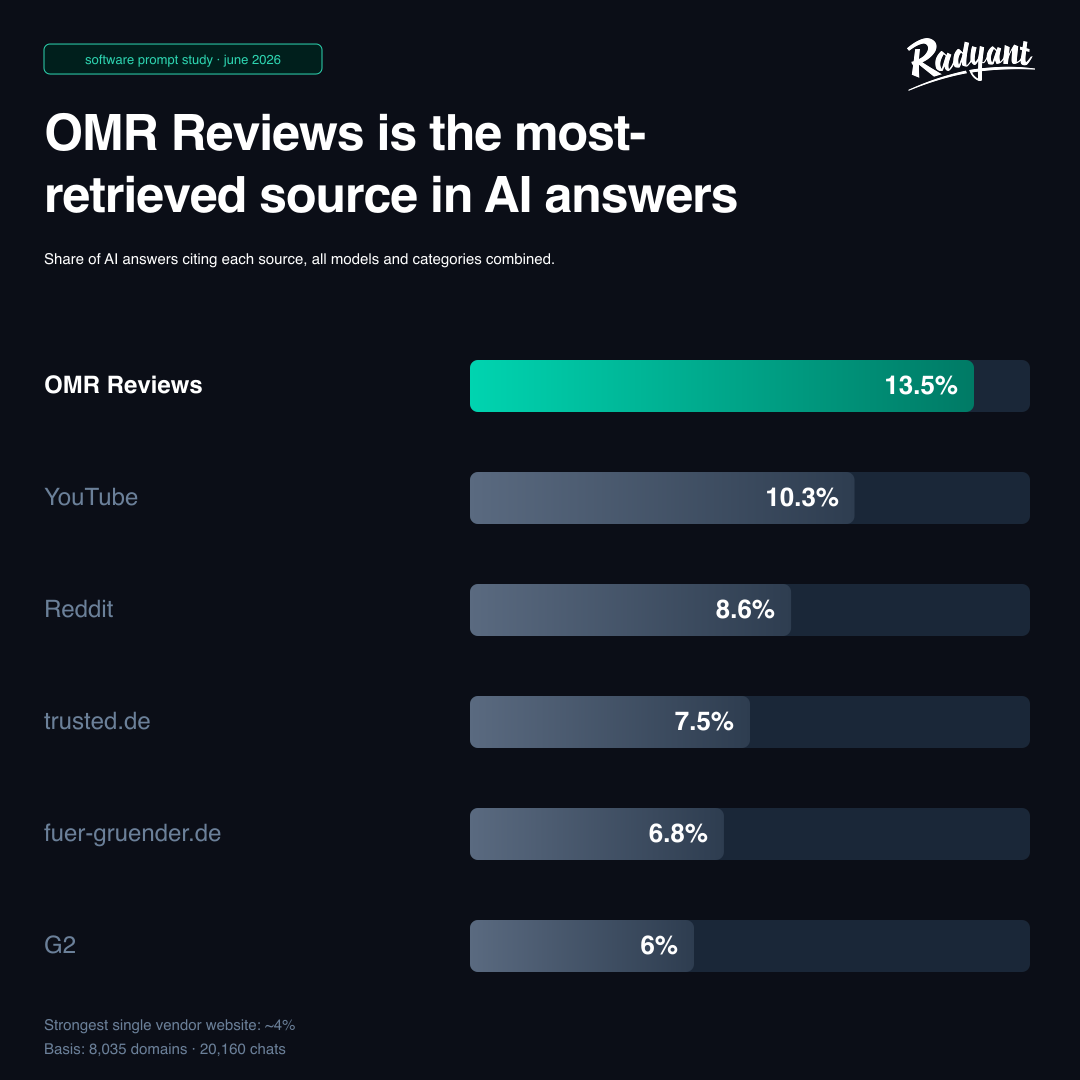
Across all 8,035 unique domains analyzed in the study, one source came out on top: OMR Reviews, with a visibility score of 13.5%.
To put that in context:
| Rank | Source | Visibility |
|---|---|---|
| 1 | OMR Reviews | 13.5% |
| 2 | YouTube | 10.3% |
| 3 | 8.6% | |
| 4 | trusted.de | 7.5% |
| 5 | fuer-gruender.de | 6.8% |
| 6 | G2 | 6.0% |
| 7 | Strongest single vendor website | ~4% |
OMR Reviews appears in more than three times as many AI answers as the strongest individual vendor website. That's a significant concentration of retrievals in a single third-party domain.
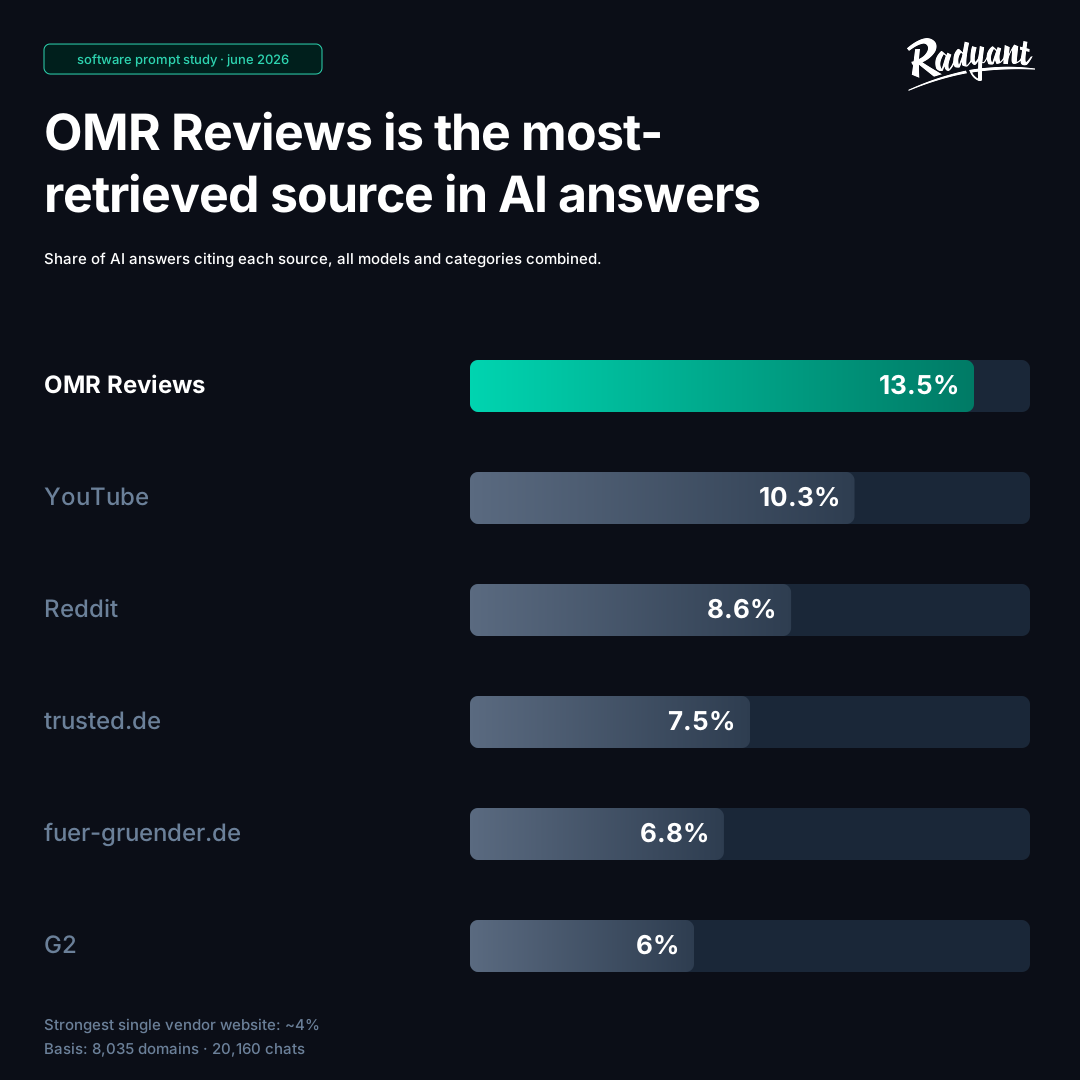
But here's the nuance that makes the finding more interesting and more useful than the headline number alone: when you look at source types rather than individual domains, vendor and manufacturer websites still dominate. They account for 63% of all retrievals. Review platforms, as a type, sit at just 7%. How can review platforms be both dominant and marginal at the same time?
The answer is distribution. Vendor retrievals are spread across hundreds of individual domains. Every software company in every category has its own website. Review platform retrievals, by contrast, concentrate on a handful of addresses. OMR Reviews, G2, Capterra, GetApp: a small number of platforms absorb a disproportionate share of all review-type retrievals.
But OMR Reviews doesn't lead on every model
The overall ranking tells one story. The model-by-model breakdown tells another, and it's one that software brands need to understand before drawing tactical conclusions.
| Model | Where OMR Reviews stands | Review-platform share |
|---|---|---|
| Google AI Overviews | Leads clearly, at 34% | 6% |
| Claude | Leads clearly, at 20% | 6% |
| Copilot | Trails: Capterra (9.3%) leads OMR Reviews (5%) | 10% (the most review-heavy model) |
| ChatGPT | Trails: G2 (14%) and Capterra (12.9%) outrank OMR Reviews (9%) | 8% |
| Gemini | Barely uses external sources | ~0% |
Two findings here deserve special attention.
Gemini uses almost no external sources for these prompt types at all. The few hits it returns point to a Gemini-internal link. If your buyers use Gemini to research software, source optimization has almost no leverage there, at least for now.
ChatGPT leans heavily on media coverage: editorial sources and media sites account for 13% of ChatGPT retrievals, well above the 8% that goes to review platforms. If you want visibility on ChatGPT specifically, media coverage, editorial mentions, and press placements matter at least as much as review platform presence.
It also varies by category
The aggregate numbers are useful for orientation. But whether review platforms are a high-leverage channel for your software category depends significantly on which category you're in.
Review platform share of all retrievals, by category:
| Rank | Category | Review-platform share |
|---|---|---|
| 1 | IT Service Management | 13% |
| 2 | HR Software | 10% |
| 3 | Project Management | 7% |
| 4 | Collaboration/Intranet | 6% |
| 5 | CRM | 6% |
| 6 | SEO Tools | 5% |
| 7 | Time Tracking | 5% |
| 8 | E-Mail-Marketing | 4% |
ITSM and HR Software show the highest review platform concentration, because multiple platforms are simultaneously active there with substantial visibility (in ITSM: Gartner 14%, Capterra 12%, G2 11%, OMR Reviews 10%).
One important nuance: OMR Reviews as an individual platform is actually strongest in Collaboration, SEO Tools, and Time Tracking (16 to 17% visibility), some of its best results in the study. But in those categories OMR Reviews dominates while other platforms are comparatively weak, which is why the aggregate type share still looks low. In SEO Tools specifically, that 5% shouldn't read as "review platforms don't matter": one platform is carrying the category almost single-handedly, making it one of the strongest single-platform opportunities in the study.
explore the data
Pick a model, a category, or a page type to see how much review platforms are retrieved as a source.
review-platform share of all retrievals
Microsoft Copilot
The most review-heavy model. Capterra (9.3%) leads OMR Reviews (5%).
The most important finding: it's not the profile. It's the list.
This is the finding with the biggest strategic implications, and one that many software brands haven't fully acted on yet.
When we looked at which types of pages within review platforms were actually being retrieved by LLMs, the breakdown was stark:
| Rank | Page type | Share of review-platform retrievals |
|---|---|---|
| 1 | Comparisons & Alternatives pages | 36.4% |
| 2 | Listicles | 22.9% |
| 3 | Category pages | 22.0% |
| 4 | Individual vendor profiles (profile/product/pricing) | 16.8% |
| 5 | Editorial & other | 1.9% |
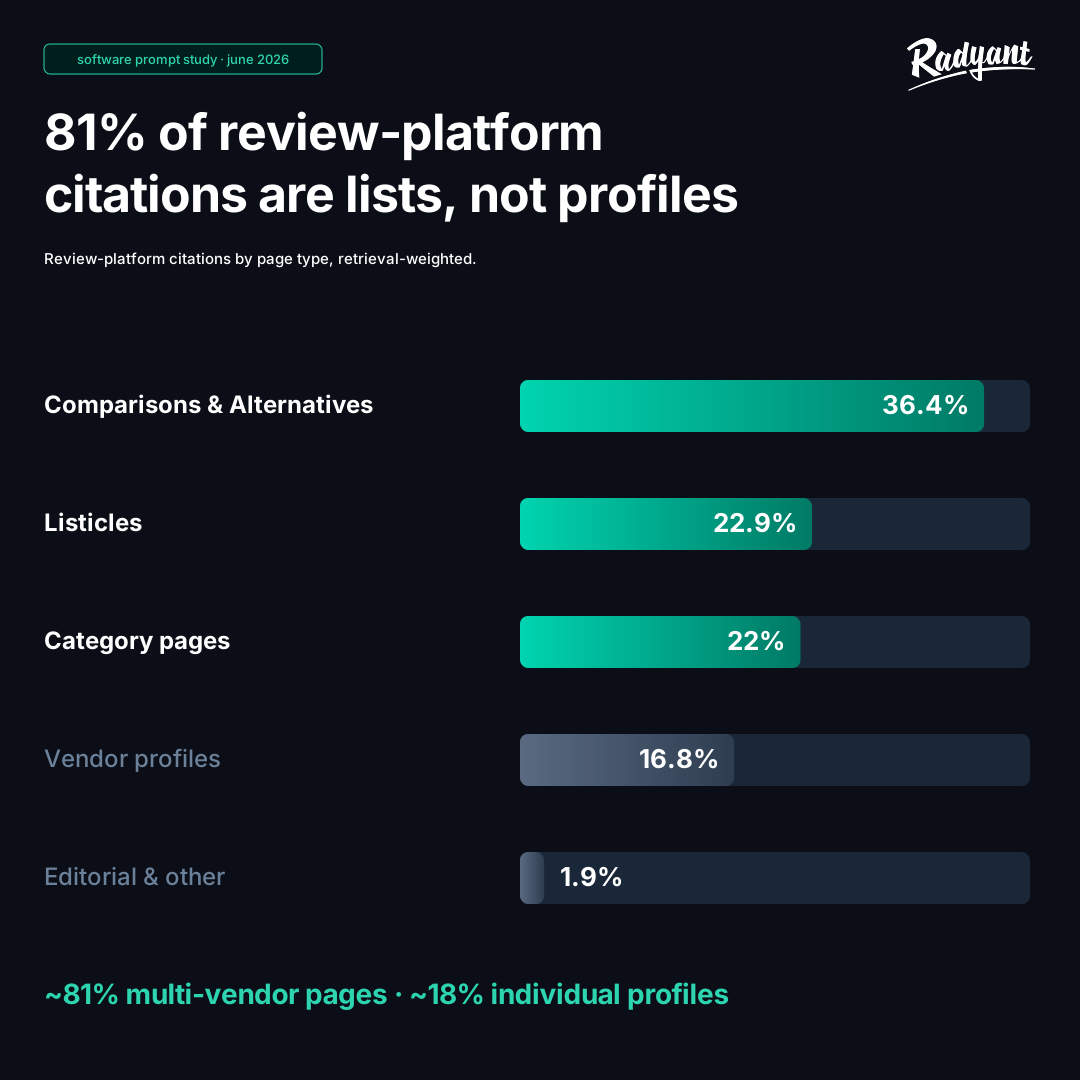
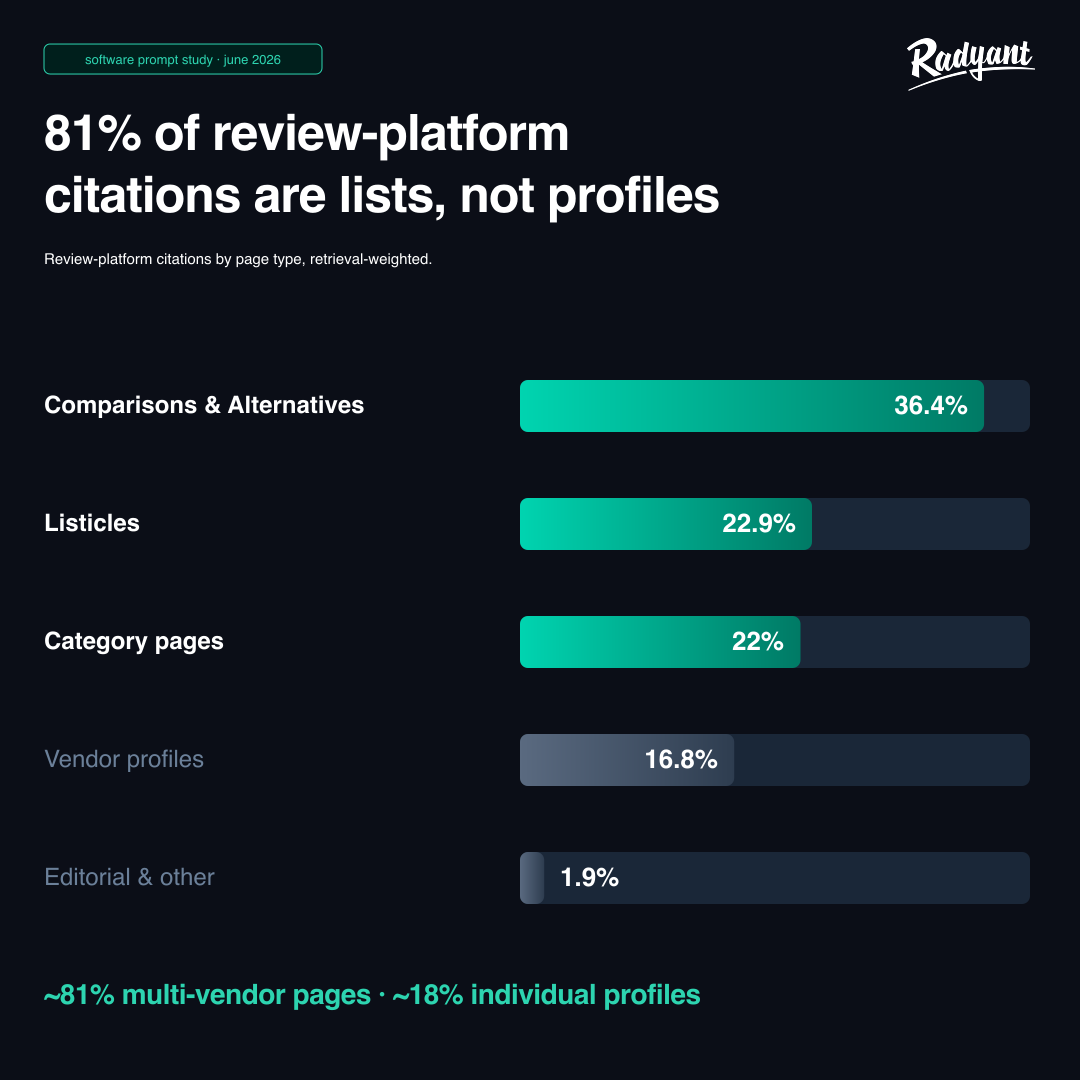
Around 81% of all review platform retrievals go to multi-vendor pages: comparisons, listicles, and category pages. Only about 17% go to individual vendor profiles.
That said, the profile is the foundation: to appear in OMR Reviews' category pages and listicles, you need a profile in the first place. And to increase your chances of being featured prominently in those lists, the number and quality of your reviews matter. More reviews signal credibility to the platform's ranking logic. The path to AI visibility on OMR Reviews runs through the profile, but it doesn't stop there.
The dominant page type varies by platform:
| Platform | Dominant page type |
|---|---|
| OMR Reviews | Listicles, at 62%. OMR Reviews is the only major platform with a real content hub. In all 8 categories we studied, the most-retrieved OMR Reviews page was the category listicle. |
| G2 | Comparisons & Alternatives, at 60% |
| Capterra | Mixed: Comparisons 35%, Category pages 32%, Profiles 27% |
| GetApp | Comparisons & Alternatives, at 44% |
| Software Advice | Comparisons & Alternatives, at 48% |
| Gartner Peer Insights | Comparisons & Alternatives, at 45% |
The strategic question isn't "do I have a profile on OMR Reviews?", it's "am I featured in the listicles and category pages on OMR Reviews?". And on G2, Capterra, and GetApp: "do I appear in the comparison and alternatives pages for my category?"
This also has direct implications for your own website. The same logic that makes LLMs prefer multi-vendor pages on review platforms applies to the open web: comparison and alternatives content (pages that put multiple tools in context and help a buyer decide) are the format AI models reach for when answering commercial software queries.
Building that content on your own domain is the one lever you control entirely.
What this looks like in practice: the deeploi case
The deeploi case makes the study findings tangible with real numbers.
deeploi is an IT management platform for growing companies. Radyant has been working with deeploi since November 2025. The strategy was built directly around the logic this study later confirmed: build comparison and alternatives content on the website, and establish a strong presence in the right places on OMR Reviews.
What was built:
- 40+ content pieces published on deeploi's website, predominantly comparisons, listicles, and alternatives articles (e.g. "Die 7 besten IT-Asset-Management-Softwarelösungen 2026", "Die 5 besten Atera Alternativen 2026 im Vergleich")
- Active OMR Reviews presence across all relevant categories, including IT Service Management, IT Asset Management, and Offboarding
- Consistent profile maintenance: complete information, content aligned with the website, ongoing review acquisition
- Multiple badges earned: 3× Leader (IT Service Management, IT Asset Management, Offboarding), 1× Top Rated (IT Service Management) for Q3/26
The AI visibility results:
- Brand visibility in AI Search (how often deeploi is named): from 0% at project start to an average of 15%, with a peak of 24.3%
- OMR Reviews retrieved share for deeploi (how often OMR Reviews is retrieved as a source): 14.4%, ranking #3 among all sources, behind only deeploi's own website and YouTube
- In comparison prompts (deeploi vs. Atera): LLMs pulled deeploi pages 32 times, Atera pages only 4 times
The business results:
- Organic web search leads: more than tripled (~+250%) since the partnership began.
- AI-attributed leads (self-reported): a new channel that didn't exist before the partnership.
A few important caveats: this is not a controlled experiment. Lead growth reflects multiple levers working in combination: content production, programmatic clusters, review platform presence, and ongoing AI visibility work. We cannot isolate the contribution of any single factor. The deeploi vs. Atera prompt result is a signal, not a causal proof.
What the case does show: when a software brand builds presence on exactly the page types and source categories that LLMs prefer (its own comparison content, OMR Reviews category pages and listicles, a well-maintained review profile), AI visibility follows, and that visibility can show up as measurable demand in the CRM.
What software brands should do next
The study points to a three-lever framework for AI Search visibility. None of the three levers work in isolation. The data consistently shows that the brands with strong AI visibility have all three working together.
Lever 1: Own your comparison and alternatives content
Build dedicated comparison pages on your own website. Tool A vs. Tool B. The top alternatives to Tool X. The best software options for use case Y.
These are the page types LLMs reach for most often when answering commercial software queries, and they're the ones you control completely. Your own domain is the only source where you can shape the narrative, the framing, and the specifics entirely. Vendor sites as a type account for 63% of all retrievals. Make sure your site is earning that share, not diluting it. Check your pricing page too. Pricing Friends offers a free audit that compares what ChatGPT, Claude and Gemini say you charge with what the page actually says.
Lever 2: Get into the lists, not just the profile
Getting featured in the right lists starts with the profile, but it doesn't end there. Here's the path:
Step 1: Get listed. A free profile is enough to get started on OMR Reviews, no paid plan required. This is table stakes: without a profile, you can't appear in category pages or listicles at all.
Step 2: Get reviewed. The number and quality of customer reviews is what actually feeds the ranking logic behind category listicles. This works on a free profile just as it does on a paid one, though a paid profile can give additional visibility support on top. If you only do one thing after setting up your profile, prioritize collecting genuine customer reviews.
Step 3: Get featured. Profile and reviews are the prerequisites; the actual AI-visibility lever is showing up in the pages that get retrieved:
- On OMR Reviews: target inclusion in category listicles and category pages. In all 8 categories in our study, the most-retrieved OMR Reviews page was the listicle, not a vendor profile.
- On G2, Capterra, GetApp: focus on comparison and alternatives pages. That's where ~60% or more of their retrievals come from.
Make sure you appear in every relevant category, not just your primary one.
Lever 3: Diversify into editorial and UGC
YouTube (10.3%) and Reddit (8.6%) are the #2 and #3 most-retrieved sources overall. ChatGPT in particular is media-heavy: editorial sources account for 13% of its retrievals, well above the 8% that goes to review platforms.
A strategy that only optimizes for review platforms will have blind spots, particularly on ChatGPT. Editorial coverage, media mentions, and presence in relevant community discussions (Reddit threads, YouTube reviews) build a source mix that's more resilient across models.
One model to deprioritize for now: Gemini. In our data, Gemini used almost no external sources for commercial software prompts. Until that changes, building source strategy specifically for Gemini visibility isn't a productive use of resources.
Limitations worth knowing
A few methodological points worth keeping in mind when reading these results:
Snapshot in time. These numbers reflect a four-week window in June 2026. LLM behavior, training data, and brand content all shift over time. The directional findings are likely to hold; specific percentages will move as models update and the competitive landscape changes.
DACH market scope. The prompt set is German-language and DACH-focused. OMR Reviews' leading position is partly a language and market effect. In English-language markets, international platforms like G2 and Capterra would likely perform stronger. Results apply to the German-speaking market.
Brand-agnostic prompts. Prompts are deliberately brand-neutral (buyer perspective, no brand names mentioned) to measure organic discovery rather than confirmation search. This structurally favors product sites as a type, because LLMs tend to recommend vendor websites directly in response to unspecific buyer prompts. In prompts that already include a brand name, the model is more likely to validate than discover, which would likely surface more review and comparison content.
The bottom line
The Software Prompt Study points to a clear signal: when buyers ask LLMs for software recommendations, AI models draw on concentrated third-party sources far more readily than individual vendor websites. Within those third-party sources, review platforms are the most powerful single-source category. And within review platforms, it's the multi-vendor pages (lists, comparisons, category pages) that drive the overwhelming majority of retrievals.
The brands showing up in AI answers have built all three levers: their own comparison content, presence in the right lists on the right review platforms, and a diversified source footprint across editorial and UGC. That combination is harder to build than a review profile, and considerably harder for competitors to copy.
This is what we measure, build, and optimize for at Radyant, for software brands serious about AI Search visibility.
FAQ
Does this study apply to markets outside the DACH region?
The prompts were German-language and DACH-focused, which explains OMR Reviews' leading position. In English-language markets, G2 and Capterra would likely rank higher as individual sources. The structural findings (that multi-vendor pages outperform profiles, and that model and category drive significant variation) are likely to hold across markets.
We already have a G2 and Capterra profile. Is that enough?
G2 and Capterra give you solid coverage across ChatGPT and Copilot, where they rank ahead of OMR Reviews. But in the DACH market, OMR Reviews is the single most-retrieved source across the entire study at 13.5% of answers, outranking YouTube, Reddit, and every vendor website. If any meaningful share of your buyers researches software in German, not being on OMR Reviews (or not appearing in its category listicles) is a gap. For DACH-market software brands, a complete review platform strategy means G2 and Capterra plus OMR Reviews. In English-language markets, the platform mix shifts, but the underlying logic stays the same: cover the platforms that dominate retrieval share for your category and your buyers' models.
Should we be on OMR Reviews even if we're not a DACH-focused brand?
If any meaningful share of your buyers researches software in German, yes. OMR Reviews has 13.5% visibility across the study, more than YouTube, Reddit, and any single vendor website. The risk of not being on it, or not appearing in its listicles, is higher than the effort to get there.
What should we do about Gemini?
Not much, for now. Gemini used almost no external sources for commercial software prompts in our data. Source optimization has near-zero leverage there on these query types. That may change as Gemini's behavior evolves. Worth monitoring, but not worth building a dedicated strategy around today.