 Add as preferred source on Google
What to actually verify before hiring a GEO or AEO agency: real case studies, contract terms, and the one visibility number that's easiest to fake.
A visibility chart that moves up looks like proof. But the score is based only on the prompts being tracked. It can rise without any AI answer about the brand actually changing.
That's the shape of most of what's worth checking before hiring a GEO or AEO agency, generative engine optimization, answer engine optimization, whatever term you use for it. Not whether the pitch sounds credible, but what's actually verifiable behind it: the number, the contract, and the claims that make it into a deck.
This guide is the questions we'd ask if we were doing the hiring, plus a few we've been asked ourselves, when another company vetted us before bringing us onto a bigger piece of work.
Key takeaways
- "AI Search ready" is a claim until you can see it. Ask for case studies with real numbers, not a screenshot.
- Visibility is a percentage of what got tracked, not how well-known you are. If an agency's fix for a low number is tracking more prompts you already win, ask what actually changed, not just what got measured.
- Ask who's actually senior on the account, not just in the pitch. A senior strategist should run the work day to day.
- The exit clause tells you as much as the case study. Ask when you can leave and what happens if you start falling behind, both in writing, before you sign.
- A confident growth multiple before they've seen your baseline is the tell. The honest answer is "it depends," not a number borrowed from someone else's account.
What does "AI Search ready" actually need to prove?
Almost every agency's service page says some version of "AI Search ready" or "GEO expertise" now. That phrase alone proves nothing. What's worth asking for is a name and a screen you can actually look at.
The specific tool an agency tracks AI visibility in matters less than whether they can show you real numbers behind it at all. Several platforms do this reasonably well, Peec AI, Profound, and others, so naming one isn't the test. Being able to point to one, and show real results from real client work, is.
When we get asked this ourselves, the answer is Peec AI for prompt tracking, plus the client's own CRM data for the rest, not a separate agency dashboard. We look at the same numbers the client already looks at, because that's the only way to tell whether the leads that came in are actually qualified, not just counted. If the answer stays at "we use AI tools and industry best practices," there's nothing to actually check.
Why does the contract matter as much as the case study?
A case study shows you what worked for someone else. The contract shows you what happens if it doesn't work for you, and that's harder for an agency to dress up than a slide. Here's our own reference point, since a real number is more useful than a hypothetical range. Our Growth Partnership runs on a 12-month commitment with an opt-out after six months, priced at €7,000 to €12,000 a month as a package tied to deliverables, not billed by the hour. That's roughly where agencies serving similarly sized clients tend to land, though it varies enough by agency size and client size that we wouldn't call it a hard standard.
What's worth asking for, whatever the numbers turn out to be, is what's written down before you sign: the exit terms, and what "this isn't working" actually means. A contract that locks you in for a year with no exit before then, and never defines failure on paper, puts all the risk on you and none on them.
| What to ask | A substantive answer | A red flag |
|---|---|---|
| How would you show us AI visibility, not just claim it? | Points to a specific platform and offers case studies with real numbers | "We use a mix of AI tools and industry best practices" |
| What happens if we're not happy after six months? | A written opt-out clause with a defined date | No exit before the full term, or "we'll work something out" |
| What happens if we're behind on goals mid-contract? | They catch it early and add more effort at no extra cost | Nothing changes until renewal, or they ask for more budget to fix it |
| How is the retainer structured? | A package tied to agreed deliverables | Open-ended hourly billing with scope that only grows |
| What KPI are we actually being measured on? | Qualified leads, pipeline, or revenue, with AI visibility as a supporting signal | Raw lead counts, visibility, ranking, or "impressions" as the headline number |
| What growth can we expect? | "It depends, let's see your baseline first" | A fixed multiple promised before they've looked at your data |
| Can we talk to a current client in a similar situation? | Yes, and they offer a name | Hesitation, or "our clients prefer to stay private" |
What do you check beyond the paperwork?
A rigorous evaluation also checks who does the work and how, not just what's in the contract.
| What to ask | A substantive answer | A red flag |
|---|---|---|
| Who's actually senior on this account? | A senior strategist runs it day to day, the same person from the pitch | Senior in the pitch, junior once you've signed |
| Is GEO run on its own, or as one system with SEO, content and PR? | One system, one team, one strategy | A standalone "AI visibility" add-on bolted onto an unrelated retainer |
| Where does the content actually come from? | Expert interviews and real customer language | Keyword tools, or an AI pipeline with no human source behind it |
Why is your own visibility score the easiest number to fake?
This is worth understanding before an agency shows you a visibility chart. Peec AI, the tool we track this in, defines Visibility Score as the percentage of AI responses that mention a brand, calculated across a project's own tracked prompts.
The catch sits in "a project's own tracked prompts." That set can change, and it isn't audited by anyone outside the account. If an agency responds to a low visibility number by proposing you track more prompts, especially ones you already win on, the score moves without anything changing in what AI engines actually say about you. The denominator changed. Your presence didn't.
So the question worth asking isn't "what's our visibility score." It's "what's in the prompt set behind it, and has it changed since last quarter." We go into why visibility alone is the wrong number to manage a program against, and what to track instead, in our guide to AI Search attribution. The fuller methodology for building the prompt set itself is in our guide to prompt tracking for AI Search.
How does Radyant answer these questions itself?
We've been the ones vetted, too. Recently, another company ran us through a structured set of questions before bringing us onto a bigger piece of work, tools by name, matching contract terms, a real KPI instead of vague visibility numbers, before anything about growth projections. So it's fair to answer the same questions about Radyant directly here, rather than only describing what a good answer sounds like in the abstract.
Our own answers
Tool: Peec AI for prompt tracking, plus the client's own CRM data for the rest, not a separate agency number. Contract: a 12-month Growth Partnership with an opt-out after six months, priced at €7,000 to €12,000 a month as a package, not by the hour. If we're missing your goals: we watch for it and add more effort at no extra cost, rather than waiting for a renewal conversation, unless the cause is genuinely outside our control.
Seniority: a senior strategist runs your account from the pitch through delivery, no handoff to someone junior. One team or many: SEO, AI Search, content and Digital PR run together under one team, never GEO as a standalone add-on. Content origin: expert interviews and your own customers' language, not a keyword tool. KPI: qualified leads and pipeline, with AI visibility and citations as supporting signals, never the headline number. Growth multiple: we don't quote one before seeing your account, we'll point you to a reference client in a similar situation instead.
None of this makes us the right fit for every company reading this. It's meant as one filled-in row of the table above, so you have a real example to hold any agency's answers against, ours included.
Does company size change what you check?
None of the questions in this guide change based on company size. What changes is how long each answer takes to verify, and who's actually asking.
If you're the enterprise buyer
Access and security review usually set the timeline, not the agency. Expect procurement, a security or data-access review before the agency's team gets into your CMS or analytics, and legal redlining the contract terms this guide just walked through. Once you've decided to move forward, build in weeks between signing and actual kickoff for access and legal, not days.
The seniority question matters more here, not less. The person who chose the agency is often not the person who works with them day to day, that gets handed off once the contract is signed. A switch from senior in the pitch to junior in delivery is easy to miss across that gap, in a way it wouldn't be at a smaller company where the buyer and the day-to-day contact are the same person.
If you're a founder or a smaller team
You can usually grant access yourself, so the technical parts of vetting move fast. What doesn't get faster is the judgment call: with fewer people reviewing the decision, the same red flags, a vague KPI, no exit clause, a growth multiple with no baseline, go unchallenged more easily, because there's often nobody else in the room to catch them.
How do you actually use this guide?
If you haven't shortlisted anyone yet, our comparisons of GEO agencies in Germany and AI SEO agencies for B2B startups are a reasonable place to build a first list. Then come back here and run each name through the tables above before you sign anything.
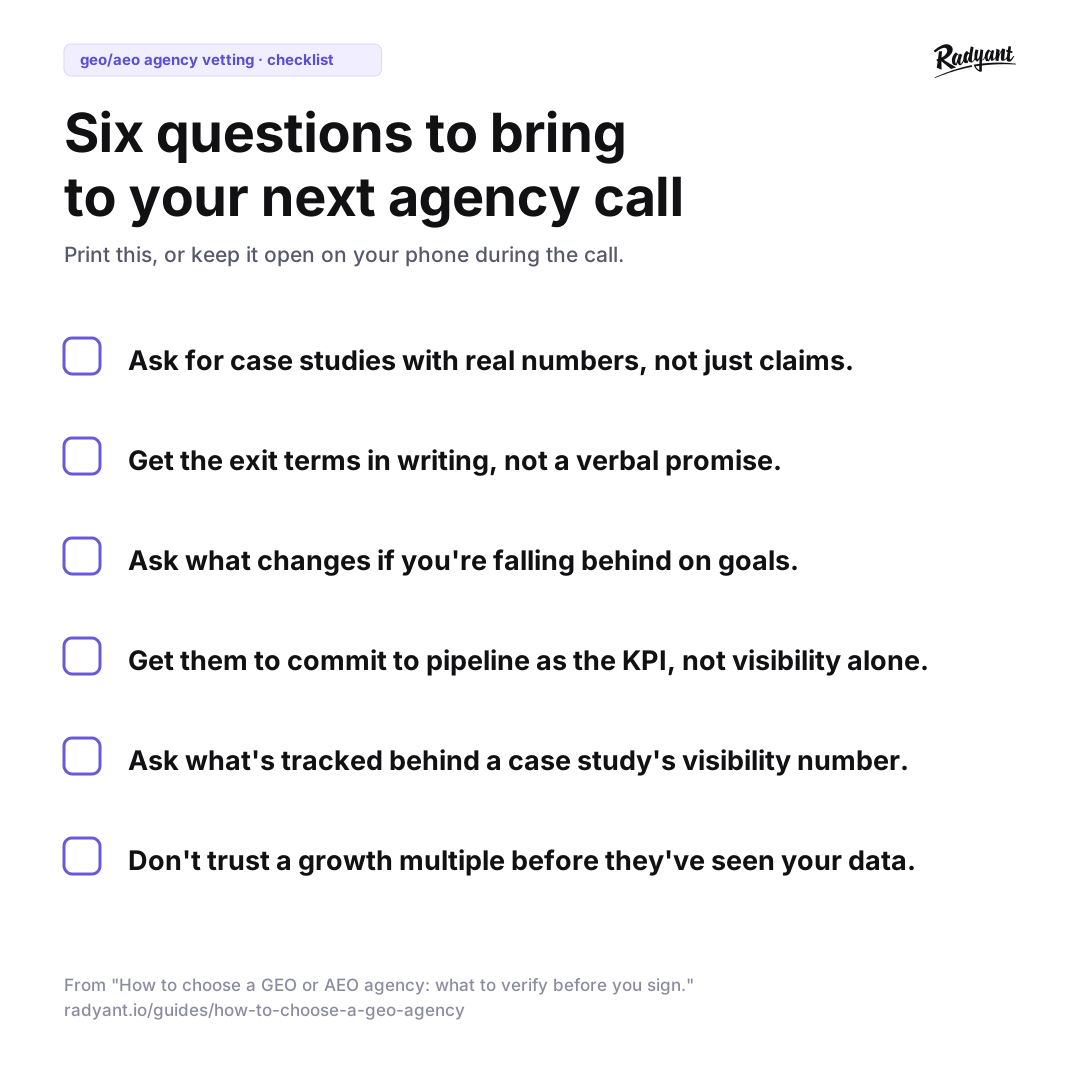
None of this is complicated. Ask for case studies with real numbers instead of a slide. Read the exit clause before the pitch. Ask what's behind the visibility number. And notice when a confident growth multiple shows up before anyone has looked at your actual account. Here's the same list as something to actually bring into the room.
FAQ
Is a 12-month contract normal for a GEO or AEO agency?
It's common, especially once an agency is set up to serve larger clients, but it's not universal enough to call a rule. Our own Growth Partnership runs 12 months with an opt-out after six. What matters more than the length is whether an exit exists at all, and whether it's written down before you sign.
How do I know if an agency's AI visibility numbers are real?
Ask which tool produced them and ask for case studies with the real numbers, not a screenshot. Then ask what's in the tracked prompt set behind the number. Visibility is calculated as a percentage of exactly those prompts, and a set that changed quarter to quarter can move the score without anything about your actual citations changing.
Should a GEO or AEO agency guarantee a ranking or a citation count?
No, and a guarantee is a reason for more scrutiny, not less. Nobody controls what an AI model decides to cite. A credible answer sounds like a target you set together and commit to reaching, not a number promised before they've seen your account.
What KPI should I actually hold a GEO or AEO agency to?
Qualified leads, pipeline, or revenue, with AI visibility and citations as supporting signals rather than the headline number. A raw lead count without a quality check doesn't tell you much, and an agency managing to visibility alone can hit that metric while your actual pipeline goes nowhere.
Does vetting an agency work the same way for a startup as it does for an enterprise?
The questions are the same, the pace and the stakes aren't. An enterprise buyer usually adds weeks for security review, data access and legal redlines, and should watch the seniority question closely, since larger engagements make it easier for an agency to staff senior for the pitch and junior for delivery. A founder or small team can grant access directly, so the same red flags need a sharper eye rather than a longer process.
Can I ask to talk to a current client before signing?
Yes, and you should. Hesitation, or an answer like "our clients prefer to stay private," is itself useful information. A short reference call with someone in a similar industry or company size tells you more than another round of slides.