 Add as preferred source on Google
AI engines read LinkedIn when they answer B2B buying questions, in the right vertical as their strongest community source. What gets cited is not what teams plan to publish.
Right now, in several of the accounts we run, someone has put LinkedIn articles on the AI visibility roadmap. Not posting for reach, which everyone already does. Articles, published deliberately, on the theory that AI engines will read them and start citing the company.
The theory is right in some verticals, and B2B software is where we noticed it ourselves. LinkedIn pages showed up in AI answers in every one of the nine client accounts we checked, and in the vertical where the written expertise most clearly lives there, compliance software, it beat YouTube and Reddit outright.
What the data also says is that the work most people plan is not the work that gets cited. So this is about how to tell whether LinkedIn matters in your vertical, and what to actually do if it does.
Key takeaways
- Whether LinkedIn is worth your time depends on your vertical. Across the nine B2B accounts we track it showed up in 1% to 8% of AI answers, and in compliance software it beat YouTube and Reddit.
- Most LinkedIn posts that get cited come from a personal account, not a company account. Our clients’ own company-page posts never took more than one citation each on category questions.
- For branded prompts, you should take good care of your company profile. It takes 68% of LinkedIn citations on branded questions and 2% on category questions, so never read the two as one number.
- LinkedIn runs its own product directory, and most teams never claim their entry. In one account that listing was the most retrieved LinkedIn page, on 385 retrievals. You get in by adding a product and picking a category.
- Your posts can get cited even though ChatGPT cannot open them. LinkedIn blocks the bots that fetch a page on request and allows the search crawlers, so pages reach answers through web search.
In the right vertical, LinkedIn moves AI answers
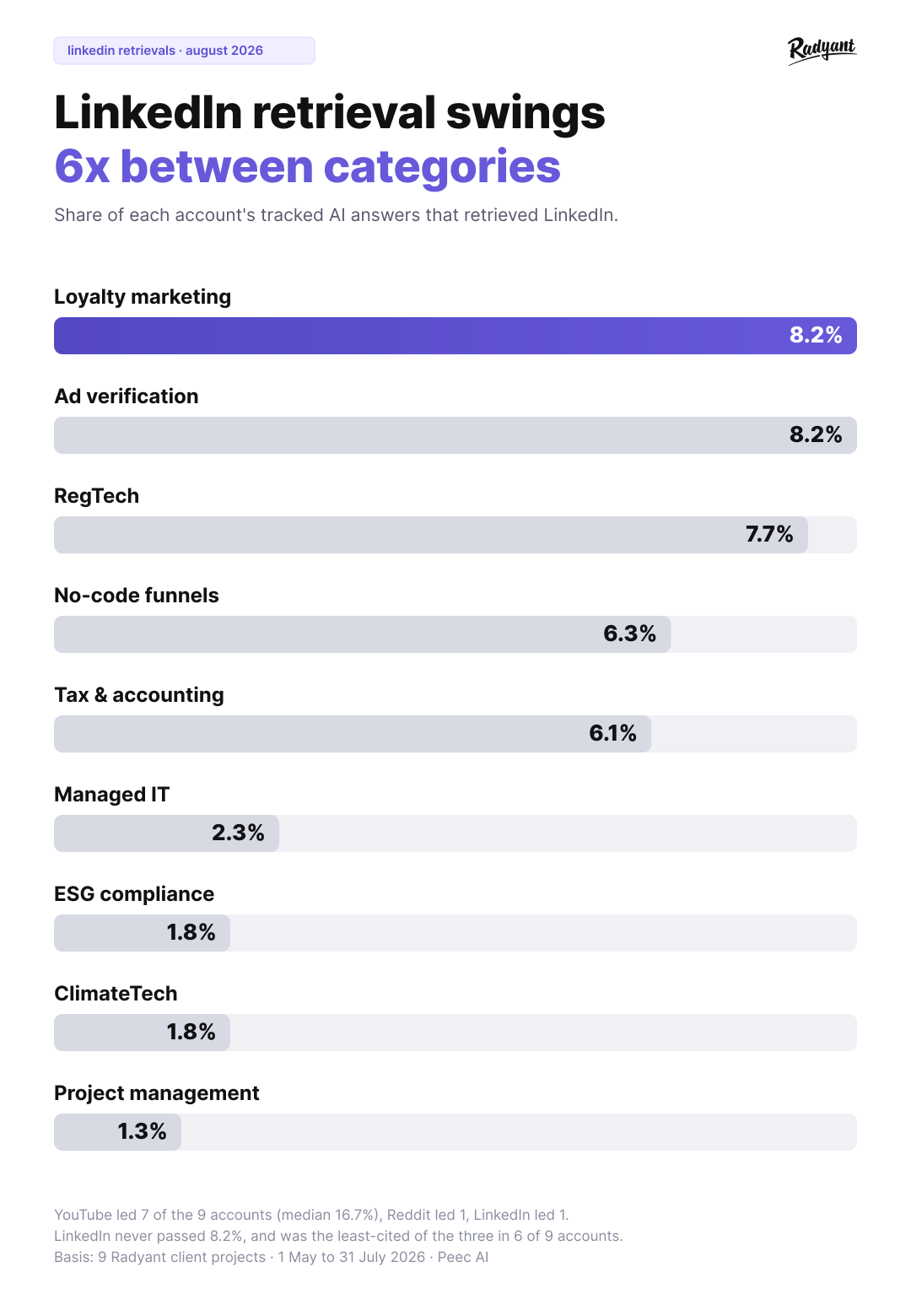
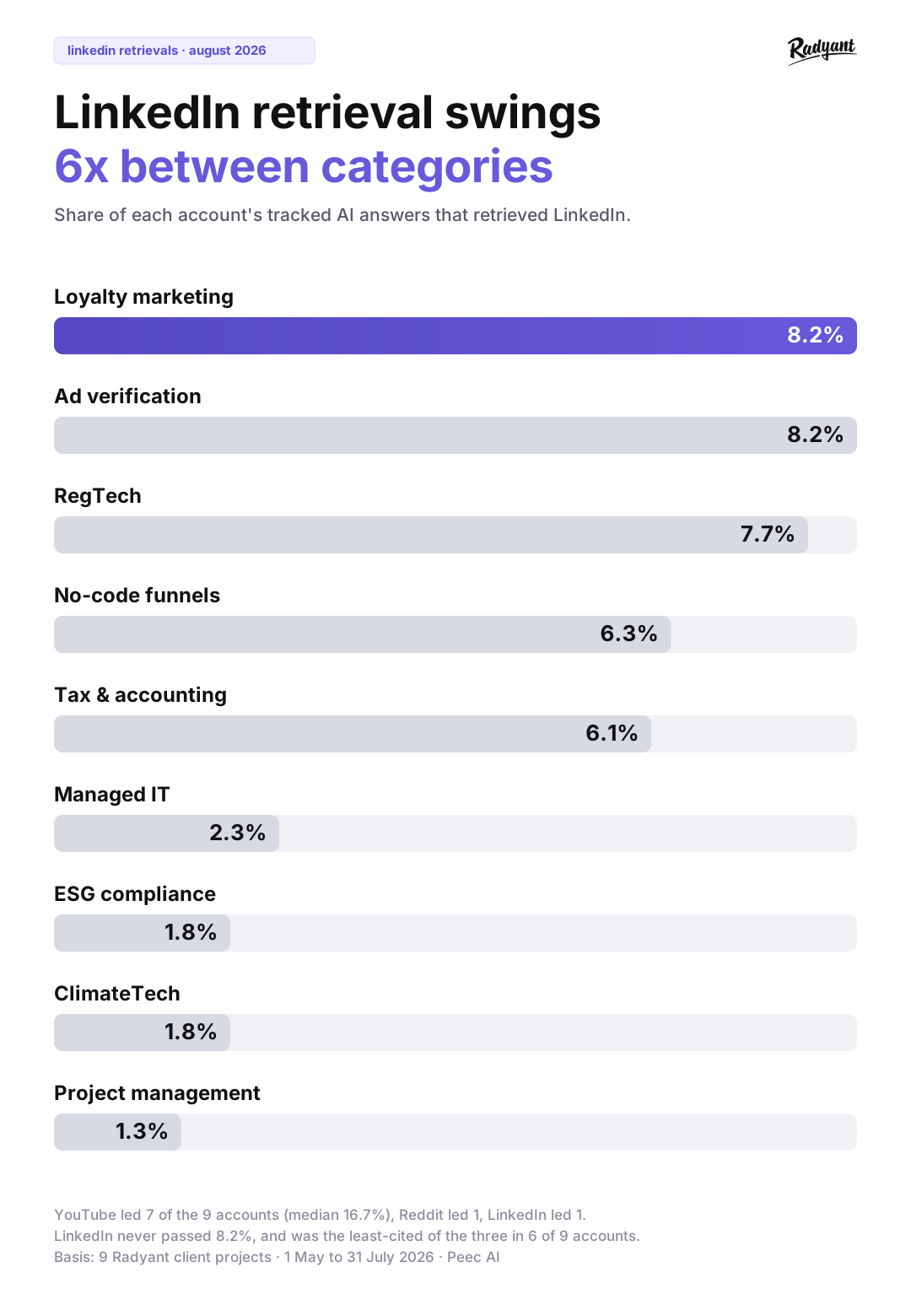
Nine client accounts, 1 May to 31 July 2026, tracked in Peec AI. We asked how often an AI answer pulled in a page from linkedin.com, and put that next to youtube.com and reddit.com so the number means something. Shares rather than raw counts, because we track far more answers for some accounts than others. Both measures are Peec's, and their definitions are public.
| Category | YouTube | ||
|---|---|---|---|
| Loyalty marketing | 8.2% | 12.1% | 4.6% |
| Ad verification | 8.2% | 11.2% | 18.4% |
| RegTech | 7.7% | 1.2% | 2.9% |
| No-code funnels | 6.3% | 21.3% | 11.7% |
| Tax & accounting | 6.1% | 18.5% | 5.5% |
| Managed IT | 2.3% | 24.4% | 14.0% |
| ESG compliance | 1.8% | 16.7% | 3.5% |
| ClimateTech | 1.8% | 22.6% | 3.9% |
| Project management | 1.3% | 10.8% | 6.9% |
The RegTech row stands out. That account sells compliance software to financial institutions, and LinkedIn reached 7.7% while YouTube managed 1.2%, the lowest video share in the set.
Our read is that LinkedIn benefits from how little video gets produced in that space. Almost nobody makes YouTube videos about financial compliance, while the expertise does get published, by named specialists, and they publish it on LinkedIn. Which channel works seems to follow where a vertical's expertise already ended up.
When LinkedIn is cited, it is cited hard
Averages hide this, so it's worth looking at single questions.
One account tracks a non-branded buying question: an MLRO at a mid-size European bank asking for a practical AML compliance checklist and which tools help. A LinkedIn Pulse article on the EU anti-money-laundering regulation answered it at 2.14 citations per retrieval, above the 1.70 Reddit averaged across our whole set, with posts by individual compliance practitioners alongside it.
Another tracks a question about ISO 20022 address cleanup after the CBPR+ deadline. More than a dozen different LinkedIn posts were cited on that one question over the three months, most of them written by individual practitioners. The strongest ran at 3.33 citations per retrieval, ten citations across three retrievals.
And on one branded question, asking whether the company's positioning holds up, the most-cited sources included five distinct LinkedIn URLs: the company profile in two regional variants, and three separate post URLs.
So LinkedIn is a specialist source. On the questions where your vertical's expertise lives there, it holds up against anything else we track.
Why UGC gets cited, and how LinkedIn gets in
Two different mechanisms are at work, and it's worth separating them.
The first is Google's own editorial policy, inherited. Google spent 2022 and 2023 deliberately tuning Search toward community content and first-hand accounts. It launched discussions and forums in September 2022 for queries that "benefit from the diverse personal experiences found in online discussions". It added Experience to E-A-T that December. Then in May 2023 it shipped a ranking change and said plainly: "You'll now see more pages that are based on first-hand experience, or are created by someone with deep knowledge in a given subject."
None of that was about AI. But Google's own guidance on AI features confirms there is no separate policy for AI Overviews or AI Mode: no extra requirements, no AI-specific files, no special structured data, just "a page must be indexed and eligible to be shown in Google Search with a snippet."
So Google's AI answers inherited the index, and with it two years of tuning toward first-hand experience. The other engines run their own indexes and their own deals, which is why the mix differs by engine, but every engine we track pulls user-generated sources into its answers.
The second is platform-specific, and for LinkedIn it is a crawler policy. LinkedIn blocks scrapers by default, which raises the obvious question of how any of it reaches an answer at all. Its robots.txt answers it, and the split is three ways rather than two:
| Crawler | What its vendor says it does | |
|---|---|---|
GPTBot, ClaudeBot, Google-Extended, CCBot | collect content for training models | blocked |
ChatGPT-User, Claude-User | fetch a page when a user asks about it | blocked |
OAI-SearchBot | "surface websites in search results in ChatGPT's search features" | allowed |
Claude-SearchBot | "navigates the web to improve search result quality" | allowed |
Googlebot, bingbot | index pages for search | allowed |
The vendors' own definitions are worth reading, from OpenAI and Anthropic, because the distinction is easy to get wrong.
Read across those rows and LinkedIn's position is precise. It has decided not to be training data, and not to be fetched on a user's instruction, while remaining in the indexes that AI Search features draw on. You can see the middle rule yourself, and we keep running into it: ask ChatGPT or Claude to open a LinkedIn URL and the fetch fails, while the same page still shows up among web-search sources.
So publishing on LinkedIn doesn't teach a model who you are. It puts a page where an engine can find it when somebody asks.
One thing to know before treating any of this as settled: it is recent and still moving. In archived copies of that file from July 2025, the search crawlers and Google-Extended were already named, but none of the OpenAI or Anthropic agents were; those fell under the blanket block. By January 2026 the named policy existed with OAI-SearchBot allowed and Claude-SearchBot still blocked. Claude-SearchBot has since been let in. LinkedIn appears to be onboarding AI Search vendors one at a time, so check the file yourself rather than trusting this table in six months.
Work out whether your vertical is one of them
This is measurable before you commit a quarter, and your own answer is worth more than our nine accounts.
Don't fall for the easy big analysis where millions of prompts are analyzed and Reddit is at the top of citations. If you look at your own industry, it might look completely different. It's not a necessity to win Reddit to become part of the AI answer.
Niklas Buschner, Founder & CEO at Radyant
Build a real prompt set rather than a keyword list. Ten to fifteen questions a buyer would actually type when they are close to choosing, written as sentences. Split them deliberately into branded prompts that name you and non-branded prompts that describe the problem, because those two behave completely differently and mixing them makes the result unreadable. Our prompt tracking guide covers how to write them and what to avoid.
Then run them and reverse-engineer the answers, which is the whole method. How often does linkedin.com show up at all? And when it does, what kind of page is it: posts, Pulse articles, product-directory listicles, or, on the branded half, your company profile? The share tells you whether LinkedIn deserves a place on your roadmap, and the page types tell you which of the workstreams below it should be. It is also what you re-run against later.
What we have noticed across accounts, as tendencies rather than rules: LinkedIn seems to do best where little video gets produced, where the expertise sits with named professionals, and where buyers are choosing people as much as products. Where a mature YouTube corpus or an active subreddit already owns a category's answers, LinkedIn shows up thinner. Your own answers beat our tendencies, which is why the prompt set comes first.
We ran the same test on ourselves
We are an agency, so our own list puts LinkedIn in play: nobody makes video about organic growth consultancies, and our buyers are choosing people.
LinkedIn is the most retrieved source we do not own: 947 retrievals against Reddit's 607 and YouTube's 516. Generic advice would have sent us to video first. We hand out that advice ourselves, we wrote a whole YouTube framework, and for us it would have been wrong.
You can see it at the level of a single answer too. One of our tracked non-branded questions asks what kind of content it takes for a B2B company to appear regularly in AI answers. Google's AI Mode answered it citing 20 sources, and six of them were LinkedIn URLs: three member posts, two Pulse articles, and one of LinkedIn's own content pages.
Branded and non-branded prompts need different work
Most LinkedIn plans go wrong here: the two prompt types pull completely different pages.
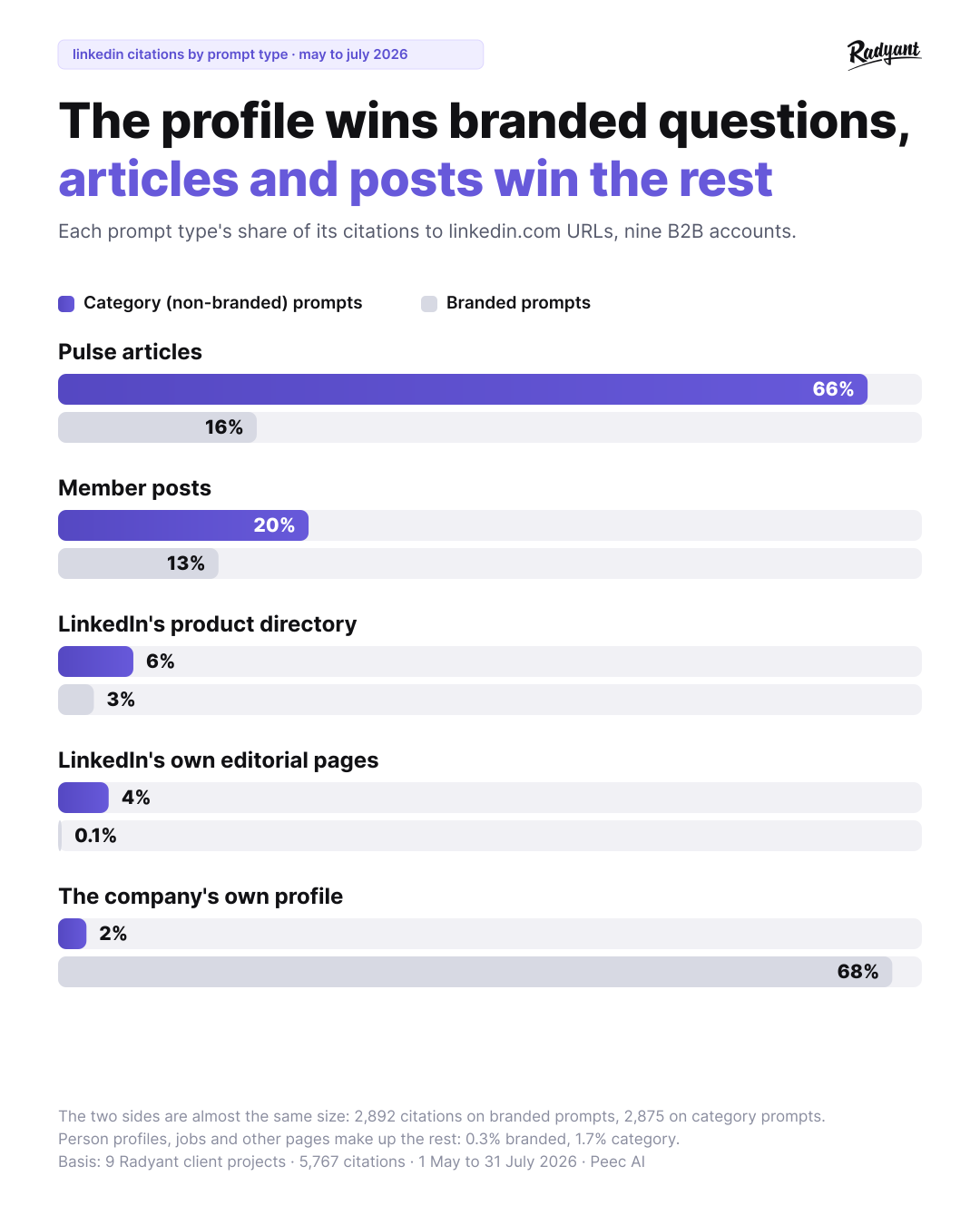
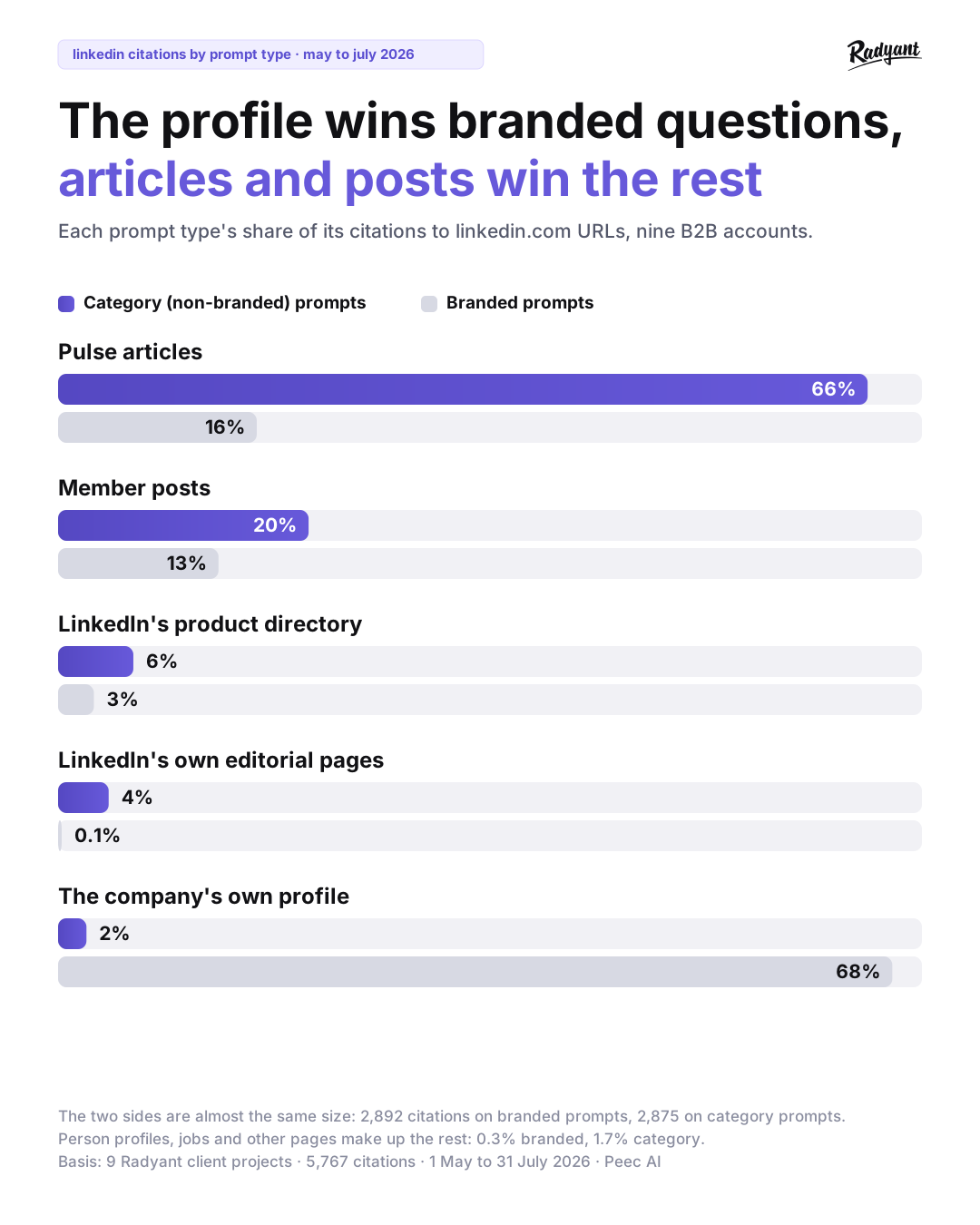
Split the citations by prompt type and the two halves invert: on category questions, articles and posts take 86% of LinkedIn citations and the company profile takes 2%. On branded questions the profile alone takes 68%.
Branded prompts: your profile is the answer, so make it the right one
Your company profile is the top retrieved LinkedIn page in four of the nine accounts, cited at up to 1.84 citations per retrieval at the account level.
It is also retrieved almost entirely on branded questions. In one account, three branded prompts accounted for 90% of its profile retrievals, every one naming the company. In another, a single branded prompt asking what the engine knows about the company drew nine in ten of them.
Ours behaves the same way. Ask an engine what it knows about Radyant, and the answer leans on the profile:
So the profile does almost no discovery work. What it does is decide what an engine says about you once somebody asks by name, which makes it a perception job rather than a visibility one. Most B2B company pages are a logo, a tagline and an industry tag. Write the description like a product page: what you do, who for, what makes you different, in the words your buyers use. Then ask the branded prompts again and check two things: whether the facts match, and whether the sentiment is right. An engine that describes you accurately but lukewarmly is still a perception problem, and the profile is the page you control that feeds it.
Non-branded prompts: posts, Pulse articles, and a directory nobody knows about
On category questions, three things get retrieved.
Other people's posts and Pulse articles. Someone else's post was the top LinkedIn page in four of the nine accounts, including one comparison of ten platforms that pulled 713 retrievals on its own. Finding who writes those in your category and making sure they have current information about you is outreach work, not a content calendar.
Your own posts and Pulse articles, which is the part you control. More on that below.
LinkedIn's own product directory, which most teams don't know exists. One account's top LinkedIn page was the linkedin.com/products/categories/ listing for "Best Click Fraud Software", on 385 retrievals. It behaves like a category listicle you happen to be allowed to edit.
Getting into one is a documented process rather than a favour. A Page super admin or content admin adds a Product Page from the Page's admin view, and LinkedIn reviews it before it publishes. Two things decide whether you can do it at all. Product Pages only exist for Pages in certain industries: B2B software, computer hardware, financial services, insurance, education, healthcare and pharmaceuticals. And a category is mandatory, so the page will not be approved with the field left blank. That category field is what puts you in the listing. You can create up to 35 products, though only the ten most recent show on your Page.
What decides the order inside a category is not documented, so treat this as a read rather than a rule. Comparing the top entry in a category against one sitting fourteenth, the difference that shows on the page is completeness: the top entry carried ten featured customers, ten intended roles, filled pricing, media, and a "top rated features" block that LinkedIn builds from G2 reviews. The lower one had customers, roles and media, but no pricing and no G2-derived features. Vendors with several product pages also occupy several slots, which is one reason a single category listing can show the same company three times.
Two things argue against reading the order as a quality ranking. One category we checked had products labelled "Retail POS Systems" sitting inside a form-builder listing, so the categorisation itself is loose. And the established vendors lead, which is what you would expect if company size or page following carries weight. Fill the entry out properly because an engine reads the page, not because a fuller profile is a proven ranking factor.
Post from people, not from the brand account
Nobody can guarantee that posting under your own name gets you cited. What our data shows is a heavy tilt that way: on category questions across the nine accounts, most of the citations to LinkedIn posts went to posts by named people, and our clients' own company-page posts never collected more than a single citation each.
The contrast inside a single account makes it concrete. A practitioner writing about a specific technical problem under their own name hit 3.33 citations per retrieval; the same account's own company-page posts took a single citation at most. Same platform, same account. The difference is who is speaking and whether they are answering a question.
That changes who owns this internally. It is a founder-and-expert motion rather than something the social team runs. Your best asset is the person who can explain the hard part of your category, writing under their own name.
The cheap way to do it: repurpose what you already published
You almost certainly have the substance already. A guide, a case write-up, a piece of documentation. The work isn't new thinking, it's putting the same thinking where the non-branded questions land, in a voice that reads like a person.
A free tool that does the mechanical half
Give it a LinkedIn profile and the URL of something you have already published. It reads that profile's recent posts to learn how the person writes, then drafts a feed post and a Pulse article in their voice.
Turn a page you already published into a LinkedIn post and article
We read the last 20 posts on a profile to learn how that person writes, then rewrite your page in that voice. Two drafts, ready to paste.
Two things worth saying about it. It writes a draft, not a finished post, and it goes out under a real person's name, so read it first. And if the page you are repurposing contains someone else's client results, keep them theirs. The tool flags phrases like "one client" for that reason: a number that was true for the original publisher becomes a false claim the moment it appears under your byline.
If you write from scratch instead, write so a claim can be lifted out. A real title rather than a hook, the answer near the top, and the number or comparison that makes it quotable. There is research behind this too: the GEO paper from Princeton and Georgia Tech, published at KDD 2024, moved visibility in generative engines by up to 40% by changing how a passage was written rather than what it was about.
And publish the substance on your own domain as well, because that's where a citation can turn into a visit.
Then check whether it moved
Re-run the same prompt set after a few weeks, reading for consistency rather than any single answer, because the same prompt can cite you one day and miss you the next. Then read the two halves separately. On branded prompts you are looking for the description to change, which is a perception result. On non-branded prompts you are looking for your pages or your people to appear at all, which is a visibility result.
Neither of those is pipeline, and neither should be reported as if it were. Turning citations into something a board recognises is a separate problem, and we wrote up how we do it in proving AI Search drives pipeline.
What we can and cannot say from this
Nine accounts is enough to show that the answer changes by vertical, which is the claim we are making. It's not a benchmark for B2B generally.
The window is three months. Shares move, and the RegTech account's missing video corpus could be filled by someone next year.
Every number here is shaped by the prompt sets we happen to track. That's the whole reason the branded and non-branded split runs through this piece, and it is the first thing to get right on your own data.
What we are confident about: LinkedIn is a specialist channel rather than a weak one. Where a vertical's expertise is published there, it is cited as hard as anything we track. Where video or forums own the category, LinkedIn articles will not change much.
Where that leaves the decision
The mistake is not choosing LinkedIn. It is choosing any channel before looking at your own answers, and then doing the generic version of the work.
Nine accounts produced three different winners. Generic advice would have sent all nine to YouTube. For seven, that would have been right. For the other two it fails: the ad-verification account belongs on Reddit, and the RegTech account would have been pointed at the one channel that barely exists in its category. Even in the accounts where LinkedIn is the answer, the default plan of publishing company articles from the brand page is the one thing the data never rewards.
If you want that prompt set built properly, with your competitor set alongside it, that is a first audit. Run a free audit or book a meeting and we will pull the table with you.
FAQ
Do LinkedIn articles help AI Search visibility?
In some verticals, clearly yes. LinkedIn appeared in AI answers in every one of the nine B2B accounts we tracked, at 1.3% to 8.2% of tracked answers, and in the strongest vertical it out-ran both YouTube and Reddit. On individual non-branded questions we saw LinkedIn pages cited at 2.14 and 3.33 citations per retrieval, above Reddit's average. What decides it is your vertical, so check yours before committing a quarter.
What is the difference between branded and non-branded prompts here?
Branded prompts name you, and they retrieve your company profile almost every time. That is a perception job: it decides how an engine describes you. Non-branded prompts describe a problem, and they retrieve posts, Pulse articles and LinkedIn's product directory. That is the discovery job. Mixing the two in one dashboard makes your profile look like your best asset whether or not it is helping you.
Should we post from the company page or from people?
From people, for the category questions. Across our nine client accounts, most citations to LinkedIn posts on non-branded questions went to posts by named individuals, and our clients' own company-page posts never took more than one citation each, while a practitioner writing about a specific technical problem reached 3.33 citations per retrieval. On branded questions the company's own profile and posts do get cited, which is the other half of the split above.
What is a LinkedIn Products directory page?
LinkedIn maintains category listings at linkedin.com/products/categories/, such as "Best Click Fraud Software". They behave like a listicle you are allowed to edit. In one of our accounts that page was the single most retrieved LinkedIn URL, on 385 retrievals. Claim your product entry and fill it in properly.
Do we have to write new content for this?
Usually not. Most teams already have the substance on their own site and simply have not put it where the non-branded questions land. Repurposing an existing page into a Pulse article and a post is the cheapest version, which is what the tool above does. Review the draft before publishing, and do not let another publisher's client results turn into yours.
Our category has no video at all. Where do we start?
That is the clearest case for LinkedIn in our data, and it was exactly the RegTech account's situation. It also means the video gap in your category is unclaimed, which is slower to fill but harder for anyone to take from you. Doing both is reasonable: LinkedIn now because the channel exists, video later because nobody has taken it. Our YouTube framework covers the second half.