 Add as preferred source on Google
Size doesn't decide who ChatGPT names in your category. What actually does, and a 30-minute way to check your own gap against real competitors.
It is one of the highest-volume questions we see buyers put to AI tools in our own tracked prompt set: their brand ranks well on Google, and a smaller competitor keeps getting named in ChatGPT instead.
It isn't about size. Google ranking is driven by a combination of content relevance, technical site quality, and off-site authority signals like backlinks. Getting named by an AI answer engine works differently. What matters is how many of the pages a model actually cites are about you and only you, versus you plus five competitors in a list.
A brand can score high on one and low on the other, and that gap is what lets a smaller competitor get named instead of you.
Key takeaways
- Being bigger, older, or better-funded is not what gets you named. A study spanning six AI models and 252,000 trials stripped brand names out entirely, and topical relevance and depth still drove which source got cited first.
- A comparison page that names ten brands cannot give any one of them full credit. Being cited alongside nine other names is real visibility, and a much smaller share of the credit than a page naming only you.
- Comparison and listicle pages are among the most-cited content in every category we track. They are worth having, and they are not enough on their own.
- The same competitor can beat you in Google AI Overviews and lose to you in ChatGPT. Each model weighs the signals differently, so check the surfaces separately before you conclude anything.
- Pair the pages that name many brands with narrower pages that name only you. The narrow page is what converts a shared citation into credit you keep.
The symptom: you rank #1 on Google, but ChatGPT doesn't know you exist
Backlinks remain an important Google ranking signal (how many other sites point to yours, how relevant they are, and how long they've pointed there), alongside relevance, content quality, technical accessibility, and many query-specific factors.
AI answer engines like ChatGPT, Gemini, and Google's AI Overviews work from a different signal set. They retrieve a handful of candidate sources for a given question and decide, in that specific moment, which ones to cite. That decision runs on entity-based authority: how clearly a system can identify what your brand is, what it does, and whether independent sources agree on the details.
The two systems are related. A site with strong Google rankings often has some of the ingredients for this too. But they aren't the same measurement, and a brand can score high on one while scoring low on the other.
Citation is decided per question, not per brand
People search for an explanation of this in different ways: why a competitor's brand appears in ChatGPT's answers when yours doesn't, often described as an entity bias in how the model picks sources rather than a classic SEO ranking problem, why LLMs recommend a competitor instead of a bigger, better-known brand, or simply as a ChatGPT SEO problem where one competitor always gets mentioned. A smaller competitor mentioned instead of a larger brand comes down to the same LLM search ranking reasons in every case: citation gets decided per question, not handed out as a permanent ranking.
It isn't that AI Search dislikes you. Visibility in an AI answer is a competitive question, not an absolute one. For any given prompt, the model compares a handful of candidate sources against each other and chooses who to cite. Your competitor doesn't need to be more famous, larger, or better funded to win that comparison. They just need to look like the stronger answer to that specific question, for that specific model, at that specific moment.
Why don't size and backlinks decide who gets cited?
Most explanations lean on a version of the same claim: your competitor built more third-party signals than you did, so go build more signals. That's directionally useful, but it treats correlation from unverified marketing pages as if it were proof. A more rigorous answer comes from a controlled citation-preference study spanning six large language models: researchers ran 252,000 trials, stripped out brand identity on purpose, and isolated 18 distinct content factors one at a time to see which ones actually change whether a source gets cited first.
The headline finding: relevance beats brand identity
The design is what makes the result useful here. Topical relevance and list position, how tightly a piece answers the exact question asked, and where it sits among the retrieved candidates, were the biggest measured drivers of getting cited first. With brand identity stripped out of the test entirely, content factors like relevance and depth were what moved citation odds. A well-known name doesn't buy a seat at the table if a smaller, more specific answer sits right next to it.
Getting cited first doesn't automatically mean getting recommended. The study measures which source a model pulls in first, not which brand it ends up naming.
What actually moves citation odds
Two content-level factors mattered most beyond relevance itself, with a recent timestamp or a listed price adding smaller gains:
| Factor tested | Effect on citation odds |
|---|---|
| Confident language vs. hedged language | Odds ratio roughly 2.7 to 754 across models |
| Deep, comprehensive coverage vs. shallow coverage | Odds ratio roughly 4 to over 10,000 across models |
| Headers and bullet lists vs. dense paragraphs | Weak, sometimes negligible effect; several models showed no meaningful lift |
Confident language means stating a fact plainly instead of hedging it, and the difference in citation odds was large and consistent across every model tested. Deep, comprehensive coverage showed an even bigger effect: content that actually answers the full question, not just the surface of it, was dramatically more likely to get cited than a shallow treatment of the same topic.
Formatting, on its own, barely moved the needle. That directly contradicts a large share of the generic "add headers and bullet points" advice circulating online. Structure your content clearly because it helps human readers. Don't mistake it for the lever that closes a citation gap.
How to check this on your own domain, in 30 minutes
- Write down the 5 to 10 questions your actual buyers ask before they buy in your category. Not brand questions ("who is [you]"), category questions ("best tool for X," "how do I solve Y").
- Run each one in ChatGPT, Perplexity, Gemini, Claude, and whatever else your buyers actually use. Record every URL each answer cites, whether or not you're the one it names.
- Open every page that isn't yours and count how many other brands it names by name.
- Sort what you find into two piles. Pages that name only your competitor mean you have a gap to fill with a narrow page of your own. Pages that name your competitor alongside four or five others, sometimes including you, mean you have a credit-dilution problem, and a narrower page beats a bigger one.
- If your own page is already on the list of cited sources and it names five or more competitors, fix that one first. Pages built narrow, naming you and at most a rival or two, keep more of the credit from each citation. That is the pattern across the accounts we track rather than a before-and-after test of narrowing a page you already have.
What you're really measuring here is not how big or well known your company is, but how often the pages that get cited in your category name you and only you. A company can have high domain authority in the classic SEO sense (backlinks, age, traffic) and still lose these answers, if everything that ranks about it also ranks about four competitors in the same breath. The 30-minute test above is a rough way to measure your own.
We see this constantly in German-language answers for category questions: one question, one answer, five different tools named off the same handful of shared sources. Every one of them splits the credit for that citation.
| Situation | What it looks like | The fix |
|---|---|---|
| No page at all | Your domain doesn't appear in any cited source for the question | Write the narrow page. Anything beats nothing here. |
| A shared page cites you | A competitor's or a third party's comparison names you alongside 3+ others | Lower priority. You're getting partial credit already. |
| Your own page dilutes you | Your highest-cited page names 5+ competitors | Fix this first. Narrow it, or split it into single-competitor pages. |
| Your own narrow page already wins | Your page is cited and names mostly you | Protect it. Keep it updated, don't broaden it "for completeness." |
Why does the same competitor beat you on one model and not another?
AI models don't weigh the same signals the same way. Some are highly sensitive to how the person asking frames their own role, others barely react to it at all.
Radyant tested this directly. Across 17,929 chat responses tracked over eight buyer personas and five AI models in our own persona study, adding a simple role declaration, such as "I'm Head of Growth" or "I'm CTO," changed which brands got recommended by as much as 24 percentage points for a single brand on a single model.
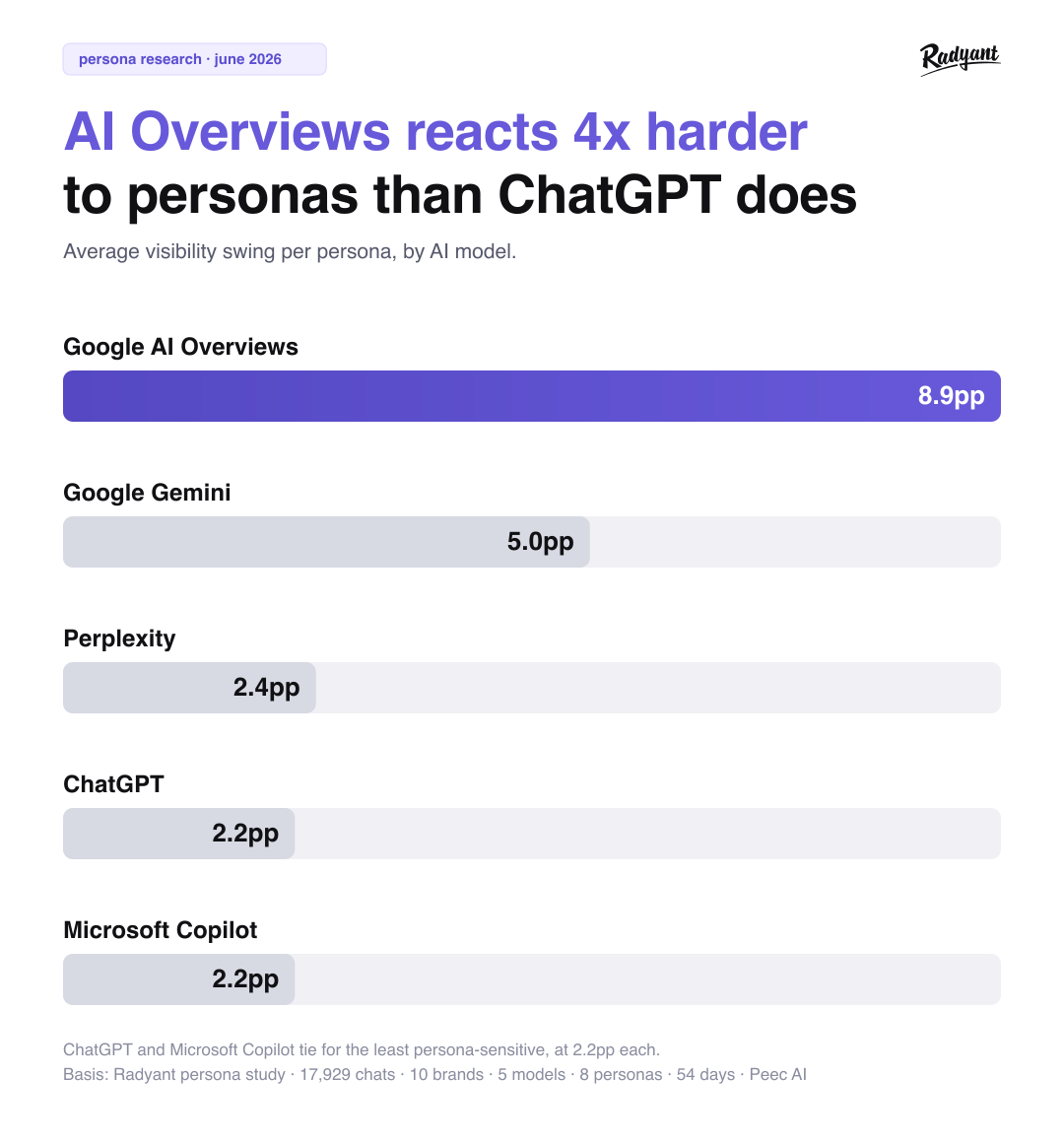
Google AI Overviews was the most sensitive platform in the study, moving by an average of 8.9 percentage points per persona, about four times the average movement seen on ChatGPT, which shifted by an average of 2.2 percentage points and mostly redistributed visibility across brands rather than narrowing the field.
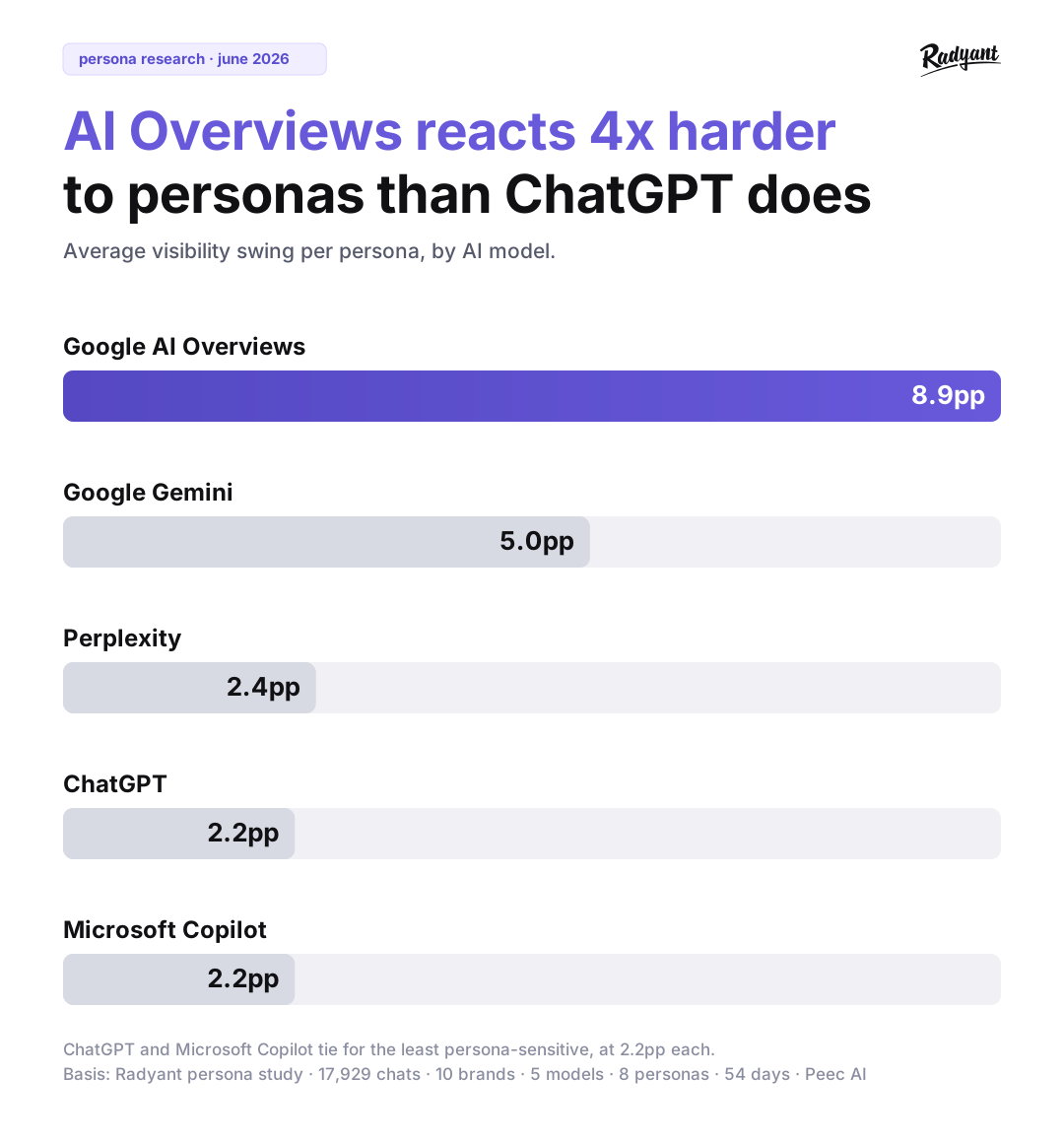
This means "why does my competitor keep beating me" rarely has one answer across every platform. You might be losing on Google AI Overviews for a persona-specific reason, a buyer role your content doesn't speak to directly, while losing to a completely different competitor on ChatGPT for a topical-relevance reason. The cause changes depending on which model and which persona you're checking. Treating AI-search visibility as one undifferentiated score hides exactly the distinction that would tell you what to fix first.
The fix: owned, earned and UGC working together, not one lever
Search this exact problem and you'll find dozens of answers, and most crown a single lever as the fix: get more reviews, get on more comparison lists, fix your formatting, get into Wikipedia. Some list several of these side by side. What none of them show is how the levers work together, so you're left holding a checklist instead of a system.
Owned content is the foundation
Owned content, the depth and confidence factors covered above, is the foundation, and it's more powerful on its own than most of that advice assumes. With Planeco Building the owned-content work was built from structured expert interviews, deep rather than surface-level, and their AI Search citation rate moved from 55% to over 110% inside 10 months. Their 5x lead growth over the same period also reflects the interactive lead magnets and the programmatic cluster, so read it as the engagement's result rather than owned depth's alone.
Earned mentions and UGC compound it, they don't replace it
Earned mentions and user-generated content, reviews, comparison articles, community threads, still matter on top of that foundation, and the persona-sensitivity finding above shows why: a platform like Google AI Overviews leans harder on external corroboration when your own content doesn't speak directly to the buyer role asking. No single lever replaces the others. They compound.
Real category visibility runs all three at once
This isn't an argument for writing narrow content and calling it done, either. The accounts we see holding real category visibility are running all three at once: pages they own that name themselves first, third-party sources that mention them without being asked, and enough presence on the forums and comparison sites buyers actually read before they type into ChatGPT. A single narrow page fixes one gap. It doesn't replace having no pages in the category at all, or having no presence anywhere else buyers look.
It's the same system we run on our own AI-search presence: pages that name Radyant first for the categories we want to own, mentions on other sites we pursue deliberately instead of hoping for, and a deliberate presence on the comparison and community pages our own buyers read before they ask ChatGPT anything. None of the three carries the other two.
If you want the full system for choosing which questions to track before you go looking for gaps like these, we wrote that up separately: Prompt tracking for AI Search. And if you're behind because top-10 Google rankings used to be enough and now aren't, that's a related but different problem: How to get cited in AI Overviews and ChatGPT.
FAQ
Does company size affect AI Search visibility at all?
Not directly, based on what we've tracked. We've seen well-funded, well-known companies lose category visibility to low-profile competitors, and small companies lose to larger ones, often in the same account. What predicts the outcome is which pages get cited and how many other brands those pages name, not headcount or funding.
If a competitor's page mentions us too, does that help our visibility?
A little, but less than owning a page that names only you. When one page names ten brands, an AI model citing it can mention any subset of those ten in a given answer. Being one of ten is real, but it's a much smaller share of the credit than being the only name on the page.
Should we stop writing comparison pages that mention competitors?
No. Comparison pages get cited a lot, sometimes more than any other page in a category, based on what we've measured. The fix isn't dropping them, it's checking how many competitors each one names and whether a narrower version, or a set of single-competitor pages, would concentrate more of that credit on you.
How do we find out which pages AI models are citing in our category?
Run your real buyer questions, not brand questions, through ChatGPT, Gemini, Perplexity, Claude, and any other model your buyers actually use, and record every URL each answer cites. Doing this consistently across a real prompt set is what prompt tracking is for.
Why does ChatGPT recommend competitors in answers?
Because the model is picking a citation for one specific question, not endorsing a brand permanently. If a competitor's page answers that exact question more directly, or covers it in more depth, it can get cited even if your brand is larger or better known overall.