
 Add as preferred source on Google
How n8n wins searches that never mention its name: a category page, an open forum, 13,600 templates and pages for other products, plus what AI Search cites.
n8n started in Berlin in 2019 as a workflow automation tool you could host yourself. In May 2026, SAP bought into the company at a valuation of $5.2 billion, and n8n says 1.7 million people build with it every month.
A company that well known gets most of its Google traffic from people who already type its name. That part is true of every famous brand, and you cannot copy it. So in this breakdown we left it out. We looked at everything else: the searches that never mention n8n, and what ChatGPT, Perplexity and Google's AI Overviews answer when buyers ask about automation tools.
To check it, Radyant pulled n8n's top 1,000 pages and top 1,000 keywords from DataForSEO. We tracked 25 buyer questions per market in Peec AI for a week, in the US and in Germany. And we checked which pages Google's AI Overviews cite for n8n across thousands of searches. What came out are four levers you can copy, and one shift in AI Search that n8n has not answered yet.
Key takeaways
- A page named after the category brings n8n more non-branded traffic than any other page.
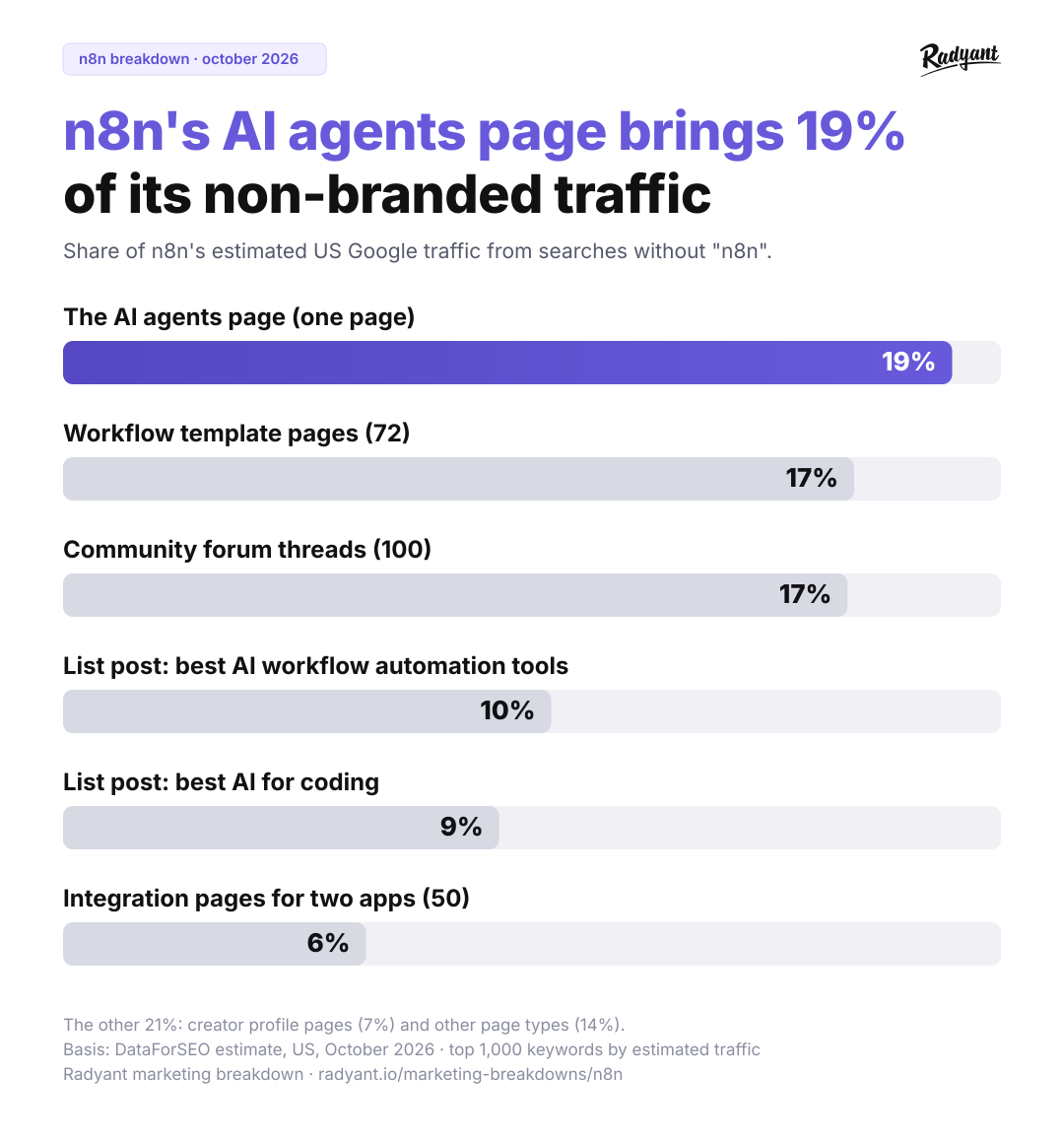
/ai-agents/alone takes about 19% of the Google traffic that does not come from searches for "n8n". - n8n's open community forum works like a long-tail content team. Threads written by users bring about 17% of n8n's non-branded traffic, and Google's AI Overviews cite them for 410 searches.
- n8n's 13,600 user-built templates show up in Google and even more in AI answers. They bring about 17% of its non-branded traffic, and in the US they get 37% of the citations AI answers give n8n's own pages.
- About a fifth of n8n's non-branded traffic comes from searches for other products. Integration pages like "Google Drive and Claude" catch people who look for the tools they already use.
- In AI Search, n8n gets named more than it gets cited. About 95% of the sources behind AI answers about its category are other sites. Its own "best tools" lists stopped being cited in AI Overviews this summer.
What does n8n's search footprint look like?
All Google traffic figures in this piece are DataForSEO estimates for the US in October 2026, not n8n's own numbers. The AI Search figures come from one week of tracked answers, 14 to 21 October 2026.
The homepage shows where n8n puts its weight. It leads with agents, not with workflow automation, and it opens with a prompt box rather than a feature list.
| What | Number | Source |
|---|---|---|
| Valuation | $5.2 billion (SAP investment, May 2026) | n8n, Bloomberg, Handelsblatt |
| Monthly active builders | 1.7 million | n8n, May 2026 |
| Workflow templates | 13,655 | n8n.io/workflows, 21 October 2026 |
| Referring domains | 29,146 | DataForSEO, October 2026 |
| Share of estimated Google traffic from searches without "n8n" | about 22% | DataForSEO estimate, US, October 2026 |
| Share of generic searches that show an AI Overview | 98% | DataForSEO, US, October 2026 |
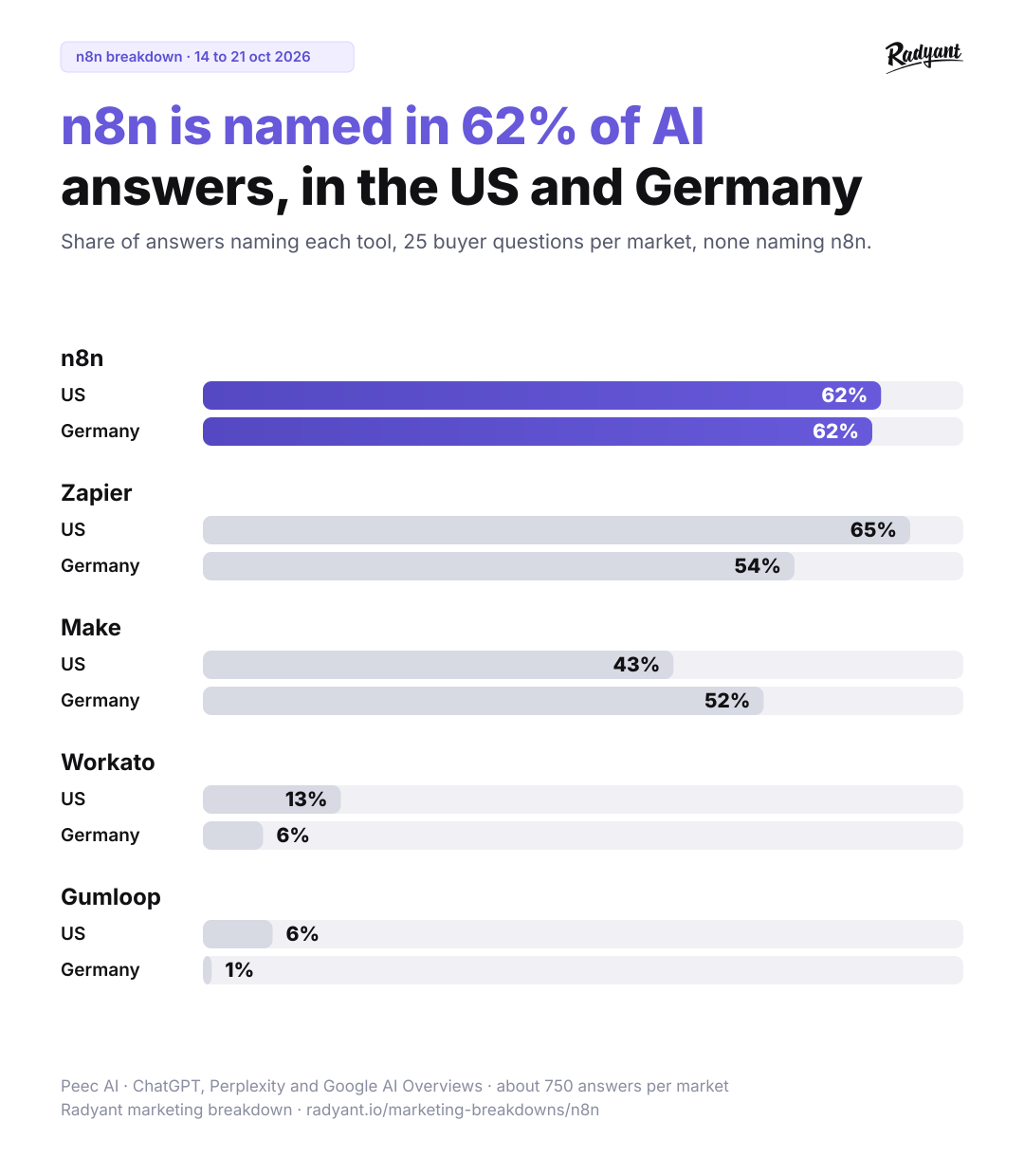
| Visibility in AI answers, US / Germany | 62% / 62% | Peec AI, 25 prompts per market, 14 to 21 Oct 2026 |
We also wanted to know which pages bring n8n traffic from people who have not searched for n8n.
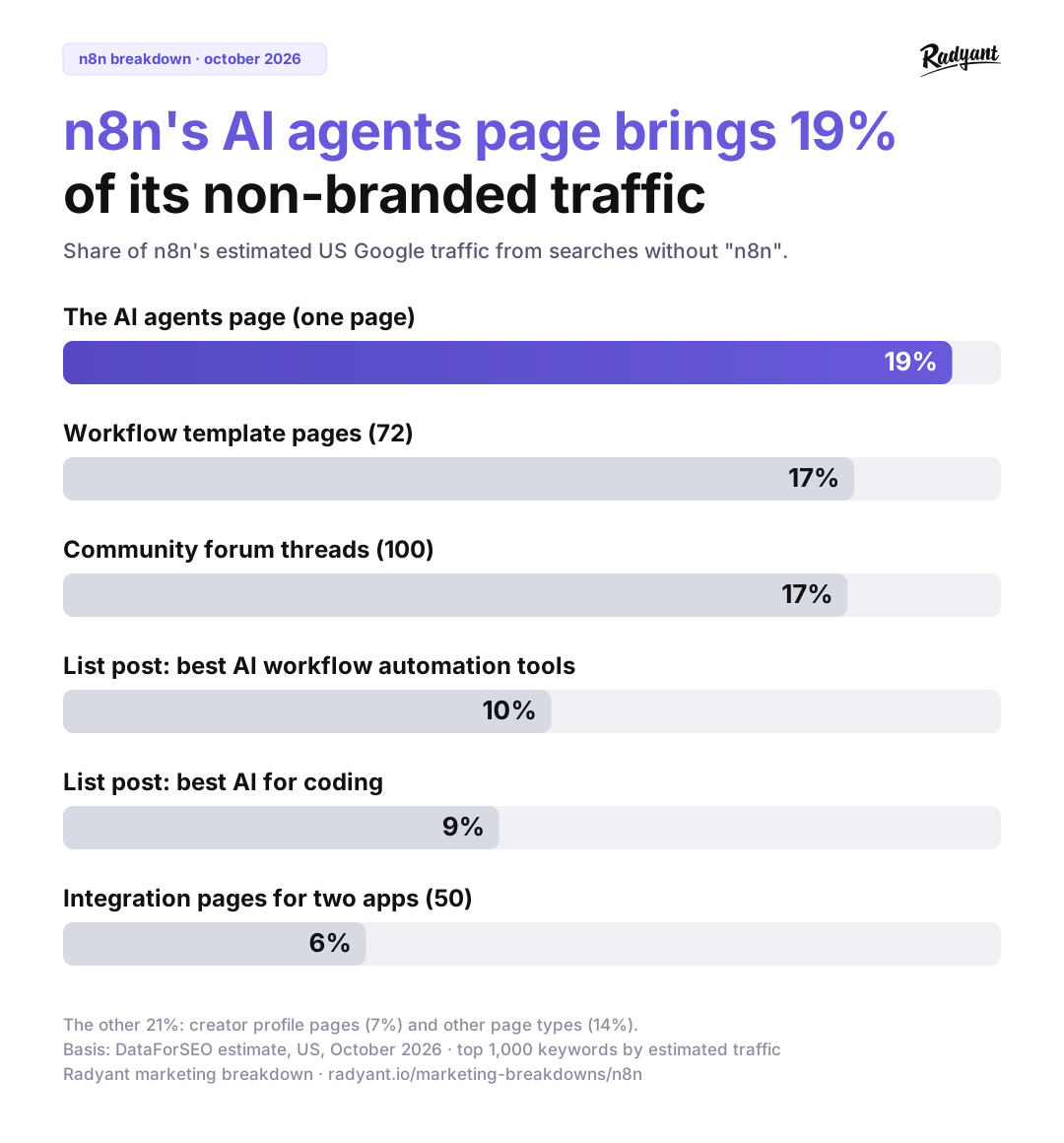
Three of the four levers below are on this chart: the AI agents page, the templates and the forum. The fourth, pages that catch searches for other products, runs across several of these page types. The two list posts come back later, in the AI Search section.
Why does a page called "AI agents" bring n8n so much traffic?
Our first lever is the simplest one. n8n has a page at n8n.io/ai-agents/, and it brings about 19% of all the Google traffic n8n gets from searches that do not contain its name. No other single page comes close.
In DataForSEO's data it ranks second for "ai agent builder" and second for "no code ai agents". It ranks seventh for "ai agent", a term with about 49,500 searches a month in the US. In our live check of 20 AI Overviews on 21 October, it was also the only n8n page that was both named and cited, for "ai agent builder".
The page itself is a product page, not an article. Its headline asks "Agent, workflow, or both?", and below it come template cards, a video, an enterprise section and a section called "But can't I just build in a coding agent?". The exact phrase "AI agent builder" does not appear on the page; "Agent Builder" shows up once, inside a collapsed FAQ answer. So it looks like the clean URL and the authority of the domain do much of the work here.
What we would do differently. We would write the page in the words people search with. We would add a short section that answers "What is an AI agent builder, and when do you need one?". That gives Google and AI Search interfaces like ChatGPT a passage they can quote. We would also fix the numbers: this page says "9,000+ community-built templates" (on 21 October it said "7500+") while the template library says more than 13,600.
Steal this. Find the category noun your buyers search for, the one your product is an answer to, and give it its own page with its own URL. Not a blog post about it, a product page named after it.
How does a forum thread from 2022 still bring traffic in 2026?
The second lever is n8n's community forum at community.n8n.io. It is open, indexable, and full of questions users asked each other. In the top 1,000 pages by estimated traffic, 442 are forum threads. In the keyword data, forum threads bring about 17% of n8n's non-branded traffic in the US.
A good example: a feature request from September 2022 asking for the European date format, DD.MM.YYYY, in one dropdown. It has ten replies, one link to the docs, and it ranks fourth for "eu date format". That is not a page a content team would put on its plan.
The forum matters even more in AI Overviews. Take all the searches without "n8n" in them where Google's AI Overviews cite an n8n page. Forum threads are cited for 410 of them, more than any other n8n page type.
It looks like forums work because they hold the exact wording of real problems, including the odd ones no keyword tool lists. When someone asks Google or an AI the same question later, the thread is the closest match there is.
What we would do differently. The thread above has no accepted answer and links to the docs, but not to a template. We would mark solved answers clearly and link the matching template from every solved thread, so the page that ranks also leads somewhere.
Steal this. Move some of your support conversations into public. If your users ask each other questions in a closed Slack or a ticket system, that knowledge is invisible to Google and to AI Search. An open forum, even a small one, turns it into pages.
How do 13,600 user-built templates show up in Google and in AI answers?
n8n's third lever is its template library: more than 13,600 ready-made workflows, each on its own page, many of them built by users. A few creators have published several hundred each, and n8n invites them to "submit your template to the n8n template library, get featured, and earn via our affiliates program".
In Google, most templates do not get much. Only 183 of the more than 13,600 template pages are among n8n's 1,000 strongest pages. Still, in the keyword data, template pages bring about 17% of n8n's non-branded traffic.
In AI Search, templates do better. Google's AI Overviews cite an n8n template for 351 searches that do not contain "n8n". In the US answers we tracked in Peec AI, 37% of all citations of n8n's own pages went to templates. Most of them came from AI Overviews, for things like RAG chatbots and invoice processing.
It looks like a template page answers a "how do I" question in a very concrete way: this is the workflow, these are the apps, here is how they connect. That is the kind of page an AI Overview can point to as a working example.
What we would do differently. Most template pages are thin on text. We would add a short written how-to to the templates that already get cited, because a page with a working example and a plain explanation gives AI Search interfaces more to quote.
Steal this. Let your users publish what they built with your product. Give them a profile and a reason to do it, and give each thing they built its own page. Templates, recipes, examples, configurations: whatever the unit is in your product.
How does n8n get found by people searching for other products?
The fourth lever is easy to miss. About a fifth of n8n's non-branded traffic comes from searches for other companies' products: an AI model, an accounting tool, a file storage service. It lands on integration pages, templates and forum threads.
The integration pages are built for this. n8n lists more than 2,400 integrations, and for many of them there is a page per pair of apps. The page for "Google Drive and Claude" has a short how-to, a list of what each app can do, five FAQs and testimonials. Someone who searches for how to connect two tools they already use finds n8n on the way.
Most of those pair pages do not pull much on their own. Of more than 3,260 pair pages in n8n's sitemap, about 120 are among its 1,000 strongest pages. Most of the traffic sits in a small share of the pages.
What we would do differently. On the "Google Drive and Claude" page, the how-to has five tabs, but only step one is in the page's HTML. Steps two to five only load when a reader clicks a tab, so Google and AI crawlers, which do not click, see one step of five. We would put all five steps in the page as text.
Steal this. Make a list of the tools your buyers already use alongside yours, and build one useful page per combination: what connects, how, and what people do with it. Start with the ten combinations your customers ask about most, not with all of them.
How does n8n show up in AI Search?
To check it, we tracked 25 buyer questions in Peec AI from 14 to 21 October 2026, in English from the US and in German from Germany. None of the questions mentions n8n. We ran each one daily in ChatGPT, Perplexity and Google's AI Overviews, which gave us about 750 answers per market. We wanted to know how often each tool gets named when a buyer asks about automation without a brand in mind.
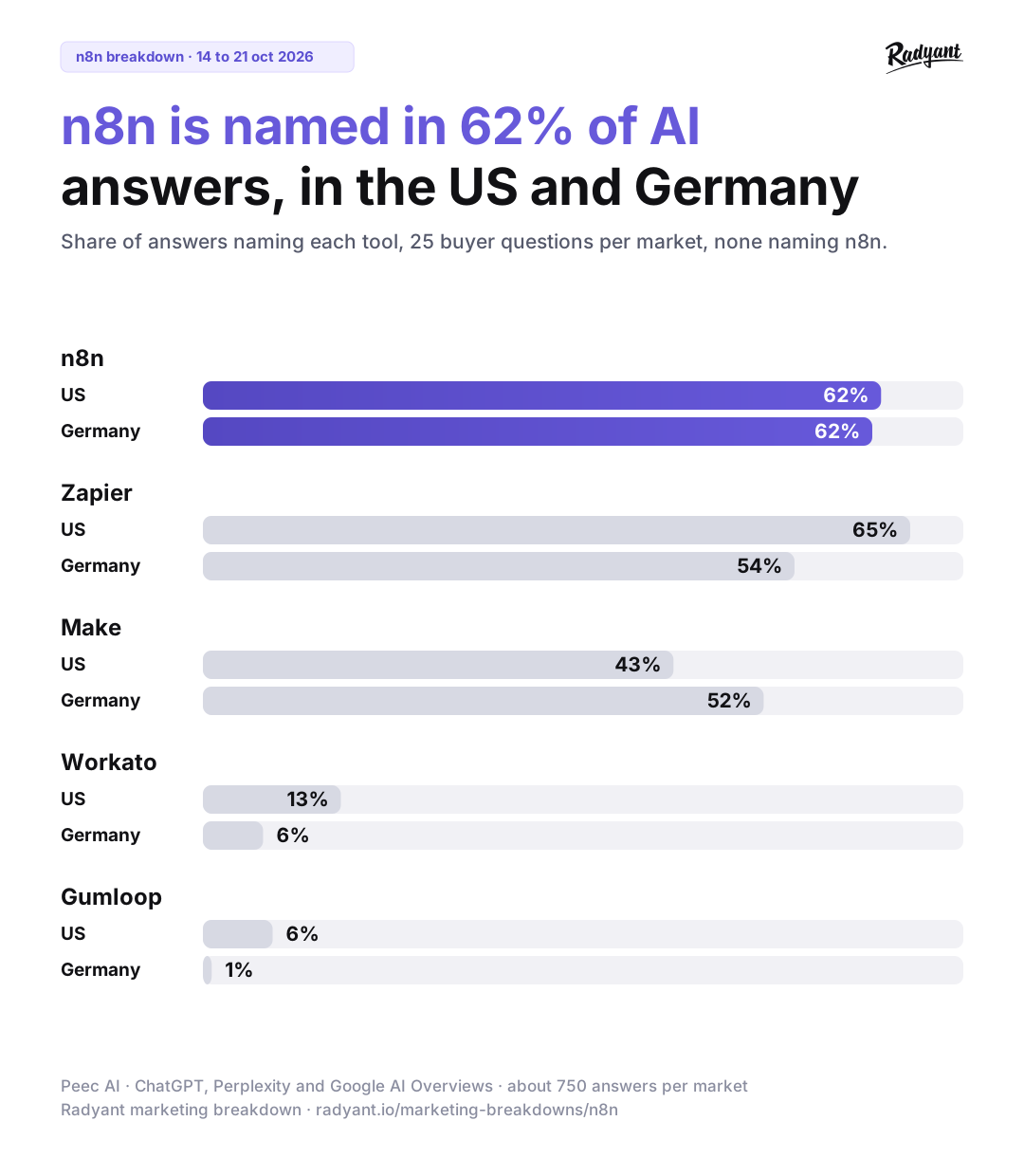
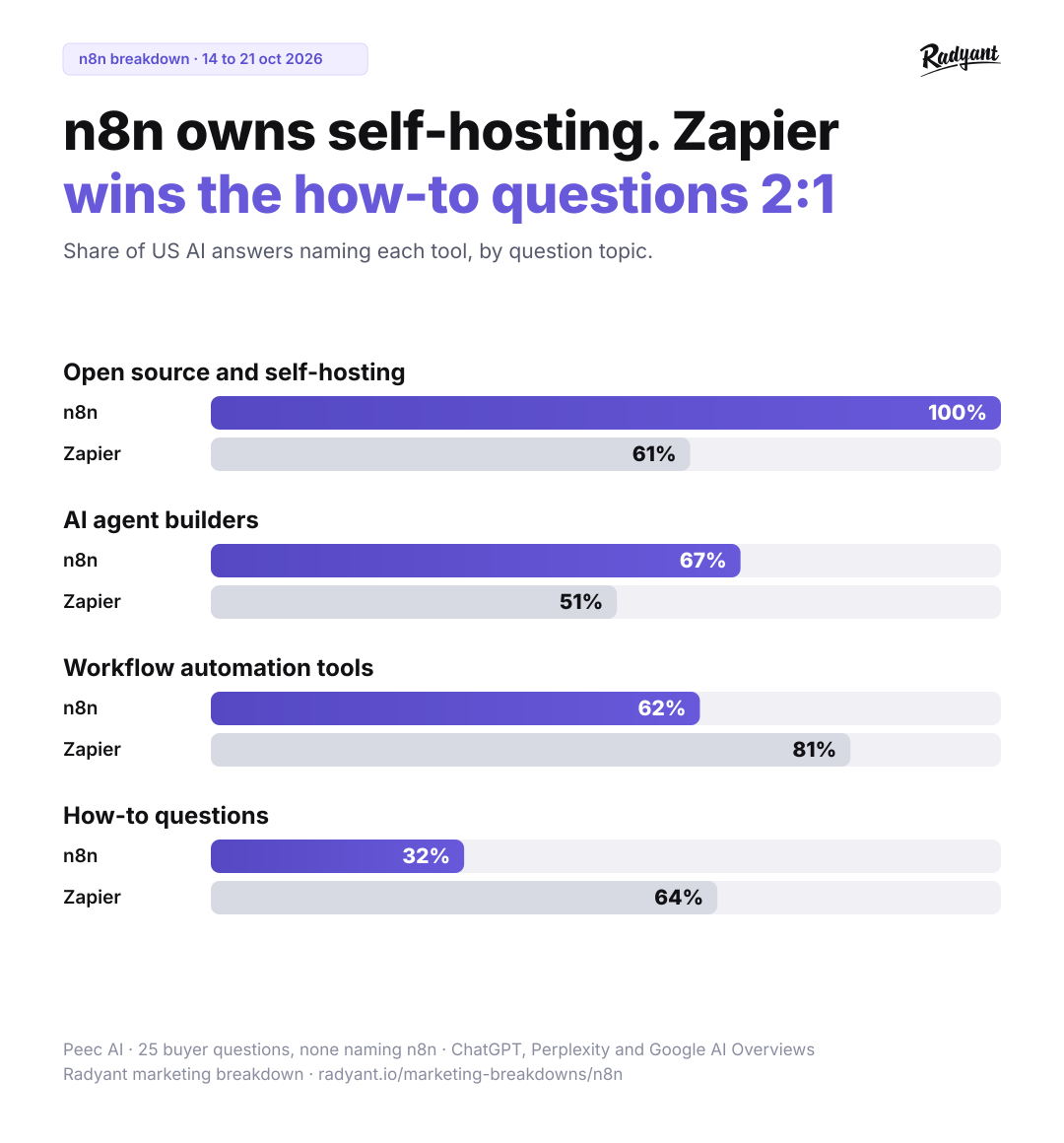
In the US, n8n and Zapier are about level. In Germany, n8n is ahead. So where does n8n win and where does it lose? We split the US answers by the kind of question.
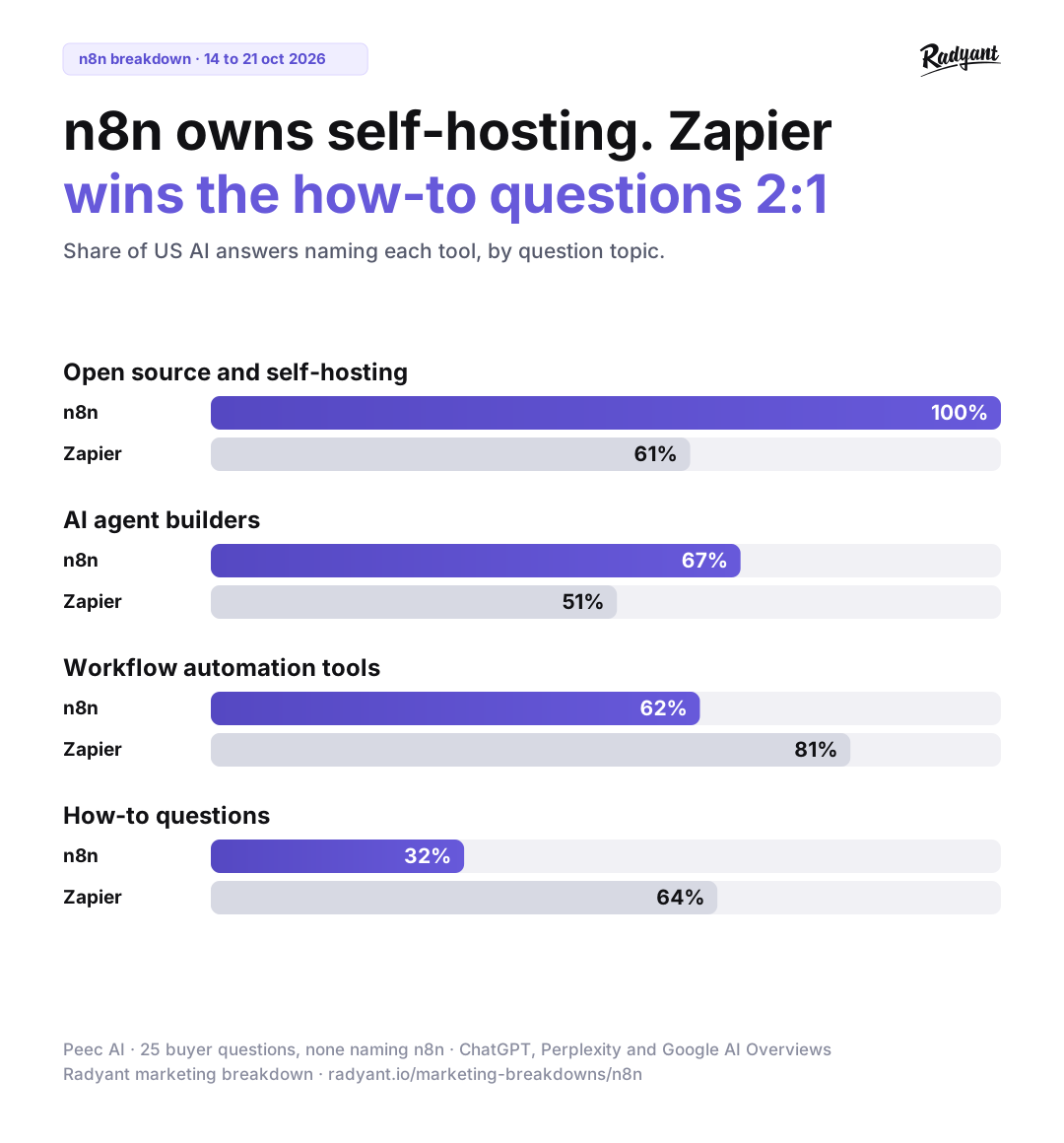
n8n is named in every answer about open source and self-hosting, and more often than Zapier on AI agents. It loses clearly on how-to questions ("How do I sync HubSpot contacts with Notion?"), where Zapier is named in 64% of US answers and n8n in 32%.
Who does AI Search quote when it talks about n8n?
Mostly other people. Of all the sources cited in our tracked answers, n8n.io got about 5% in the US and 3% in Germany. The rest went to listicles on other sites, YouTube, Reddit, other software vendors and agency blogs. In Germany, Perplexity named n8n in 53% of its answers but opened an n8n page in 2 of 250.
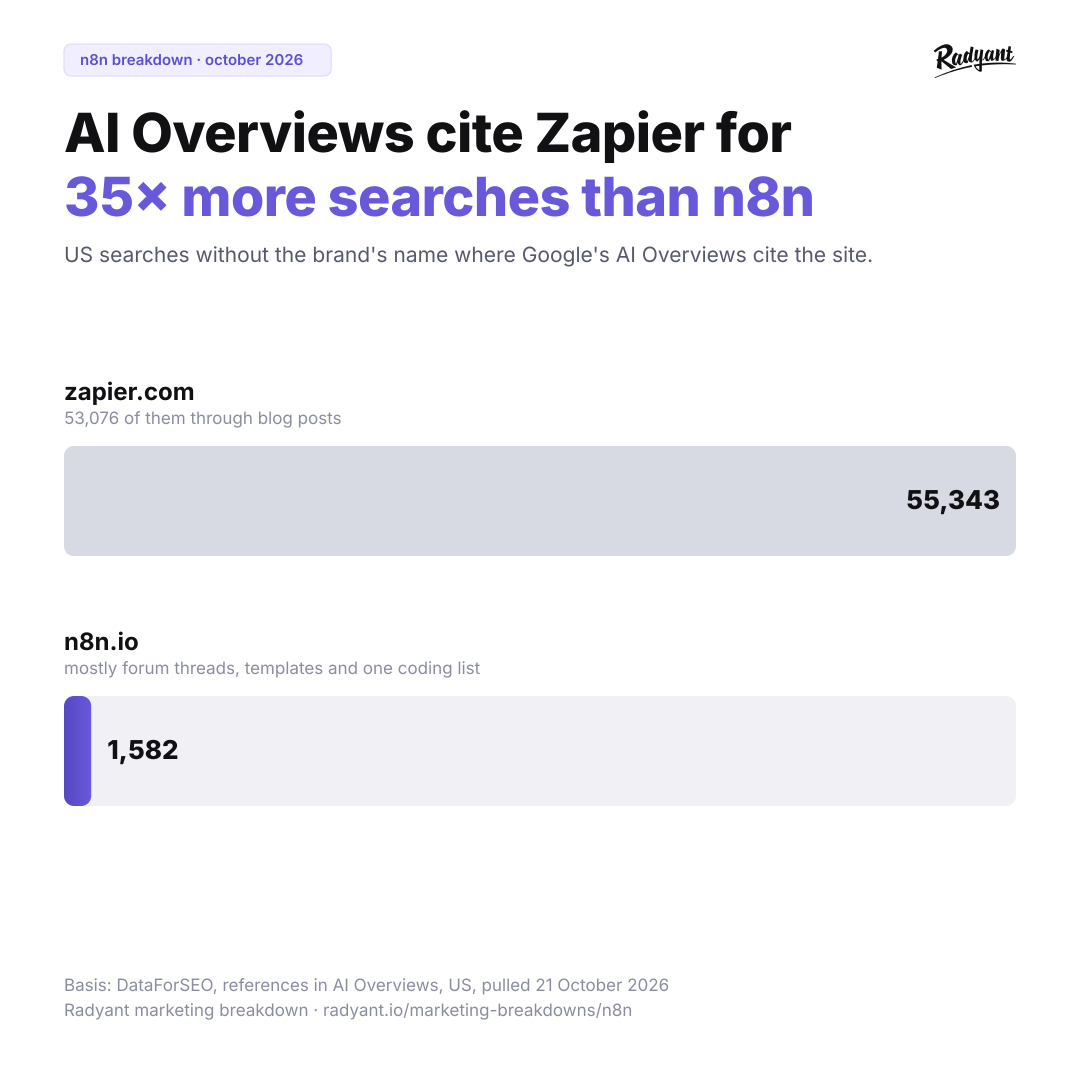
We also wanted to know whether this holds beyond our 25 questions, so we looked at every US search where Google's AI Overviews cite n8n.io or zapier.com.
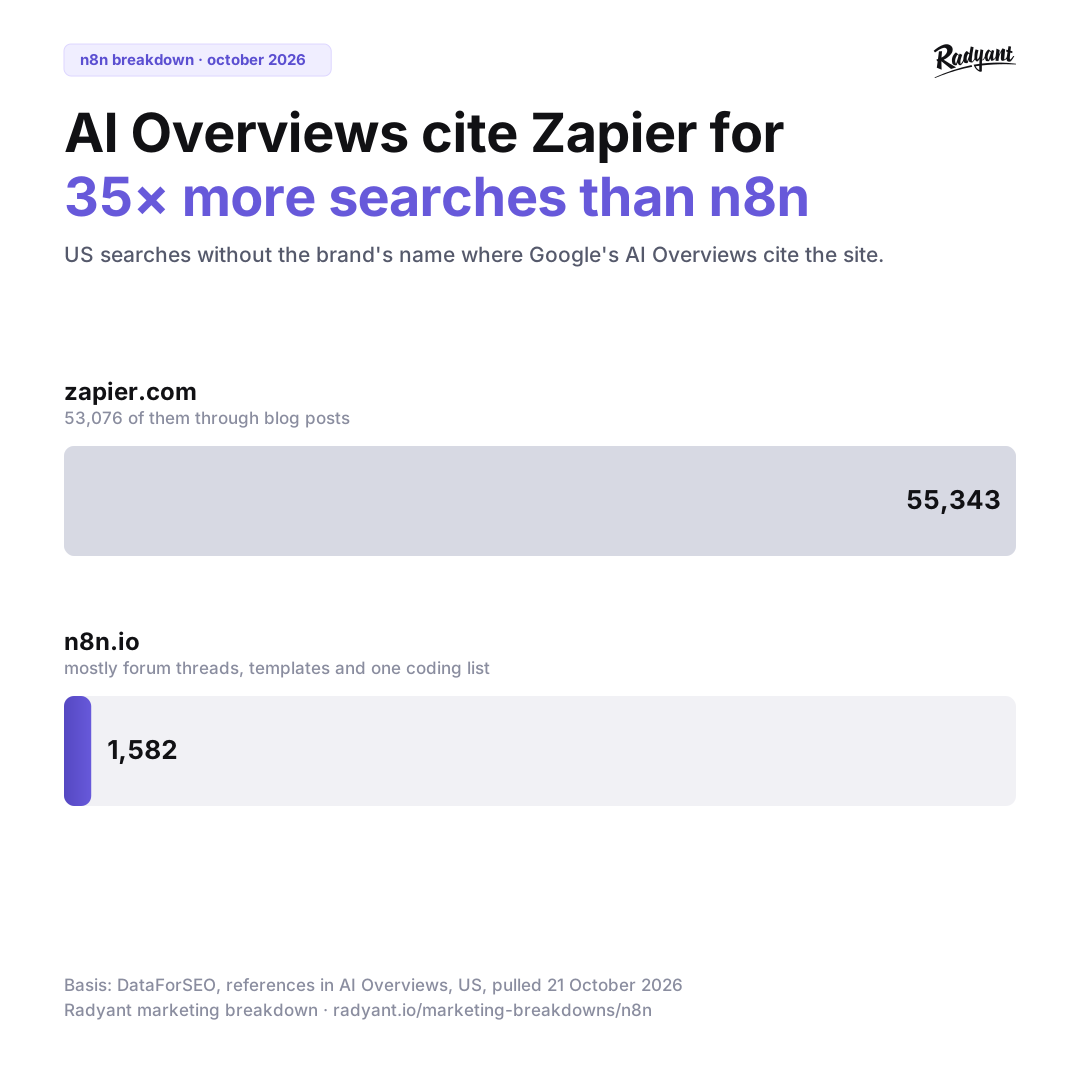
It holds, and the gap is large. zapier.com is cited in AI Overviews for more than 55,000 searches that do not contain "zapier", almost all through its blog. n8n.io is cited for about 1,600 searches that do not contain "n8n", 35 times fewer.
What happened to n8n's own "best tools" lists?
For a while, n8n's own lists worked very well. Its "best AI workflow automation tools" post, published in November 2025, brings about 10% of n8n's non-branded Google traffic on its own. Its list of the best AI coding tools, from March 2025, brings another 9%.
We wanted to know how often Google's AI Overviews used it as a source for the searches it ranks for.
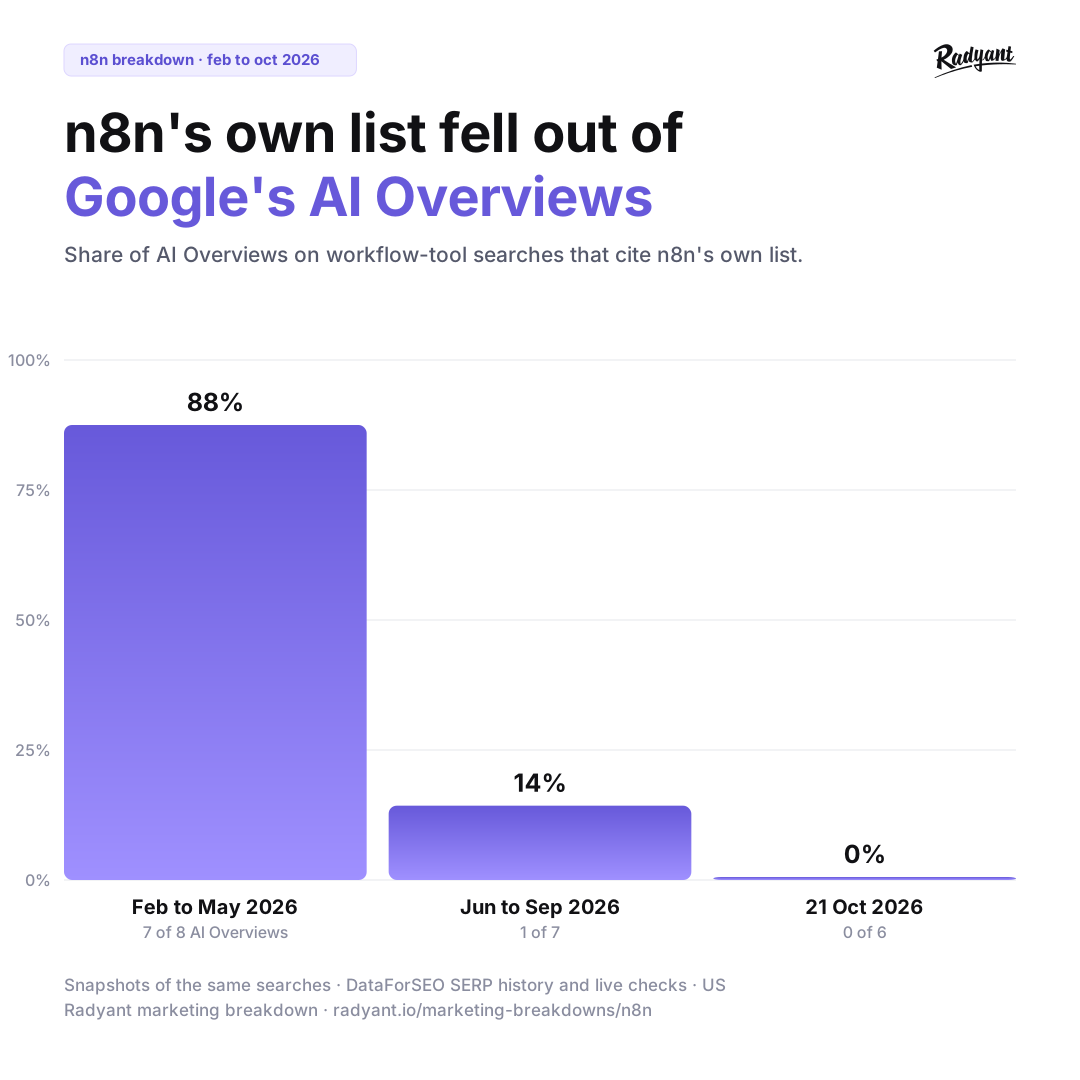
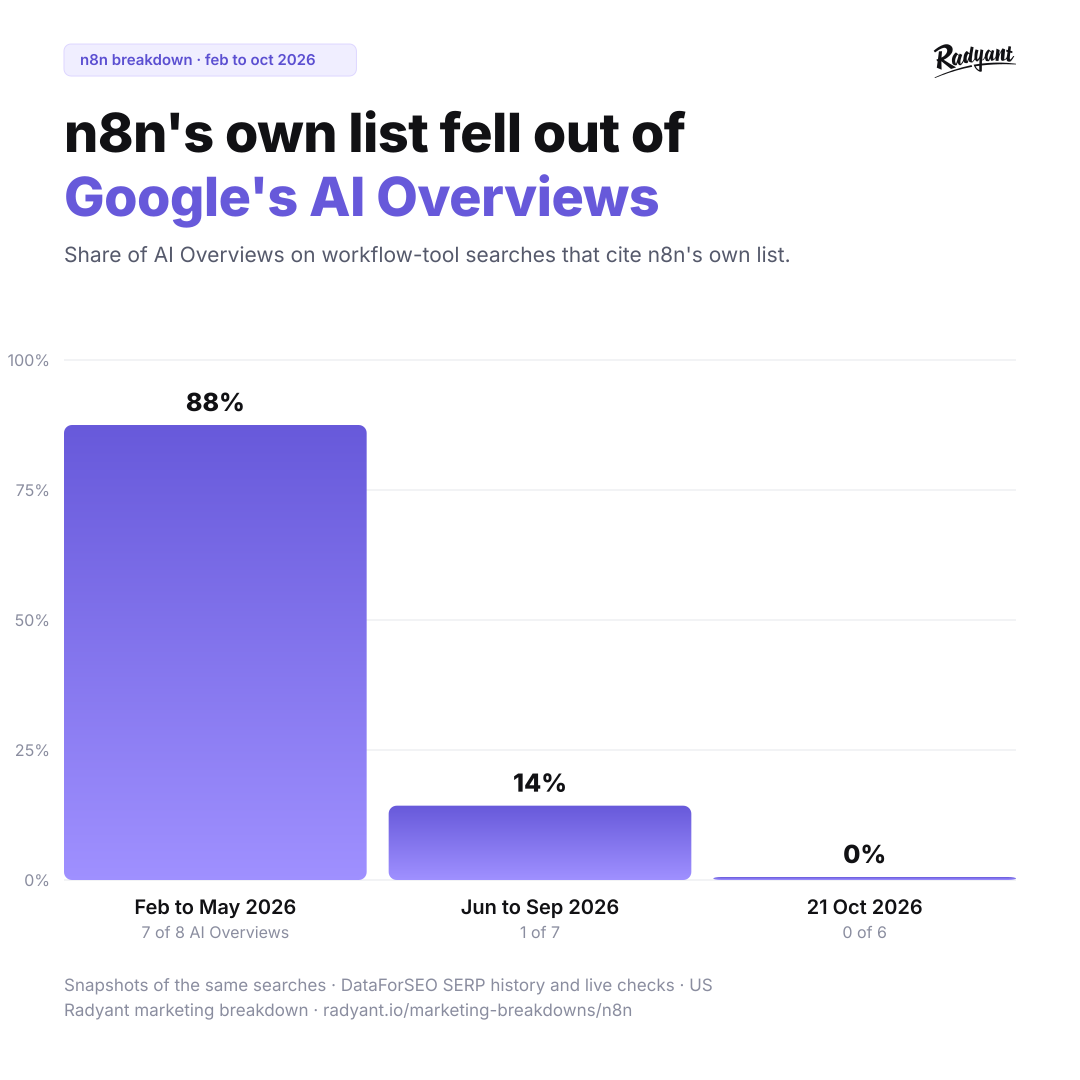
Between February and May 2026 it was cited in 7 of 8 AI Overviews we could check. From June to September it was 1 of 7, and in our live check on 21 October it was 0 of 6, although the post still ranked between second and sixth on Google into September.
The sources these AI Overviews cite moved toward video. From late 2025 to the months since June, videos and forum posts, most of them on YouTube, grew from 16% to 37% of the cited sources, while lists on other sites fell from 61% to 46%.
One list did keep its place: Gumloop's own list under the same title, which ranks Gumloop first, was cited in 7 of 8 and then 6 of 7 of the same checks. So it is not that vendor lists stopped working altogether. n8n's stopped being cited, and on the same searches a competitor's kept going.
Our Peec data shows a similar picture. In the US, lists on other sites took 68% of the citations for questions about workflow automation tools. n8n's own lists took under 1%.
This fits what others see. Peec AI analysed nearly 200,000 AI responses across eight engines and found that being ranked first in frequently cited listicles goes with 13 to 17 percentage points more visibility. So where you stand on the lists that get cited makes a measurable difference. For n8n, our own data covers one category, one week of tracked answers and a few months of snapshots of AI Overviews.
Where would we push further?
Four things stood out where n8n leaves something on the table. Each one works as advice for your own company too.
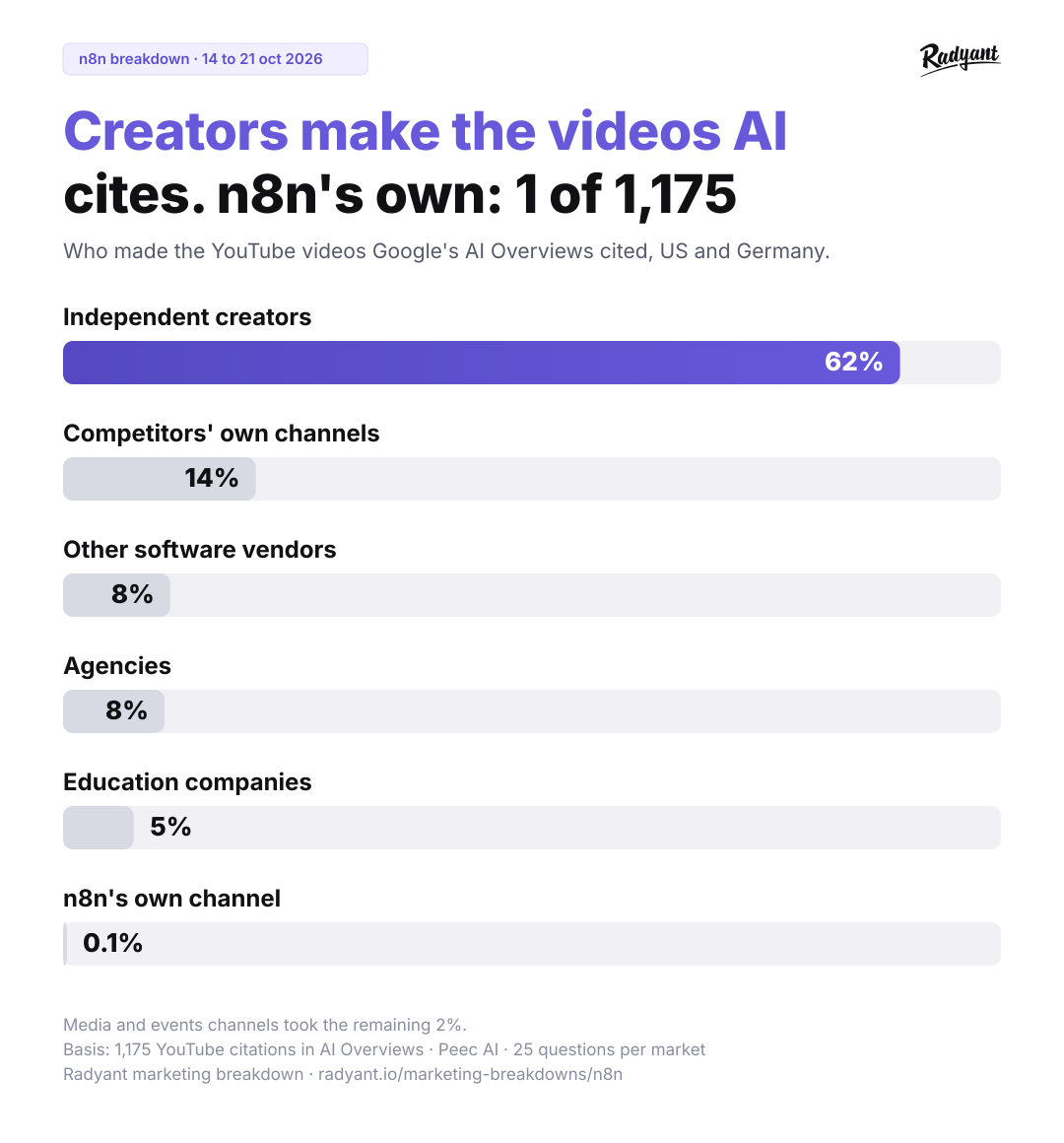
Make videos for the how-to questions. In our tracked answers, only Google's AI Overviews cited YouTube, and we looked up who made each cited video.
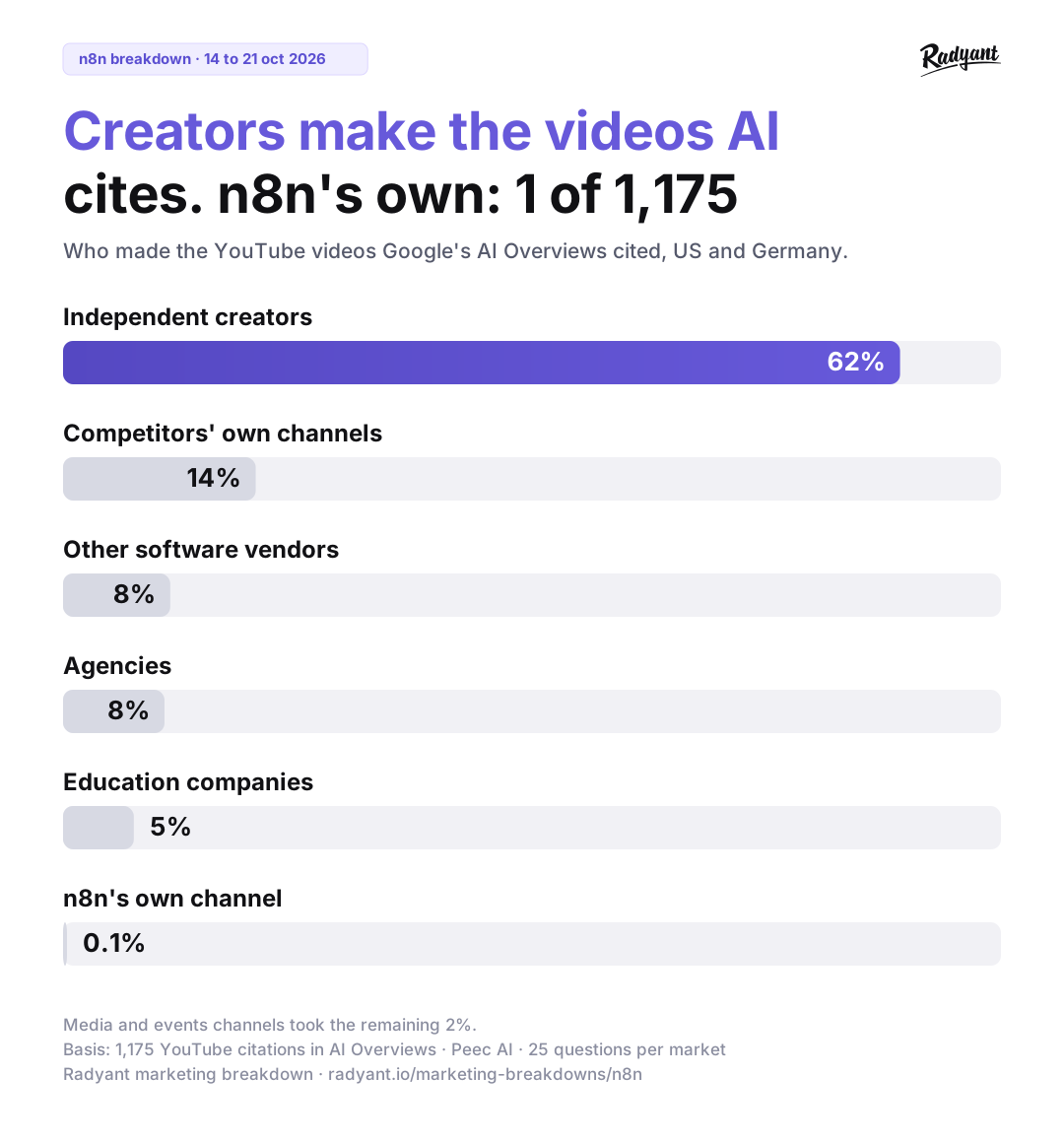
Independent creators made the videos behind about 62% of those citations, most of them task tutorials like connecting a Telegram bot to ChatGPT. n8n's own channel has about 250,000 subscribers and 400 videos, and it got 1 of the 1,175 citations. Zapier's channel got about 9% of the US citations, including two videos it published in October, one of them during our tracking week.
These are the same how-to questions n8n loses to Zapier, although its template library covers tasks like these. And a cited video does not need a big audience: the Zapier tutorial AI Overviews cited for syncing HubSpot contacts with Notion had 513 views when we looked.
n8n does not have to start from zero. We ran a version of this with Heyflow, where their existing product videos, re-optimised, with no new uploads, started getting cited regularly.
Get onto the lists that get cited. Since n8n's own lists stopped being cited, the lists that matter are on other sites. We would track which ones AI Overviews and ChatGPT cite for each category question, and work on being in them. Our guide on off-page work for AI visibility shows how we find them.
Keep staging pages out of AI answers. In our German tracking, ChatGPT opened www-staging.n8n.io/pricing six times, and pricing links with affiliate tracking parameters showed up too. A staging site that AI crawlers can read could put outdated prices into an answer.
Use one number for one thing. The template library says more than 13,600 templates, the AI agents page says "9,000+" (on 21 October it said "7500+") and an integration page says "1000+". An AI answer can quote any of the three.
What does this mean for your company?
Most of what n8n does is open to companies far smaller than n8n. A category page, an open forum, user-built examples and pages for the tools your buyers already use do not need a $5.2 billion valuation. They need someone to decide that these pages are worth building and keeping in shape.
That is the work we do at Radyant. We track the questions your buyers ask in AI Search, find out which pages AI answers cite for your category, and build the pages and placements that get you named. For Planeco Building we launched 247 programmatic pages in 7 days that drove more than 60 leads. Not every lever fits every company. The free audit is a quick way to see which one fits yours first.
FAQ
Where does n8n's non-branded Google traffic come from?
Mostly from four kinds of pages. By DataForSEO's US estimate for October 2026, the AI agents page brings about 19% of n8n's non-branded traffic. Template pages and forum threads bring about 17% each, and two blog lists about 20% together.
Do n8n's templates help its SEO?
Yes, but unevenly. Only 183 of more than 13,600 template pages are among n8n's 1,000 strongest pages, and template pages bring about 17% of its non-branded traffic. Templates do better in AI Overviews, which cite them for 351 searches that do not mention n8n.
How visible is n8n in ChatGPT and other AI answers?
Very visible. We tracked 25 buyer questions from 14 to 21 October 2026, and n8n was named in 62% of answers in the US and in Germany. That is level with Zapier in the US and ahead of it in Germany.
Which sources do AI answers use when they recommend n8n?
Mostly other sites. n8n.io got about 5% of the citations in our US tracking and 3% in Germany. Lists on other sites, YouTube tutorials by independent creators and Reddit carry most of the rest.
Should you still publish your own best-tools listicle?
It can still rank, but it may not get cited. n8n's own list was cited in 7 of 8 AI Overviews we checked from February to May 2026 and in 0 of 6 on 21 October. Being on the lists other sites publish now matters more.
How we measured
Google figures are DataForSEO estimates for the US, and for Germany where stated, pulled on 21 October 2026. We used n8n's top 1,000 pages and top 1,000 keywords by estimated traffic. Searches containing "n8n" or a misspelling of it count as branded and are left out of the non-branded shares. Citations in AI Overviews come from DataForSEO's data on AI Overviews and from a live check of 20 searches on 21 October 2026. AI answers come from Peec AI. We ran 25 questions per market, none naming n8n, every day from 14 to 21 October 2026 in ChatGPT, Perplexity and Google's AI Overviews. That gave about 750 answers per market. YouTube channels were looked up for the most-cited videos. Business figures come from n8n's own announcements and named outlets.