 Add as preferred source on Google
Two German public buyers wrote AI Search into SEO contracts at about €17,500 a month. What providers charge, and why the scope sets the number.
Two very different things get sold as AI Search optimization. One is a subscription that tracks which prompts mention you, from about €70 a month. The other is a €840,000 SEO engagement the federal association of Germany's statutory health insurers put out to tender, running from December 2025, with large language models and Google's AI Overviews written into the scope.
Both are real prices for something real. What separates them is scope, and that is the part almost every page answering this question skips.
Radyant works on this across seven published engagements, and the honest answer starts with what can be checked: what providers charge, what public buyers put in contracts, and how many places your buyers' answers actually come from.
Key takeaways
- Two purchases share this name, and they are two orders of magnitude apart. A tool that tracks prompts runs €70 to €360 a month. A public contract with AI Search written into it works out at €17,500 a month.
- The average SEO retainer is the wrong anchor. Ahrefs polled 439 people who sell SEO and found $3,209 a month on average, with 68.8% charging $2,000 or less. Most buyers start from that number.
- Two German public buyers wrote AI Search into SEO contracts at roughly €17,500 a month. A federal association of health insurers at €840,000 over four years, a state development bank at up to €850,000.
- The work reaches well past your website. Across the seven cases Radyant publishes it spans content, video, review platforms, LinkedIn, third-party press, help centers, programmatic clusters and expert interviews.
- Track a real prompt set before you set a budget. Read which domains get cited for your buyers' questions, then fund those surfaces. Of fifteen cost pages we read in August 2026, none started there.
The two things people mean by the question
Ask what AI Search optimization costs and you get answers two orders of magnitude apart, because two different purchases share the name.
The first is software. Peec AI runs €70, 180 or 360 a month on annual billing. Profound starts at $99 and its Growth plan is $399. Semrush sells an AI Visibility Toolkit at $99 a month for one domain and 25 tracked prompts. These tell you where you stand. None of them changes where you stand.
The second is the work: producing what gets cited, on the surfaces where citations happen, and keeping it current as the engines shift.
We see the same confusion in our own Search Console data. Over the sixteen months to 17 August 2026, queries about pricing tools and queries about pricing agencies arrived at roughly the same volume. Google's AI Overviews answer the head query with agency retainers and DIY tool subscriptions in one list, which is how a €180 subscription ends up filed as a budget for AI Search.
Worth being explicit, since we sell one of these: you need the measurement either way. A tracking subscription is the cheapest useful thing you can buy here, and moving the number it reports is separate work.
What providers charge, as far as anyone can check
There is no pricing survey for AI Search optimization with a stated method and a real sample. Anyone quoting a market rate for it, us included, is quoting an impression.
What does exist is the SEO baseline sitting in most buyers' heads. Ahrefs polled 439 people who sell SEO and found an average monthly retainer of $3,209, with 68.8% charging $2,000 a month or less. That is the reference point a CFO brings to the conversation.
The most useful public read on where agency pricing actually sits comes from Lars Lofgren, who has been hiring agencies across SEO and GEO content, YouTube, Reddit, social, influencer and link building on behalf of clients. He puts it in three tiers.
At $5,000 a month organic is "technically possible" with "limits on scope". At $10,000 "a real SEO/GEO effort is possible. Or YouTube, or socials", and his qualifier is the important half: "You can't do it all at this level but you will make steady progress in whatever channel you pick." $20,000 to 40,000 is where he puts full service. Competitive categories, he notes, start higher again.
Read those tiers as scope statements rather than price statements and they say the same thing twice: what changes as the budget rises is how many things you can run at once. He said more about how he evaluates agencies in our Masters of Search episode with him, and his original post is here.
What public buyers are putting in contracts
Agency rate cards are marketing. Public procurement records are contracts, with values, terms and scope published because the law requires it. Nobody answering this question seems to read them, and they are the most checkable prices available.
Two German public buyers have now written AI Search into SEO contracts.
The federal association of Germany's statutory health insurers, AOK-Bundesverband, tendered an SEO engagement with AI expertise in August 2025 at an estimated €840,000, running 1 December 2025 to 30 November 2029. That is 48 months, so €17,500 a month. The scope names organic visibility for the AOK portals and visibility "in die relevanten Large Language Models" plus findability in "der Google AIO (AI Overview)".
KfW, the German state development bank, awarded an SEO framework in January 2026 with a ceiling of €850,000 over four years, up to €17,708 a month if it is drawn down in full. Its own description of the job is the sentence worth keeping: making the KfW sites easier to read for "Suchmaschinen wie Google und Microsoft Bing - und nun zusätzlich im Bereich der KI-Suchmaschinen wie Perplexity & Co."
And now additionally. That is a state bank's procurement office describing AI Search as scope added on top of the search work it was already buying.
For contrast, Ireland's Irish-language public broadcaster TG4 tendered SEO services in November 2025 at €110,000 over five years, about €1,833 a month, and its scope mentions no AI at all: indexation, URL structures, keyword selection, monthly monitoring.
The honest reading of that pair is narrower than it looks. AOK and TG4 differ by far more than AI scope: country, sector, organization size, number of portals, buyer sophistication. What the pair shows is narrower: AI Search is being written into scope by named institutional buyers, at a price point in a completely different band from the SEO retainer average. Whether AI scope is what moved the number, these two contracts cannot say. And these are two buyers we happened to find. No tender in either country titles itself GEO, AEO or LLMO, so there are likely more that no keyword search surfaces.
Why the spread is a scope spread
When people picture what they are buying here, they picture blog posts. Across the seven cases Radyant publishes, the work breaks down like this.
| Surface | Cases running it |
|---|---|
| Content and editorial | 5 of 7 |
| Video and YouTube | 4 of 7 |
| Programmatic clusters | 3 of 7 |
| Interactive tools and lead magnets | 3 of 7 |
| Expert interview programs | 3 of 7 |
| Review platforms | 2 of 7 |
| 1 of 7 | |
| Third-party press | 1 of 7 |
| Help center and documentation | 1 of 7 |
| Technical and onsite | 1 of 7 |
No single engagement ran all ten. The widest ran six. Ten is what the span reaches across seven clients, and it is a range rather than a checklist anyone should be buying.
That is why a package tier is a poor way to price this. Two companies of identical size can need completely different work, because their categories cite completely different sources.
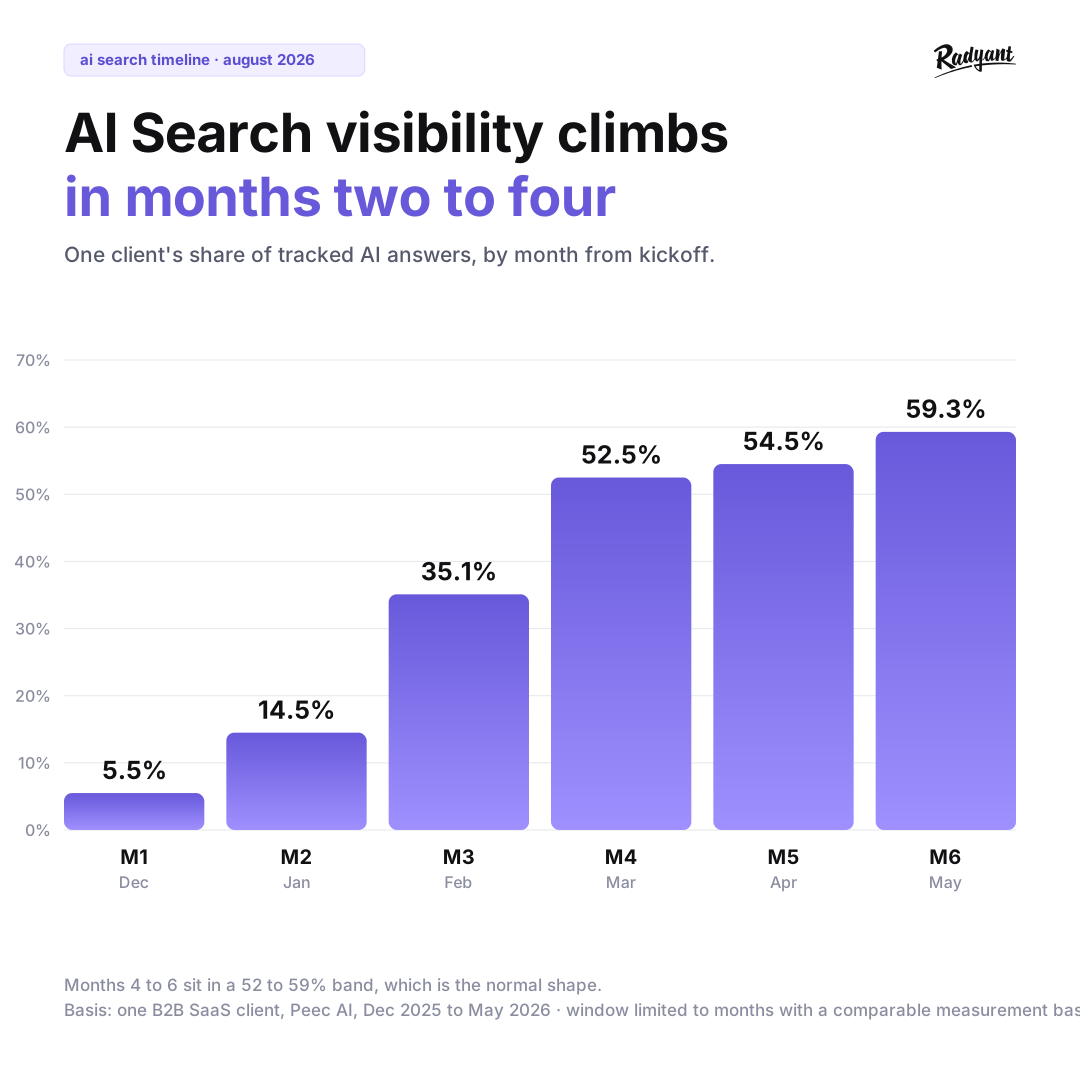
In one B2B SaaS engagement, visibility climbed from 5.5% to 52.5% of tracked answers between month one and month four, then settled into a band.
The external evidence points the same way. Kevin Indig and Amanda Johnson measured where AI answers actually pull from in August 2026 and found user-generated platforms at 17.1% of cited domains against publishers at 4.0%, more than four times the share. If the citations in your category sit on Reddit, YouTube and review sites, a budget that only funds your own blog is funding the wrong surface competently.
Enterprise buyers have started treating this as its own line rather than a rounding error on SEO. Conductor surveyed over 250 senior marketing leaders and reported 12% of digital budgets allocated to answer engine optimization in 2025, with 94% planning to increase it in 2026.
Sizing it for your own situation
The useful question is which surfaces your buyers' answers already cite, because that is what you have to fund.
That is answerable before you spend anything, and it is the step every cost page we read skipped:
- Track a real prompt set. Not keywords. The questions your buyers actually put to ChatGPT, Perplexity and Google AI Mode, with their job title and their problem in the wording. Our guide on prompt tracking covers building one that reflects buyers rather than your own vocabulary.
- Read which domains and page types get cited, split branded from non-branded. Branded questions pull your own pages almost by definition and will flatter you.
- Fund the surfaces that show up. If YouTube is the most cited domain in your category, video is the work. If it is review platforms, blog posts will not substitute at any volume.
- Price the work, then compare it to the tiers above. Now the budget conversation is about a named list of surfaces instead of a package name.
This order matters because it inverts the usual one. Most proposals pick a tier and infer the scope. The measurement decides the scope, and the scope decides the number.
What a smaller budget actually buys
We have no evidence for a floor, and the pages that name one are guessing. What we can say is what shrinks.
A smaller budget buys fewer surfaces done properly. Lofgren's $10,000 tier says the same thing from the buyer's side: steady progress in whatever channel you pick, and you cannot pick them all.
The failure mode at a small budget is spreading across five surfaces and finishing none of them. One surface, chosen from what your category cites, beats five started. And the measurement stays the cheapest useful purchase, because the expensive mistake here is funding the wrong surface.
There is a real counter-argument worth reading. Kevin Indig has published a twelve-month AI Search test program scoped at 0.3% or less of marketing spend, framed as a risk-managed experiment rather than a channel build. If your goal is to find out whether this matters for you, that is a more honest starting point than a retainer.
What we can and cannot say from this
Our own numbers: we work from €10,000 for a fixed project and €7,000 to €12,000 a month for a partnership on a 12-month term with an opt-out after six months, all of it on our pricing page. That is one data point in the bands above, not the answer to the question.
Three limits worth stating plainly. There is no AI Search pricing survey with a method, so every market-level figure here is either a specific contract, a specific rate card, or a named practitioner's read. The two AI-scoped tenders are two buyers we found, both German, both public sector. And nothing here measures the same buyer before and after AI Search entered the scope, which is the study that would actually settle whether this costs more than SEO did.
What we are confident about: the price range for this work is wide because the scope range is wide, and the scope is knowable before you commit to a number.
Where that leaves the number
If you want a figure to plan against, the tiers are the honest version: a few thousand a month buys one surface and the measurement, ten thousand buys a real effort in one channel, and the twenty-thousand-plus band is where several run at once. Where you sit in that is decided by how many places your buyers' answers come from.
Which you can find out this month, for the price of a tracking subscription, before anyone sends you a proposal.
FAQ
What does AI Search optimization cost per month?
There is no market rate with real evidence behind it. Reference points that can be checked: the average SEO retainer is $3,209 a month across 439 people polled by Ahrefs, two German public buyers have written AI Search into SEO contracts at roughly €17,500 a month, and tracking software runs €70 to €360 a month. What decides where you sit is how many surfaces your buyers' answers actually cite.
Am I buying a tool or the work?
Both exist and both get called AI Search optimization. Tools like Peec AI, Profound and Semrush's AI Visibility Toolkit tell you which prompts mention you and which sources get cited, from about €70 to $399 a month. They do not produce anything. The work is making what gets cited on the surfaces where citations happen. Buy the measurement first either way, because it is what tells you which work you need.
Is AI Search optimization more expensive than SEO?
Nobody has published a before-and-after on the same buyer, so treat any confident answer with suspicion. What is documented is that the scope grew. KfW's procurement notice describes AI Search engines as something it is buying "now additionally" alongside Google and Bing, and answers pull heavily from surfaces most SEO retainers never touched: user-generated platforms are 17.1% of cited domains against publishers' 4.0%.
What can a small budget not buy?
It buys fewer surfaces, done properly. The realistic constraint at a smaller budget is that you pick one place to show up and finish it, rather than starting five. Which one you pick should come from what your category actually cites, not from what you already publish. If your budget is genuinely tight, a twelve-month test program scoped at a fraction of a percent of marketing spend is a more honest structure than a retainer.
How do I work out what I should spend?
Track a real prompt set, read which domains and page types get cited for your buyers' questions, split branded from non-branded, and price the surfaces that show up. That produces a named list of work instead of a package tier, and it is the only step that tells you whether video, review platforms or your own site is the constraint. It costs a tracking subscription and a few weeks.