 Add as preferred source on Google
We tracked 80 buyer questions across six AI engines for a month. AI-written pages won the top source slot in 27 of 50 questions. Fit decided the rest.
"Will AI-written content get us penalized?" is still one of the first questions we hear from marketing leads. Behind it sit two separate questions. Do AI engines use AI-written pages as readily as human-written ones? And does publishing AI content at scale put a site at risk in Google, which would cost it visibility in Google's AI and in every other AI engine too?
We tracked 80 real buyer questions across six AI engines for all of September 2026, 43,200 AI answers in total, in Peec AI, and compared 656 pages head to head on the same questions to see what actually decides which page an engine picks. We also pulled Search Console data for the domains behind our own programmatic AI clusters.
The short answer: who wrote the page made no difference to whether AI engines used it. What decided the outcome was fit to the question, quality, and whether the page could be found in Google at all.
Key takeaways
- Who wrote the page made no difference. Our AI-written pages were the most-used source for their question in 27 of 50 prompts and in the top 3 for 36 of 50. Human-written pages showed up at both the top and the bottom.
- AI content done right didn't hurt the site. None of five domains behind our programmatic AI clusters showed a site-wide drop in Google. Impressions grew on all of them, by 15% to 614% year over year.
- When Google drops a site, Google's AI drops it too. A large SaaS blog that lost almost all its Google traffic fell to 0% in AI Overviews and 10% in ChatGPT, but still showed up in 20% of Claude's answers.
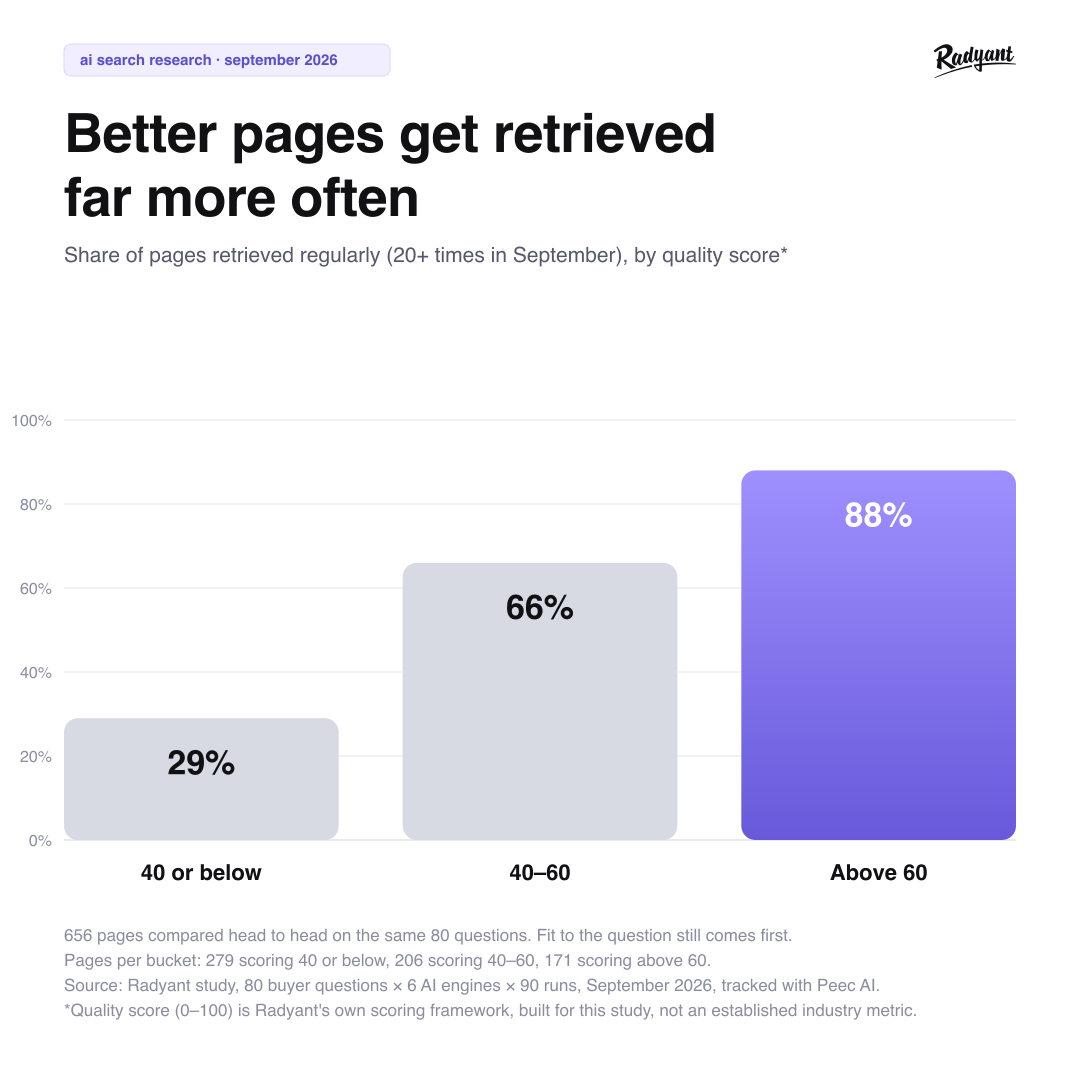
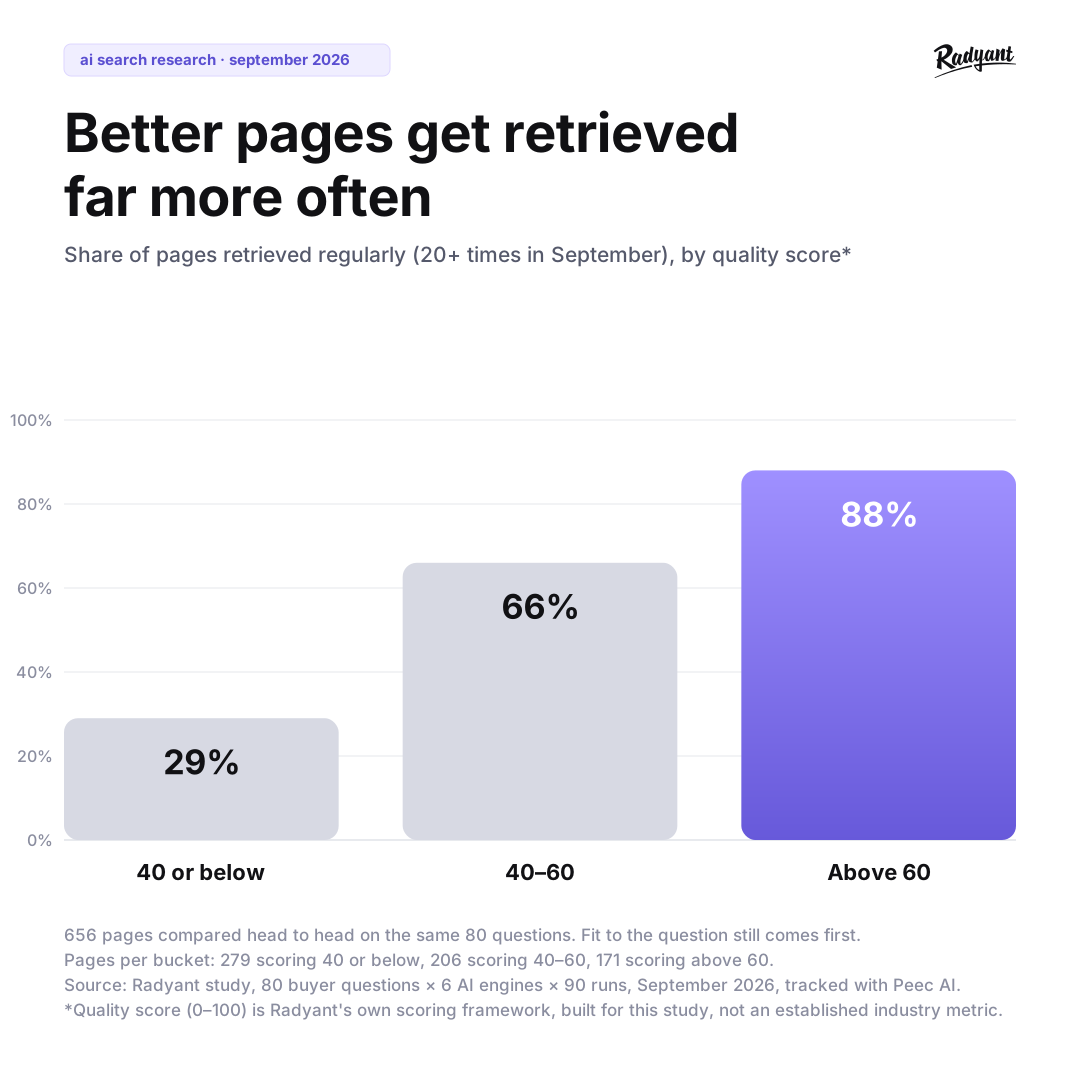
- Fit decides which page gets picked, and quality comes second. Only 29% of pages scoring 40 or below were retrieved regularly, against 88% scoring above 60, and fit mattered even more among pages that already fit.
- AI detectors catch AI text however good it is. Pangram flagged 50 of 50 AI pages at quality scores from 56 to 81, and labeled none of 16 human pages as AI.
How we ran the study
For every study page we tracked the one buyer question it is meant to answer, 80 questions in total. We set up the questions for the AI-written sites first, then added the human-written sites once we had a reliable way to find pages we could be fairly sure were written by hand. Each question ran 90 times per engine in September across ChatGPT, Claude, Gemini, Google AI Mode, Google AI Overviews and Microsoft Copilot. That is the 43,200 AI answers behind this piece.
We don't name the sites. What matters is how the content was made, not who published it.
| Site | What it is | Used for |
|---|---|---|
| Sites A, B, C | Our programmatic AI clusters | AI answers, Google, AI detection |
| Site D | Large SaaS blog with mass-produced "alternatives to X" lists | AI answers, Google, AI detection |
| Site E | AI content site that removed its pages before September | Its Excel questions, answered by the human sites |
| Sites F, G | Two more of our programmatic programs | Google only |
| Human sites 1, 2 | Excel sites written by hand by experts | AI answers, AI detection |
For all 80 questions we also pulled the other pages the engines actually used as sources: the four most-used pages plus four used only a few times. Together with our study pages, that gave us 656 pages to compare head to head on the same question, scored blind to how often each one had actually been used.
Per page we measured: retrieval rate (in how many answers the page was pulled in as a source, over answers where the engine searched), rank as a source, citation rate per retrieval, a quality score we built for this study (0 to 100, covering fact coverage, own data, terms, freshness, answer up front, readability, depth, structure and a named author), prompt fit (1 to 10, how directly the page answers the question, plus whether the title uses the question's words and whether the format matches it), AI share (detected with Pangram), and Google position (a top-20 check per question, plus Search Console data for our own pages).
Explore the data yourself
Pick a view below: how often each study site got used as a source, or what actually separates a picked page from the rest, across all 656 pages and again among only the pages that already fit the question.
explore the data
Pick a view: how often each study site got used as a source, or what separates a picked page from the rest, before and after narrowing to pages that already fit the question.
retrieval rate, counted over answers where the engine searched
Site A (AI)
Top source for its question in 14 of 17 prompts, top 3 in all 17. Median Google position 7.1.
Who wrote the page made no difference
The first question is whether AI engines use AI-written pages as often as human-written ones. We ranked every study page against every other page the engines used for the same question in September. Sites A, B and C are our AI-written clusters, Human sites 1 and 2 are Excel reference sites written by hand by experts, and Site D is a large SaaS blog with mass-produced "alternatives to X" lists.
Human-written pages showed up at both ends. Human site 1 did well. Human site 2, an Excel tutorial site also written by an expert, was almost never used (0.7% retrieval rate) even though its quality score was slightly higher. Within each site, the detected AI share showed no link to retrieval at all. What separated the pages at the top from the rest was fit to the question, quality and Google visibility, as the sections below show. Site D is the outlier here: about half AI-written, but rarely used, and we come back to why.
Our AI clusters didn't trigger a site-wide drop in Google
The second question is about the whole site. If Google decides a site publishes scaled content without added value, it can demote entire sections or the whole domain, and that pulls down its visibility in AI answers too. So we pulled Search Console data for the domains behind our study clusters (Sites A, B and C, all built with AI and our content process) and for two more of our largest programmatic programs (Sites F and G).
| Domain | Impressions, Sept 2026 vs. Sept 2025 |
|---|---|
| Site B | +614% |
| Site C | +83% |
| Site F | +28% |
| Site A | +18% |
| Site G | +15% |
None of these shows the cliff you see with Site D. Impressions grew on every domain. For context on scale, Site G carries over 500 programmatic pages, a few hundred shipped within a single week, and Site D's blog had thousands of pages built on one promotional template.
When Google drops a site, Google's AI drops it too
Site D shows what the downside looks like. Third-party analyses documented that its blog lost almost all its Google traffic between early 2025 and spring 2026, over several core and spam updates. The blog ran hundreds of "alternatives to X" lists that all rank the publisher's own product first. In our check, none of its 15 study pages appeared in Google's top 20 for its keyword.
| Engine | Site D retrieval rate |
|---|---|
| Google AI Overviews | 0% |
| Google AI Mode | 0.2% |
| Gemini | 0.7% |
| ChatGPT | 10% |
| Copilot | 13% |
| Claude | 20% |
The Google surfaces dropped Site D almost completely. ChatGPT kept it at a low level. Claude and Copilot, which rely on other search indexes, still pulled it in regularly. This matches what Lily Ray has described: when a site loses organic visibility, its citations in AI Overviews and AI Mode drop, and often in ChatGPT too (as reported by PPC Land).
Ranking yourself first on your own list isn't the whole story, though. Site A's pages also list its own product first, and they were the top source in 14 of 17 questions. The difference is that Site A still ranks in Google. The same pattern shows up inside our own clusters: pages with a better Google position were retrieved more often by ChatGPT, AI Mode and Gemini, and Claude showed no relation. Site B's pages in Google's top 10 had a 54% retrieval rate, the rest 28%. For Site A it was 69% against 48%.
Fit and quality both matter, and fit comes first
This is the core of the study. For each of the 80 questions, we compared a sample of the pages the engines used as sources, from the most-used to ones used only a few times, 656 pages in total. Then we asked one thing: what do the pages that get picked have that the others don't?
A higher quality score goes with far more retrievals across all 656 pages: 29% of pages scoring 40 or below were retrieved regularly (20 or more times in September), against 66% scoring 40 to 60 and 88% scoring above 60.
Most of the low scorers were help-center articles, product pages and docs that engines pulled in for side questions, not the actual answer to the question we tracked.
But quality isn't the whole story. Once we kept only the pages that clearly answer the question, the picture changes: a higher quality score still helped (70% of pages scoring 40 or below were retrieved regularly among pages that fit, against 90% scoring above 60), but most of that edge came from fit itself. Hold fit constant, and the quality score's own effect becomes too small to measure. What kept making a difference, among pages that already fit: a direct answer to this exact question, the format the question asks for, and the question's own words in the title. The explorer above breaks out all eight traits we tested, across all 656 pages and again among only the pages that fit.
Two pages from Human site 1 show what that looks like in practice. Its CHOOSE and CODE pages, whose titles match the question word for word, reached 48 to 56% retrieval. Its POWER page answered "Is there a way to calculate exponential values in Excel?" and reached 7%. The content was fine. The title used the expert term, not the words of the question. Synonyms, on the other hand, did fine.
Once an engine pulled a page in, pages that fit the question better were also cited more often per use, in every engine and most clearly in Claude and Copilot. Text quality, fact coverage and self-promotion made no measurable difference to citations.
Quality scores also compare well only within one question. Site D scored 68 and Site A scored 66, at 7% against 67% retrieval. Human site 2 scored higher than Human site 1 and was almost never used. Within each site, the better half by quality score was even retrieved slightly less often in five of six sites. Across sites and questions, Google visibility and whether the engine searches at all weigh more than the score. It is most useful when comparing pages that answer the same question. In our own head-to-head scoring, our pages scored well above the most-used other pages for the same questions: 26 points higher for Site C, 17 for Site A and 9 for Site B.
Our read: a page needs both, and fit comes first. Answer one exact question, in the format it asks for, with its words in the title. Then make it better than the other pages engines already use for that question.
AI detectors catch AI text, however good it is
We expected detectors to struggle with our AI content. It goes through a quality process, starts from a gold standard page and gets a senior check, so it reads less like typical machine text. Many people in the industry also assume good AI text can't be told apart from human writing anymore, and German is often said to be harder for detectors to flag. Our hypothesis going in: the better the AI content, the more often a detector would take it for human writing.
That didn't hold. Pangram flagged 50 of 50 pages in our AI group as AI, at quality scores from 56 to 81. Detection didn't drop as quality went up. German didn't help either: all 13 German pages from Site C came out at 100% AI. At the same time, Pangram labeled none of the 16 human pages as AI.
Mixed texts were recognized as mixed. Pangram found AI passages in all 15 pages of Site D, including passages that had been rephrased. It classified 11 of them as mostly or partly AI and 4 as mainly human-written, with an average AI share of 43%. On one Site D page, the version from September 1 came out at 7% AI, and the rewrite from September 16 at 93%.
So a detector tells you how a text was made, not how good it is. And as the first finding showed, AI engines didn't care either way.
Why our AI content didn't get penalized, and still gets picked
This is the process we run at Radyant for every programmatic AI cluster we build, and it is why our clusters grew in Google instead of collapsing like Site D did.
Built to be useful, at a sensible scale. Google rewards helpful content however it is produced, and its spam policies target scaled content without added value (Google Search Central). Ahrefs found no ranking penalty for AI-generated content across 600,000 pages. Our clusters usually run 13 to 20 pages per topic, sometimes more, each tied to a real buyer question.
Better than the other pages for the same question. Our pages scored 9 to 26 points higher on our quality score than the most-used other pages for their questions.
Visible in Google. Median Google positions in September: Site C 3.4, Site A 7.1, Site B 14.7. That puts them in the candidate pool for AI Overviews, AI Mode, Gemini and ChatGPT.
Specific, long-tail questions. For almost all keywords behind Sites A and C, keyword tools show no measurable search volume. AI answers to these questions draw on many domains (261 on average per Site A question in September), but few pages answer a question as specific as "which CRM works for small breweries".
Exact fit. 98% of our titles use the term of the question, and average prompt fit lands between 8.1 and 8.8 out of 10.
A quality check before anything ships. Every cluster starts from a gold standard page and passes a senior quality check before it ships. That doesn't mean a person rewrites every text. If the model did a good job, no edit is needed.
Site D shows the opposite on most of these points: very large scale, one promotional template, head terms with heavy competition, and no Google visibility left.
What this means in practice
Check three things, in this order. Can the engine find the page at all, meaning Google, and Bing for Copilot? Does it fit the question, with the buyer's words in the title, an answer up front, and the format the question asks for? And is it better than the other pages engines already use for that exact question? A great page that fails the first check gets nothing.
A few things follow from that, in our own work and in what we'd recommend to anyone running this kind of program:
- Compare your page with the pages AI engines already use. Pull the pages engines cite for your question and benchmark against those, not against an abstract checklist.
- Name things the way buyers ask for them. Put the buyer's term in the title, even when the expert term is more precise.
- Pick questions where engines actually search. Comparison and "which tool" questions almost always trigger a search. Many how-to questions get answered from the model's own knowledge instead.
- Match the format to the question. Lists for "which tool" questions, checklists and step-by-step pages for how-to questions.
- Grow programmatic content in steps. Ship a cluster, watch Search Console and retrieval data, then scale what's working.
What we expected vs. what we found
We started with three hypotheses.
H1: content quality predicts whether AI engines use a page better than whether a human or a model wrote it. Mostly supported. Origin made no difference. On the same question, higher-quality pages were retrieved far more often, though much of that came from a closer fit to the question, which has to be there first. Across different sites and questions, the score alone says little.
H2: good AI content gets mistaken for human writing by AI detectors, and more so the better it is. Not supported. Pangram flagged 50 of 50 pages in our AI group, at quality scores from 56 to 81. AI text edited by people was recognized as mixed, and human-written pages as human.
H3: publishing low-quality AI content at scale hurts a domain's organic visibility, while publishing good AI content at scale doesn't. Supported in direction, not proven. Site D collapsed in Google and our clusters didn't, even though Site D's pages scored as high as ours on our quality score. What set it apart was scale, one promotional template and highly competitive head terms. Site D's traffic loss comes from third-party data, not from our own before-and-after measurement.
Limitations worth stating plainly
Sites, topics and page types overlap across our study groups, so we can't fully isolate single factors. The head-to-head comparison on the same question removes most of that, but read everything here as a clear direction rather than proof.
In the head-to-head comparison we sampled the most-used and the rarely-used pages, which widens the gap between them. That's why we also report the result for pages that fit the question only.
Candidate pages were scored from snapshots taken in early October, not exactly as they looked in September. Very long pages were cut off for scoring, which may understate their fact coverage. All pages were scored with the help of one AI model, blind to the results, without a second rater.
The "known problem" group is based on public documentation, not page-by-page production records. Site D's pages in particular may be heavily edited by people.
We used one AI detector, Pangram. We didn't measure Bing or Brave rankings, which likely matter for Copilot and Claude.
The bottom line
AI engines don't check or care who wrote a page. AI-written pages were picked as often as human-written ones, and often more. The real risk with AI content is a different one: that Google demotes a site that publishes at scale without adding value, and Google's AI and ChatGPT follow it down. Built with a real process, our AI clusters grew in Google instead.
Among the pages engines can find, they pick the one that answers the question in front of them, in the shape the question asks for, and does it well. Write for that, with a person who knows the topic signing off, and it stops mattering whether a model did the drafting.
FAQ
Do AI engines cite AI-written content?
Yes. AI-written pages were the most-used source for their question in 27 of 50 prompts and in the top 3 for 36 of 50, and the detected AI share showed no link to retrieval within any site. Fit to the question, quality and Google visibility made the difference, not who wrote the page.
Does AI-written content get a site penalized in Google?
Not when it's built to be useful. None of the five domains behind our programmatic AI clusters showed a site-wide drop, and impressions grew on all of them. The one site in our study that did collapse ran thousands of pages on a single promotional template.
Does a higher content quality score get you cited more?
Yes, it helps a lot, but fit comes first. Pages scoring above 60 on our quality score were retrieved regularly 88% of the time, against 29% for pages at 40 or below. Among pages that already fit the question, fit itself made the bigger difference.
What makes an AI engine pick one page over another?
A direct answer to that exact question, the format the question asks for, and the question's own words in the title. All three mattered both for being picked and for being cited once used.
Why does my page show up in Claude but not in Google's AI Overviews?
The engines use different search indexes. In our study, a site that lost its Google rankings dropped to 0% in AI Overviews but still appeared in 20% of Claude's answers.